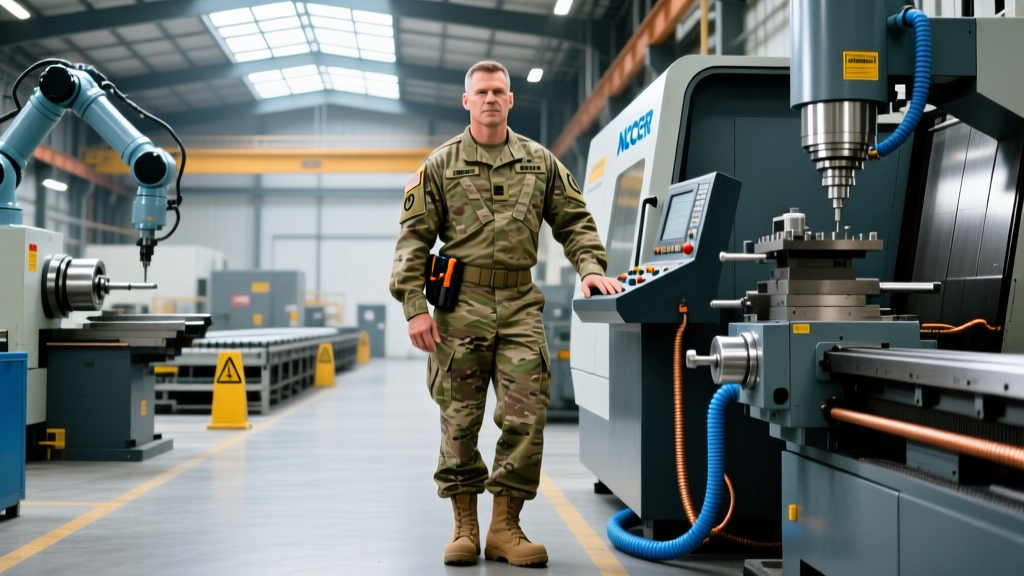
Transitioning Your Army Heavy Equipment Operator MOS to Foreman
Guide for transitioning an Army heavy equipment operator MOS to a civilian foreman role, covering NCCER certs, union rules, and 2026 salary data.
Transitioning from an Army heavy equipment operator MOS to a civilian heavy civil foreman requires bridging a specific regulatory, cultural, and documentation gap. Military Non-Commissioned Officers (NCOs) possess elite leadership capabilities, logistical discipline, and operational experience on heavy machinery. However, civilian general contractors (GCs) and trade unions require standardized, commercially recognized certifications that the Department of Defense does not automatically issue upon separation.
WARNING: The NCO TrapMany separating E-5s and E-6s assume their squad or platoon leadership experience automatically qualifies them for a civilian foreman position. In the commercial sector, foreman status is legally tied to OSHA compliance, specific NCCER registry credentials, and documented civil blueprint reading skills. Without these, you will be hired as a lead operator, not a supervisor.
Decoding the Army Heavy Equipment Operator MOS for Civilian GCs
The primary Army heavy equipment operator MOS is the 12N (Horizontal Construction Engineer), alongside the 12H (Construction Engineering Supervisor). In a military context, a 12N operates bulldozers, excavators, motor graders, and loaders to build roads, airfields, and forward operating bases. A 12H supervises these operations, managing equipment maintenance, material estimates, and troop safety.
Civilian GCs value the 12N/12H background for its emphasis on preventive maintenance checks and services (PMCS) and extreme-weather operations. However, military earthmoving often prioritizes speed and tactical necessity over commercial tolerances. Civilian foremen must manage strict sub-grade compaction testing (ASTM D1557), laser-guided grading tolerances (often within 0.02 feet), and complex stormwater pollution prevention plans (SWPPP). To advance from operator to foreman, you must prove you can manage commercial quality control, not just tactical execution.
The Certification Gap: Bridging Military Experience to Civilian Compliance
To be hired as a heavy equipment foreman in 2026, you must possess a specific stack of civilian credentials. The military provides equivalent training, but civilian site safety managers require the physical cards and digital registry verifications.
| Certification | Civilian Requirement Purpose | Estimated Cost (2026) | Time to Complete |
|---|---|---|---|
| OSHA 30-Hour Construction | Mandatory for all supervisors on commercial and federal sites. | $160 - $220 | 4 Days |
| NCCER Core & Supervisor Modules | Industry-standard registry for craft supervision and merit-shop hiring. | $350 - $500 | 2 Weeks (Part-time) |
| Competent Person: Trenching & Excavation | OSHA legally requires a designated 'Competent Person' for any trench over 5 feet. | $250 - $400 | 2 Days |
| First Aid/CPR/AED (Red Cross or AHA) | Required for site emergency action plans (EAP). | $90 - $120 | 1 Day |
Navigating the IUOE and Union Apprenticeship Hour Requirements
If you are targeting a union foreman role, you will likely interact with the International Union of Operating Engineers (IUOE). The IUOE training and apprenticeship programs are highly structured. A common friction point for military veterans is that the IUOE requires a specific number of documented, civilian on-the-job training (OJT) hours to classify you as a journeyman or foreman, regardless of your military rank.
The 'Helmets to Hardhats' Pathway
The Helmets to Hardhats program is specifically designed to translate military experience into union apprenticeship credit. If you were a 12N or 12H, the program can audit your military service records (specifically your SF-298 or deployment equipment logs) to credit you with up to 4,000 hours of OJT. This allows you to bypass the entry-level apprenticeship years and test directly for journeyman or foreman status, provided you pass the local union's practical equipment exam (usually involving a Cat 336 Excavator or Komatsu D65 Dozer on a graded course).
Edge Case: Non-Union Merit Shop Contractors
If you are entering the non-union (merit shop) sector, contractors affiliated with the Associated Builders and Contractors (ABC) rely heavily on the NCCER registry. In this environment, your advancement to foreman is less about union hour-logging and more about your ability to pass the company's internal leadership assessment and manage subcontractor schedules using software like Procore or Bluebeam.
2026 Foreman Salary Data and Market Realities
Understanding the financial landscape is critical when negotiating your first civilian supervisor role. According to the Bureau of Labor Statistics data for First-Line Supervisors of Construction Trades, the compensation structure varies wildly based on union affiliation and regional infrastructure spending.
- Base Salary (Non-Union): $72,000 - $88,000 annually, often with a company truck and fuel card.
- Union Foreman Total Comp: $95,000 - $135,000+ annually (factoring in prevailing wage rates, pension contributions, and annuities in states like California, New York, and Illinois).
- Heavy Civil vs. Commercial: Foremen in heavy highway/civil earthmoving (managing scrapers, dozers, and blasting) typically earn 15-20% more than those in commercial site prep due to the higher liability and technical grading requirements.
Market Insight: In 2026, the severe shortage of qualified civil foremen means GCs are increasingly offering 'Sign-On Bonuses' ranging from $5,000 to $10,000 for veterans who already possess their OSHA 30 and Competent Person certifications upon hiring.
The 12-Month Transition Framework
Do not attempt to jump straight from a military deployment to a civilian foreman role on day one. Use this phased approach to build civilian site credibility.
- Phase 1: Pre-Separation (Months -6 to 0)
Secure your OSHA 30, Trenching Competent Person, and First Aid cards. Translate your military evaluation reports (NCOERs) into a civilian resume that highlights budget management, equipment maintenance cost-reduction, and safety record metrics rather than tactical achievements. - Phase 2: Lead Operator / Assistant Foreman (Months 1 to 6)
Accept a 'Lead Operator' role on a complex earthwork site. Your goal here is to master civilian civil blueprints, which use different contour intervals, benchmark datums, and stationing notation than military tactical maps. Learn the site's specific SWPPP (Stormwater) compliance requirements. - Phase 3: Foreman Promotion (Months 6 to 12)
Once you have proven you can read civil plans and manage daily dirt-haul tickets, request the Assistant Foreman or Foreman title. You will now be responsible for daily production reports, managing fuel logistics for 15+ pieces of iron, and conducting daily site-specific JHA (Job Hazard Analysis) meetings.
Tactical Communication: Shifting from Squad Leader to Site Supervisor
The most significant failure mode for transitioning military NCOs is applying squad-leader communication styles to civilian heavy equipment operators and subcontractors. In the military, compliance is driven by the Uniform Code of Military Justice (UCMJ). In the civilian sector, compliance is driven by employment law, union grievance procedures, and financial incentives.
A successful civilian foreman must master 'influence without authority.' When a civilian operator is cutting corners on daily greasing intervals or ignoring trench box protocols, you cannot use military discipline. Instead, you must leverage site safety policies, document the infraction, and utilize the GC's progressive discipline matrix. Furthermore, you must learn to coordinate with civilian surveyors and third-party material testing labs (who verify soil compaction and concrete PSI), entities that do not exist in the same capacity in tactical military engineering. Mastering these civilian-specific workflows is the ultimate key to cementing your status as a top-tier heavy civil foreman.