Heavy Equipment for Sale in Maine: Forestry & Marine Case Studies
Discover what to look for when evaluating heavy equipment for sale in Maine. Real case studies in forestry and marine construction guide your next purchase.
Maine’s Unique Topography Demands Specialized Iron
Evaluating heavy equipment for sale in Maine requires looking far beyond standard operating hours and undercarriage wear. Maine’s operational environments—from the dense, rocky slopes of the Acadian Forest in Penobscot County to the highly corrosive tidal zones of the Portland Harbor—accelerate machine degradation in ways that Midwest or Southern fleets never experience. Standard-spec excavators and harvesters frequently suffer premature hydraulic failure, undercarriage spalling, and electrical corrosion when deployed in these regions without targeted modifications.
This guide analyzes three distinct industry applications in Maine, detailing the exact machine configurations, model numbers, and inspection metrics buyers must prioritize when sourcing equipment for the state’s most demanding sectors.
Case Study 1: Mechanized Harvesting in the Acadian Forest
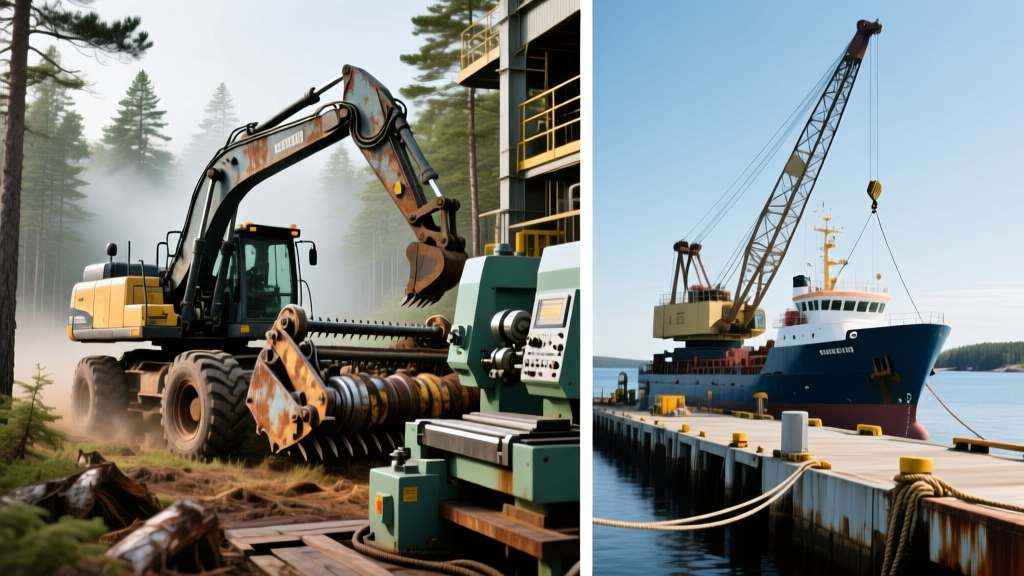
Maine’s logging industry operates on steep, granite-laden slopes where temperatures routinely drop below -20°F in January. Standard wheeled harvesters lose traction and suffer catastrophic hydraulic cavitation in these conditions. When reviewing forestry equipment listings in the state, buyers must prioritize machines equipped with high-traction bogie tracks and extreme-cold hydraulic packages.
Machine Focus: Tigercat H855E Harvester
The Tigercat H855E is the benchmark for Maine’s clear-cutting and selective harvesting operations. When browsing used models (typically 2021–2024 vintages priced between $480,000 and $610,000), verify the presence of the following Maine-specific configurations:
- Bogie Track Systems: Standard tires will slip on wet granite. Look for the factory-installed tracks with 28-inch or 32-inch track shoes to maintain ground pressure below 6 psi.
- Cold-Weather Hydraulic Packages: Standard ISO 46 hydraulic fluid thickens and causes pump cavitation at -10°F. Maine-spec machines must feature synthetic ISO 32 hydraulic fluid and integrated block heaters. Check the hydraulic tank for a 120V or 240V immersion heater element.
- Cab Pressurization and Insulation: Verify the cab pressurizer filter is intact; in Maine’s winter logging camps, a failing pressurizer allows diesel particulate and -20°F drafts into the operator station, leading to severe fatigue and safety risks.
Case Study 2: Marine Infrastructure on the Gulf of Maine
The Gulf of Maine features some of the highest tidal ranges in the world, creating an aggressively corrosive environment for coastal construction and dredging equipment. Standard excavators used for wharf reconstruction or tidal bridge piling will experience rapid pin and bushing seizure due to saltwater intrusion.
Machine Focus: Liebherr HS 8100 HD Duty Cycle Crane
For deep foundation driving and marine dredging, the Liebherr HS 8100 HD is heavily utilized in ports like Portland and Searsport. When sourcing these machines (often priced from $850,000 to $1.2M for late-model used units), buyers must differentiate between standard earthmoving specs and true marine configurations.
| Component | Standard Earthmoving Spec | Maine Marine Spec (Required) |
|---|---|---|
| Hydraulic Rams | Standard chrome plating (prone to pitting) | Nickel-chromium marine coating or stainless steel |
| Swing Circle Bearing | Standard grease seals | Double-lip labyrinth seals with auto-greasing |
| Electrical Harnesses | Standard PVC loom | Marine-grade epoxy potting and sealed connectors |
| Paint System | Standard polyurethane topcoat | Zinc-rich primer with marine epoxy topcoat |
According to environmental and infrastructure data from the EPA’s Gulf of Maine program, the region’s unique estuarine dynamics demand infrastructure that can withstand intense tidal scouring. Equipment operating in these zones must be rigorously maintained; a standard-spec machine deployed here will typically require a complete swing gear rebuild 18 months earlier than a marine-spec unit.
Case Study 3: Cranberry Bog Operations in Washington County
Washington County produces a significant portion of the nation’s wild blueberries and cranberries. Harvesting and bog maintenance require machines that exert minimal ground pressure to prevent sinking into deep peat and destroying the delicate root systems of the bogs.
Machine Focus: Cat D6K2 LGP (Low Ground Pressure) Dozer
When looking at bulldozers for sale for agricultural and peat bog applications, the Cat D6K2 LGP is the industry standard. Buyers must verify the track shoe width. A standard D6K2 might feature 24-inch shoes, but Maine bog operations require 34-inch or even 36-inch extreme-service (ES) track shoes to achieve a ground pressure of roughly 3.8 psi. Purchasing a standard-width machine and attempting to retrofit wider shoes will overload the final drives, leading to planetary gear failure within 500 hours.
The Hidden Costs of Out-of-State Sourcing
Many buyers attempt to save capital by purchasing equipment from Midwest auctions and trucking it to Maine. While the initial hammer price might be 10% to 15% lower, the total landed cost often erases these savings.
Transport Economics (2026 Data): Moving a 95,000 lb excavator (e.g., Volvo EC480) from an auction in Ohio to a job site in Bangor, Maine, requires a multi-axle lowboy trailer and specialized permits. At current 2026 freight rates of $4.50 to $5.25 per loaded mile, plus Maine’s specific oversize load permit fees and bridge routing restrictions, transport costs easily exceed $6,500. Factor in the immediate need to replace Midwest-spec track pads (which wear out 30% faster on Maine’s abrasive granite bedrock), and the ‘bargain’ quickly becomes a liability.
Critical Inspection Checklist for Maine-Spec Undercarriages
Maine’s geology is dominated by glacial till and exposed granite. This rock is highly abrasive and will destroy standard undercarriages at an accelerated rate. Before finalizing the purchase of any track-type machine in the state, execute this specific inspection protocol:
- Measure Grouser Height: Use a depth gauge to measure the track pad grouser (cleat) height. If the original height was 2.5 inches and it is worn below 1.2 inches, the machine has lost critical traction and the pads are due for immediate replacement (a $12,000 to $18,000 expense on large dozers).
- Check for Track Link Spalling: Inspect the track chain links for micro-spalling (flaking of the hardened steel surface). In Maine’s wet, rocky environment, water acts as a cutting fluid, accelerating surface fatigue. Spalling indicates the links have reached 80% of their service life.
- Sprocket Wear Pattern: Look for ‘hooking’ on the sprocket teeth. Hooking occurs when the track pitch stretches due to abrasive packing in the link joints. A hooked sprocket will rapidly destroy a new set of track chains if not replaced simultaneously.
- Idler Flange Condition: Maine’s sidehill logging and grading operations cause severe lateral loads. Check the idler flanges for uneven wear; a difference of more than 3mm between the inner and outer flange indicates chronic side-loading and potential internal bearing failure.
For further guidance on heavy vehicle weight restrictions and transport routing across state highways, operators should consult the Maine Department of Transportation to ensure purchased equipment can be legally and safely moved to its final operating site without incurring severe overweight fines.
Final Procurement Strategy
Securing the right heavy equipment for sale in Maine is an exercise in environmental matching. A machine’s value is not determined solely by its engine hours, but by its configuration’s compatibility with the state’s extreme cold, abrasive granite, and corrosive coastlines. Prioritize verified marine coatings for coastal work, bogie tracks and cold-weather hydraulics for forestry, and extreme-width LGP undercarriages for agricultural peat operations. By focusing on these application-specific metrics, buyers can avoid catastrophic premature failures and maximize their return on invested capital.