Industrial Food Manufacturing Equipment ROI: 2 Scaling Case Studies
Explore real-world ROI, throughput metrics, and equipment specs for industrial food manufacturing equipment in high-moisture extrusion and bakery scaling.
Beyond the Brochure: Real-World Equipment Performance
Procuring industrial food manufacturing equipment requires looking past manufacturer spec sheets to understand actual throughput, energy consumption, and maintenance bottlenecks on the factory floor. In 2026, capital expenditure (CapEx) for processing lines remains high, making the calculation of return on investment (ROI) heavily dependent on Specific Mechanical Energy (SME) efficiency, yield rates, and changeover times. This analysis examines two distinct facility scaling projects—a high-moisture extrusion (HME) plant-based protein line and an automated commercial bakery tunnel oven upgrade—to provide concrete data on equipment performance and financial payback.
Case Study 1: Scaling Plant-Based Protein via High-Moisture Extrusion
A mid-sized alternative protein manufacturer in the Midwest needed to transition from dry texturized vegetable protein (TVP) to high-moisture extrusion (HME) to produce whole-cut chicken analogues. The primary challenge was achieving a fibrous, anisotropic protein structure without over-denaturing the pea and soy protein blend.
Equipment Selection and Technical Specifications
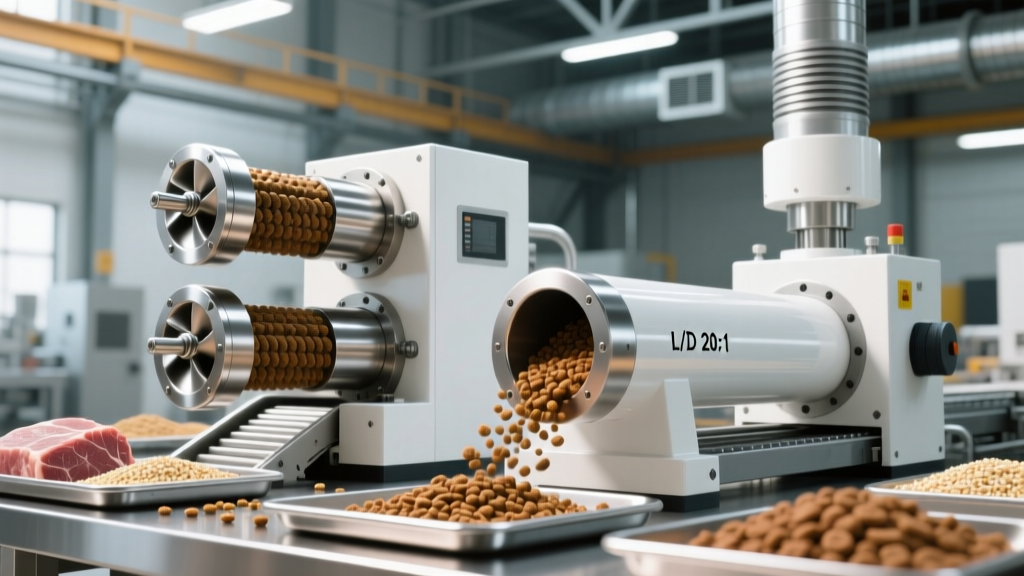
The facility selected the Coperion ZSK 70 Mc18 twin-screw extruder paired with a GEA long cooling die. According to technical documentation from Coperion's food processing division, the ZSK 70 features a do/Di (outer to inner diameter) ratio of 1.55. This higher free volume is critical for HME, as it allows for better heat transfer and gentler mechanical shear, preventing the destruction of the protein matrix.
Key Process Parameters (HME Line):- Target Moisture Content: 60-65% (injected via liquid pump at Zone 2)
- Barrel Temperature Profile: Zone 1: 40°C | Zone 3: 120°C | Zone 5: 165°C
- Specific Mechanical Energy (SME): Maintained strictly between 150-180 kJ/kg
- Screw Speed: 450 RPM (yielding a throughput of 800 kg/hr)
The Cooling Die Bottleneck
While the extruder handles the thermomechanical transformation, the cooling die dictates the final texture. The facility utilized a 1.2-meter GEA cooling die with internal static mixers. A common failure mode in HME is product swelling at the die exit due to pressure drops. By maintaining a die pressure of 45 bar and a final exit temperature of 85°C, the facility achieved a consistent fibrous tear without post-extrusion expansion. For deeper insights into cooling die thermodynamics, engineering teams frequently reference GEA's extrusion technology guidelines.
CapEx and ROI Breakdown
| Line Component | Estimated Cost (USD) | Operational Impact |
|---|---|---|
| Coperion ZSK 70 Mc18 Extruder | $820,000 | Core thermomechanical processing; high wear on screws requires bimetallic linings. |
| GEA 1.2m Cooling Die & Temp Control | $240,000 | Requires 15°C chilled water loop; critical for fiber alignment. |
| Downstream Cutting & Packaging | $310,000 | Ultrasonic guillotine reduces product smearing by 40% vs. mechanical blades. |
| Total Line CapEx | $1,370,000 |
ROI Analysis: Operating at 800 kg/hr across two 8-hour shifts (5 days/week), the line produces roughly 320 metric tons annually. With a wholesale margin of $3.50 per kg on premium whole-cut analogues, the gross annual margin is $1.12 million. Factoring in a 15% energy premium for HME versus dry extrusion and bimetallic screw replacement every 4,000 hours ($18,000), the equipment payback period is 16.5 months.
Case Study 2: Commercial Bakery Tunnel Oven Automation
A regional artisan bakery producing 4,000 loaves daily faced a severe bottleneck at the baking stage. Their existing rack ovens required manual loading, resulting in a 22-minute bake cycle and inconsistent crust coloration. To scale to 10,000 loaves daily while maintaining artisan quality, they installed a continuous tunnel oven system.
Line Configuration: AMF to RBS
The upgrade centered on a Reading Thermal Systems (RBS) Scorpion Tunnel Oven (24 meters in length), integrated with an AMF Bakery Systems automated pan handling and proofing loop. The transition from batch to continuous processing required precise control over the Maillard reaction and oven spring.
- Proofing Stage: AMF spiral proofing tower maintaining 38°C and 85% relative humidity (RH). Dwell time: 55 minutes.
- Oven Zone 1 (Oven Spring): Direct-Fired Gas (DGF) burners. High humidity injection (steam) to delay crust formation, allowing maximum volume expansion. Temp: 215°C.
- Oven Zone 2 & 3 (Structure Set): Convection heat transfer. Temp drops to 190°C to set the crumb structure without burning the exterior.
- Oven Zone 4 (Crust Development): DGF top heat to achieve the target artisan crust coloration. Temp: 205°C.
Energy Consumption and Efficiency Matrix
The shift to a Scorpion tunnel oven drastically altered the facility's energy profile. According to data aggregated by the Institute of Food Technologists (IFT) regarding modern thermal processing, continuous ovens reduce per-unit energy waste by minimizing the thermal cycling inherent in batch rack ovens.
| Metric | Legacy Rack Ovens (Batch) | RBS Scorpion Tunnel (Continuous) | Variance |
|---|---|---|---|
| Energy Source | Electric / Gas Hybrid | Direct-Fired Natural Gas (DGF) | N/A |
| BTU per lb of Dough | 1,450 BTU | 980 BTU | -32.4% |
| Bake Cycle Time | 22 minutes | 18 minutes | -18.1% |
| Labor Required (Baking) | 3 operators per shift | 1 operator per shift | -66.6% |
Troubleshooting the Transition
The primary edge case encountered during commissioning was 'band tracking'—where the oven belt drifted laterally, causing loaves near the edge to underbake. This was resolved not by adjusting the belt tensioners, but by recalibrating the cross-zone airflow dampers. Uneven air pressure in Zone 2 was creating a lateral force on the belt. Once balanced, the coefficient of variation (CV) for loaf weight and crust color dropped below 2.5%.
Decision Framework: Upgrading vs. Retrofitting
When evaluating industrial food manufacturing equipment for capacity expansion, facility managers must decide between purchasing new modular systems or retrofitting legacy machines. Use the following framework to guide capital allocation:
When to Retrofit:
If the core mechanical drive (e.g., the main extruder gearbox or oven chassis) is under 7 years old, and the bottleneck is strictly thermal or control-based. Upgrading PLC cabinets to modern IoT-enabled controllers (like Rockwell PlantPAx) and adding variable frequency drives (VFDs) to downstream conveyors can yield a 15% throughput bump for roughly 20% of the cost of a new line.
When to Replace Entirely:
If the product formulation requires a fundamental shift in processing physics—such as moving from low-moisture to high-moisture extrusion, or shifting from convection baking to direct-fired impingement. Legacy equipment lacks the specific barrel L/D (length-to-diameter) ratios or zone-specific burner configurations required for these phase changes, making retrofitting mathematically unviable due to yield loss.
Final Operational Takeaways
The efficacy of industrial food manufacturing equipment is ultimately dictated by the integration of upstream preparation and downstream handling. In the HME case study, the extruder was only as effective as the chilled water loop feeding the cooling die. In the bakery case, the tunnel oven's efficiency was predicated on the uniform dough density provided by the AMF divider. Procurement teams must evaluate the entire thermal and mechanical ecosystem, ensuring that auxiliary systems (chillers, steam generators, air compressors) are sized to handle the peak transient loads of the primary processing equipment.