How Food Equipment Manufacturers Engineer Sanitary Processing Lines
Discover how leading food equipment manufacturers engineer sanitary processing lines, from 316L steel specs to IP69K motors and CIP fluid dynamics.
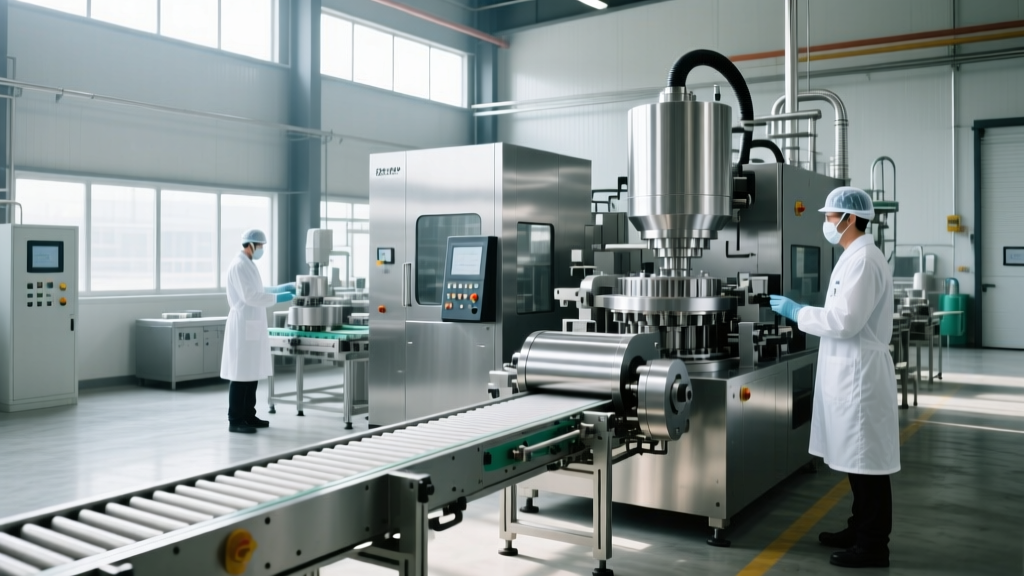
The engineering tolerances required in modern food processing leave zero margin for error. A microscopic crevice in a weld or an under-specified motor enclosure can lead to bacterial harborage, product recalls, and catastrophic downtime. Leading food equipment manufacturers differentiate themselves not through aesthetic design, but through rigorous adherence to sanitary engineering principles, advanced metallurgy, and precise fluid dynamics. This guide deconstructs the technical specifications and design frameworks that top-tier OEMs use to build compliant, high-throughput processing machinery.
The Metallurgy of Sanitary Design: 316L vs. 304 Stainless Steel
Material selection is the foundation of sanitary equipment design. While 304 stainless steel is sufficient for dry or low-moisture environments, top-tier food equipment manufacturers mandate 316L stainless steel for product contact zones in high-acid, high-chloride, or high-moisture applications. The addition of 2% to 3% molybdenum in 316L drastically increases resistance to pitting and crevice corrosion caused by aggressive cleaning chemicals and acidic food matrices (e.g., tomato paste, citrus juices, and dairy cultures).
According to guidelines established by the European Hygienic Engineering & Design Group (EHEDG), material selection must directly correlate with the chemical aggressiveness of both the product and the Clean-in-Place (CIP) caustics used. For highly corrosive environments, such as brine processing or high-salinity sauces, manufacturers are increasingly moving toward Duplex 2205 stainless steel, which offers superior stress corrosion cracking resistance.
| Alloy Grade | Key Composition | Pitting Resistance (PREN) | Primary Application | Relative Cost |
|---|---|---|---|---|
| 304 / 304L | 18% Cr, 8% Ni | ~19 | Dry goods, packaging, low-acid liquids | Baseline (1.0x) |
| 316L | 16% Cr, 10% Ni, 2% Mo | ~25 | Dairy, meat, acidic beverages, CIP piping | 1.3x - 1.5x |
| Duplex 2205 | 22% Cr, 5% Ni, 3% Mo | ~35 | High-salinity brines, aggressive chlorides | 1.8x - 2.2x |
Surface Finish and Ra Tolerances
The raw alloy is only half the equation; the surface finish dictates cleanability. Sanitary standards require product contact surfaces to achieve a maximum surface roughness average (Ra) of 0.8 micrometers (µm). High-end manufacturers achieve this through sequential mechanical polishing followed by electropolishing. Electropolishing removes the smeared metal layer left by mechanical abrasives, exposing a chromium-rich passive layer that actively repels protein adhesion and biofilm formation. Any surface with an Ra > 1.2 µm significantly increases the required CIP cycle time and chemical concentration.
Drive Systems and IP69K Washdown Enclosures
Motors, gearboxes, and Variable Frequency Drives (VFDs) represent the highest failure points in wet processing environments. Budget manufacturers often rely on IP65 or IP67 rated enclosures, which protect against low-pressure jets and temporary submersion, respectively. However, modern food processing facilities utilize high-pressure, high-temperature foam and caustic washdowns that easily breach these lower-tier seals.
Premium food equipment manufacturers specify IP69K-rated components (per DIN 40050-9 / ISO 20653). An IP69K rating certifies that the enclosure can withstand close-range, high-pressure (up to 100 bar) and high-temperature (80°C) spray-downs. To achieve this, OEMs engineer drive systems with:
- Double-lipped Viton (FKM) shaft seals: Prevents caustic ingress along the rotating output shaft.
- Breather vents with hydrophobic PTFE membranes: Allows internal pressure equalization during thermal shock (e.g., transitioning from a 85°C washdown to a 4°C cold room) without drawing moisture into the gearbox.
- Epoxy-coated stators and potted connections: Eliminates air gaps in the motor windings where condensation could cause dielectric breakdown.
Fluid Dynamics: Engineering for Clean-in-Place (CIP)
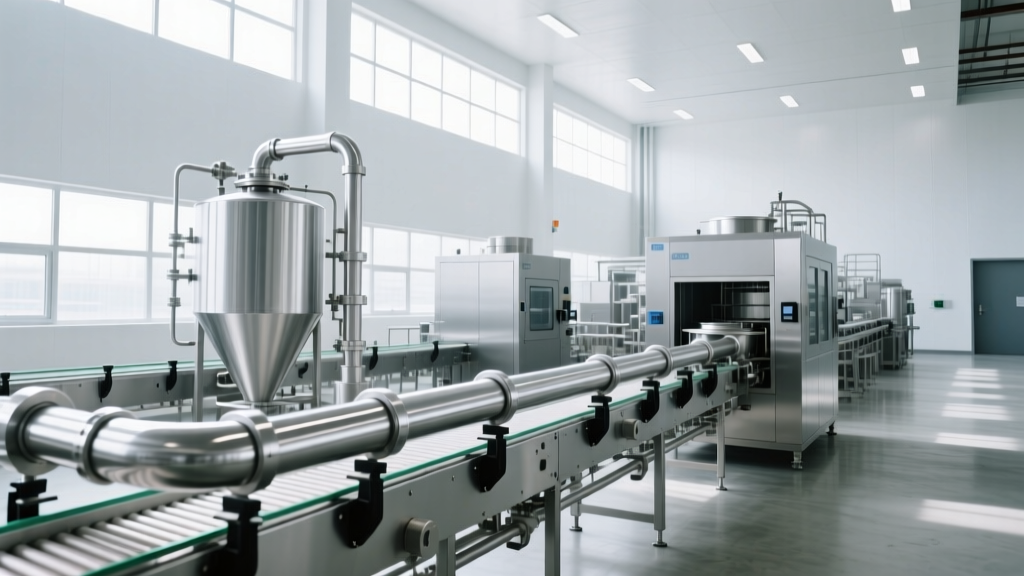
The internal geometry of pumps, valves, and piping must be engineered to support turbulent flow during CIP cycles. Laminar flow fails to generate the necessary shear stress to strip protein soils and biofilms from pipe walls. Food equipment manufacturers design fluid pathways to guarantee a minimum flow velocity of 1.5 meters per second (m/s) during CIP, which typically yields a Reynolds number > 10,000, ensuring fully turbulent flow.
Eliminating Dead Legs and Harborage Points
A "dead leg" is any branch pipe or instrument port where fluid stagnates. The FDA and 3-A Sanitary Standards strictly govern these geometries. The industry-standard rule is the L/D ratio of 2:1 or less, where L is the length of the dead leg and D is the internal diameter of the main pipe. If a temperature sensor port exceeds this ratio, it becomes a bacterial incubation zone that CIP flow cannot penetrate.
To solve this, advanced manufacturers utilize:
- Flush-mounted diaphragm valves: Eliminates the cavity found in traditional ball or butterfly valves.
- Inline sensor housings: Integrates pH and conductivity probes directly into the flow stream via retractable mechanisms, removing dead legs entirely.
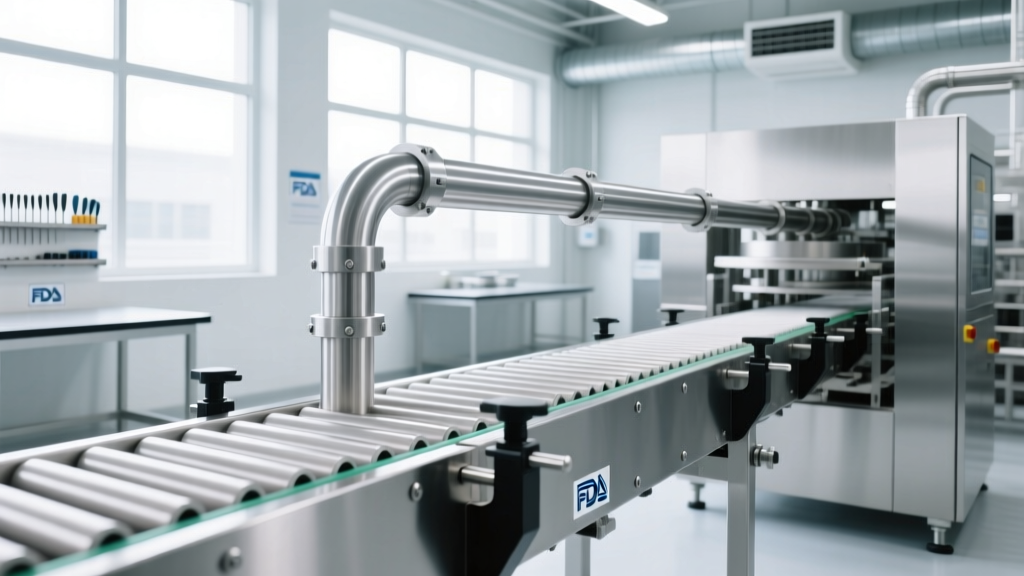
- Continuous TIG welding: All joints are orbital-welded and ground flush. Intermittent welds or threaded fittings in product zones are strictly prohibited in sanitary blueprints.
Evaluating OEM Spec Sheets: A Technical Decision Matrix
Procurement teams and plant engineers must look beyond throughput claims and scrutinize the sanitary engineering specifications. According to industry analyses by PMMI (The Association for Packaging and Processing Technologies), total cost of ownership (TCO) in food processing is heavily skewed toward sanitation downtime and maintenance, making initial capital savings on sub-par equipment a false economy.
Use the following matrix to audit the technical specifications provided by prospective food equipment manufacturers:
| Component | Budget / Tier 3 OEM Spec | Premium / Tier 1 OEM Spec | Impact on Operations |
|---|---|---|---|
| Product Contact Material | 304 SS, Mechanical Polish | 316L SS, Electropolished (Ra < 0.8 µm) | Reduces CIP chemical usage by 15-20%; extends time between passivation treatments. |
| Motor Enclosure | IP65 / IP67 (Painted Cast Iron) | IP69K (316L or Epoxy-Coated Aluminum) | Prevents catastrophic motor failure during high-pressure foam washdowns. |
| Gaskets & O-Rings | Nitrile (Buna-N), Standard Silicone | PTFE-encapsulated FKM, FDA-compliant EPDM | Prevents elastomer swelling and degradation when exposed to aggressive CIP acids. |
| Telemetry & Sensors | 4-20mA Analog Outputs | IO-Link Digital Protocols with Predictive Diagnostics | Enables real-time vibration and temperature monitoring for predictive maintenance. |
| Welding Standard | Manual TIG, Visual Inspection Only | Orbital TIG, Endoscopic & Dye Penetrant Testing | Guarantees zero micro-fissures in piping joints, eliminating biofilm harborage. |
The Shift Toward IO-Link and Predictive Telemetry
The latest generation of processing equipment integrates IO-Link communication protocols directly into sanitary sensors and smart motors. Unlike legacy 4-20mA analog signals, IO-Link provides bidirectional data, allowing the PLC to read internal motor temperatures, bearing vibration frequencies, and seal wear metrics. This telemetry allows plant engineers to transition from reactive maintenance to predictive maintenance, scheduling gearbox replacements during planned sanitation windows rather than suffering unplanned line stoppages mid-shift.
When specifying new lines, mandate that food equipment manufacturers provide open-protocol IO-Link master configurations rather than proprietary locked ecosystems. This ensures seamless integration with existing plant SCADA systems and long-term data accessibility for continuous improvement algorithms.