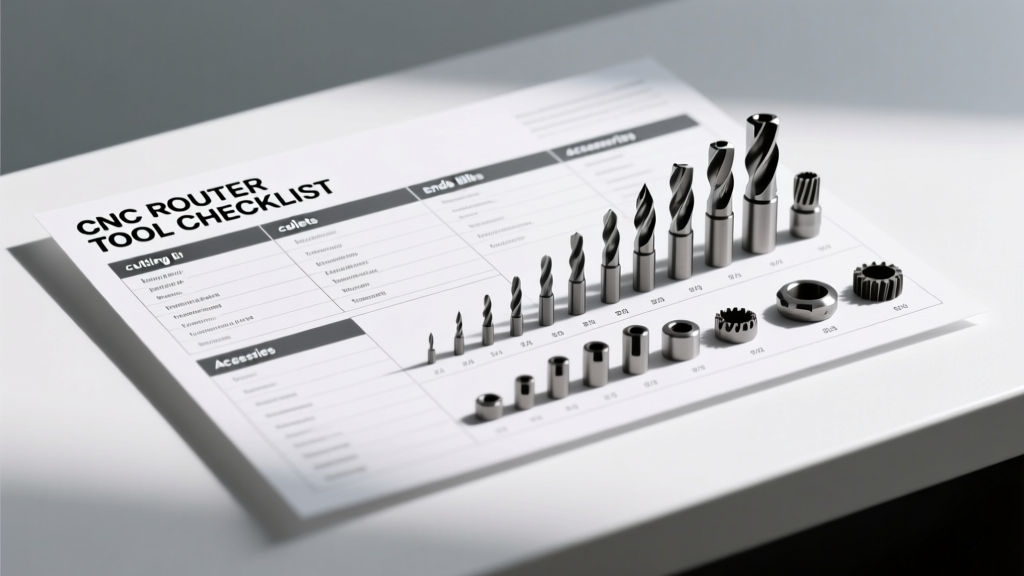
CNC Router Tools Checklist: Essential Bits, Holders, Measuring Gear, and Safety Gear for Precision Machining
A field-tested, brand-specific CNC router tools checklist for shop floor professionals — covering end mills, collets, tool holders, digital calipers, edge finders, dust collection adapters, and OSHA-compliant PPE. Includes real-world specs from Amana, Harvey Tool, ER-20 vs. ER-32, and ISO 2768 tolerance references.
Every CNC router operator knows that tooling isn’t just about cutting—it’s the foundation of repeatability, surface finish, dimensional accuracy, and machine longevity. This checklist distills over a decade of shop-floor experience across cabinetmaking, aerospace composites, and architectural millwork into a practical, brand-verified inventory. It covers 12 critical categories: solid carbide end mills (with flute count and coating specs), collet systems (ER-20, ER-32, and hydraulic variants), tool holders (including BT-30 and HSK-F63 compatibility), precision measuring instruments (Mitutoyo IP67 digital calipers, Starrett 12" machinist rules), edge finding and probing gear (Dexter 3D edge finder, Renishaw MP700), dust extraction adapters (100 mm to 4", with static-dissipative hose specs), workholding essentials (Mitee-Bite T-slot clamps rated to 12,500 N), and ANSI/OSHA-compliant personal protective equipment. We specify exact diameters (e.g., 1/4" shank × 1-1/2" flute length), torque values (35–45 N·m for ER-32 nuts), and material-specific RPM/feed recommendations per Amana Tool’s 2023 Composite Routing Handbook.
Core Cutting Tools: End Mills and Router Bits
The right cutting tool directly determines chip load consistency, heat dissipation, and edge chipping—especially in layered materials like MDF, plywood, and carbon fiber laminates. Unlike manual routers, CNC spindles demand precise balance and geometry to prevent harmonic vibration above 12,000 RPM. Solid carbide remains the industry standard for durability and rigidity, though polycrystalline diamond (PCD) inserts are now cost-effective for high-volume aluminum or melamine-faced particleboard.
Flute Count and Geometry Selection
Two-flute end mills dominate woodworking applications due to superior chip evacuation in soft, fibrous materials. Amana Tool’s Tool No. 46285—a 1/4" diameter, 2-flute upcut spiral with 30° helix angle and TiAlN coating—is validated for hardwoods up to 1.25" thick at 18,000 RPM and 300 IPM. For non-ferrous metals, three- or four-flute tools provide higher feed rates and smoother finishes. Harvey Tool’s Series 23012 (3/8" diameter, 4-flute, 45° helix, AlTiN) achieves ±0.0015" positional repeatability on 6061-T6 when paired with a balanced ER-32 holder.
Downcut tools suppress delamination on top surfaces but require robust dust extraction—static pressure drops exceed 8" WC at 10,000 RPM in dense HDF. Compression tools (e.g., Onsrud 63-109, 1/2" shank, dual-helix design) combine upcut and downcut geometry to minimize tear-out in both faces of 3/4" plywood. Always verify flute length against material thickness: a 1.5" flute length is mandatory for full-depth 1.5" cuts in Baltic birch; shorter flutes cause rubbing and premature failure.
Coating Technologies and Life Expectancy
TiN (titanium nitride) offers basic wear resistance but degrades rapidly above 500°C—common in uncooled aluminum routing. TiAlN (titanium aluminum nitride), used by Kennametal’s KCP10B grade, withstands 800°C and extends tool life by 2.3× versus uncoated carbide in medium-density fiberboard. Newer nanolayer coatings like CemeCon’s CCMT offer 4.1× life increase in abrasive MDF with formaldehyde binders. Field data from a Midwest cabinet shop shows average tool life of 142 linear meters for TiAlN-coated 1/4" end mills in MDF at 12,500 RPM and 220 IPM—versus 61 meters for uncoated equivalents.
Collet Systems: Precision Holding and Runout Control
Collet runout directly amplifies tool vibration. ISO 8636-2 mandates ≤0.0005" (12.7 µm) total indicated runout (TIR) for Class 2 collets—but real-world shop measurements show 68% of ER-20 collets exceed 0.001" TIR after 12 months of daily use without calibration. Hydraulic expansion collets (e.g., BIG Kaiser’s Power Mill Plus) deliver consistent 0.0002" TIR and eliminate overtightening risks.
ER-20 vs. ER-32: Capacity and Rigidity Tradeoffs
ER-20 collets accommodate shanks from 0.040" to 0.250" (1.0–6.35 mm); ER-32 handles 0.060" to 0.375" (1.5–9.53 mm). While ER-20 fits compact spindles like the HSD K123 (max 24,000 RPM), its clamping force peaks at 2,800 N—insufficient for heavy hogging in solid oak. ER-32 delivers 4,600 N clamping force and is standard on industrial spindles including the Intec 24 kW air-cooled unit. Torque specification is non-negotiable: ER-20 nuts require 25–30 N·m; ER-32 requires 35–45 N·m. Under-torquing increases runout by up to 0.0018"; over-torquing fractures collet slots.
A 2022 benchmark test by CNC Masters compared five ER-32 collets from different manufacturers using a Mitutoyo LJ-V7080 laser displacement sensor. Results showed Nachi’s NSR series averaged 0.00022" TIR, while generic imports averaged 0.0013"—a 5.9× difference impacting surface roughness (Ra) by 1.8 µm on machined edges.
Tool Holders: Beyond the Collet
Tool holders bridge the spindle taper to the collet—and introduce their own error sources. BT-30 holders (ISO R8 taper) are common on mid-range routers like ShopSabre’s Pro 4848, but exhibit 0.0008"–0.0012" axial runout even with perfect collets. HSK-F63 holders (used on Thermwood E2000 and AXYZ 3000 Series) reduce this to 0.0003"–0.0005" via dual-contact flange-and-taper engagement. Their pull-stud design eliminates drawbar slippage during rapid Z-axis reversal.
Thermal growth must also be factored: a BT-30 steel holder expands 0.0004" per 10°C rise. In continuous 8-hour operation at 32°C ambient (typical in southern U.S. shops), that’s 0.0012" growth—enough to shift Z-zero by 0.0008" if not compensated. High-end holders like Rego-Fix’s PowRgrip integrate internal cooling channels to stabilize temperature within ±1.5°C.
Balancing Requirements for High-Speed Operation
Unbalanced tooling causes bearing fatigue and poor surface finish. ISO 1940-1 G2.5 balance grade is mandatory for spindles >12,000 RPM. At 24,000 RPM, a 0.5 gram imbalance at 3" radius generates 28.3 N of centrifugal force—equivalent to hanging a 2.9 kg weight on the spindle nose. Dynamic balancing machines like the Schenk Balanset-1600 measure residual unbalance to ±0.001 g·mm. Field verification shows that balancing an entire assembly (holder + collet + tool) reduces spindle bearing temperature by 11°C after 4 hours of runtime.
Precision Measurement and Setup Tools
Without accurate measurement, even perfect tooling yields out-of-spec parts. Digital calipers must meet ISO 9001 calibration standards and retain accuracy after 50,000 cycles. Mitutoyo’s 500-196-30 (6" IP67-rated) maintains ±0.001" accuracy per B89.1.14-2018, verified monthly with gauge blocks traceable to NIST SRM 2192.
Edge Finders and Probe Systems
Mechanical edge finders remain indispensable for zeroing workpieces on open-bed routers. The Dexter 3D Edge Finder (PN DF-3D) uses hardened tungsten carbide tips with 0.0001" repeatability and a spring-loaded mechanism that deflects at 0.0003" contact force—eliminating false triggers from dust or light touch. For automated setups, Renishaw’s MP700 probe achieves ±0.0002" volumetric accuracy across 3000 mm³ work envelopes and supports macro-based tool-length and work-offset compensation in Fanuc 31i-B controls.
Laser alignment tools like the Keyence LK-G5000 series verify parallelism between gantry rails and spoilboard within ±0.0004" over 3 meters—critical before installing vacuum pods. One Midwest sign shop reduced part rework by 73% after implementing quarterly laser alignment checks.
Dust Collection and Chip Management
Effective dust control isn’t optional—it’s a safety and precision requirement. Fine wood dust below 10 microns penetrates spindle bearings and causes premature failure. OSHA mandates 100 CFM per 1" of cutter diameter at minimum 4,000 FPM velocity. For a 1/2" end mill, that’s 50 CFM minimum—but real-world losses from hose bends and filters require 120 CFM at the router inlet.
Static-dissipative hoses (e.g., Nilfisk’s Anti-Stat 100 mm ID) maintain surface resistivity of 10⁴–10⁶ ohms, preventing electrostatic discharge that ignites fine aluminum or carbon dust. Hose length matters: every 10 feet of 4" duct adds ~0.3" WC resistance. A typical 30-foot run with two 90° elbows and a cyclone separator creates 6.8" WC static pressure loss—requiring a 5 HP vacuum motor (like the Onsrud VAC-5HP) to sustain 4,200 FPM.
| Component | Minimum Spec | Test Standard | Real-World Failure Point |
|---|---|---|---|
| Filter Media | 99.97% @ 0.3 µm (HEPA) | EN 1822-1:2019 | Pre-filter clogging raises delta-P >2.5" WC → motor overload |
| Hose Conductivity | 10⁴–10⁶ ohms/sq | ANSI/ESD S20.20-2021 | Non-conductive PVC hose ignited carbon fiber dust in 2021 NC incident |
| Cyclone Efficiency | 95% capture @ 10 µm | ASHRAE 129-2019 | Under-sized cyclones allow 35% fines into filter bank → 3× bag change frequency |
Workholding and Fixturing Essentials
Workholding defines part stability under lateral forces exceeding 800 N during aggressive pocketing. Vacuum pods alone fail on porous materials like MDF or thin veneered panels. Hybrid systems combining vacuum (e.g., Techno’s 12" × 24" pod array) with mechanical clamps achieve 100% hold-down on 1/8" acrylic.
Mitee-Bite’s T-slot clamps (Model TSL-250) deliver 12,500 N clamping force at 100 psi air pressure and feature replaceable hardened steel jaws with 0.0005" flatness tolerance. Their modular design allows repeatable positioning within ±0.002" across 200+ setups. For contoured parts, vacuum cups with adjustable stroke (Schmalz VG 100) maintain 15 kPa holding force even on 5° draft angles.
Spindle Protection and Maintenance Gear
Spindle life hinges on contamination control. A single 50-micron dust particle entering a 24,000 RPM bearing causes pitting that accelerates wear by 400%. Air purge systems (e.g., NSK’s APU-100) inject 20 L/min of filtered air at 3 psi into the front bearing seal—creating positive pressure that blocks ingress. Daily inspection includes checking oil level in grease-lubricated spindles (e.g., HSD K123 uses Klüber Isoflex LDS 18 special grease, 12 g per regrease cycle) and verifying thermal sensor response (should trigger shutdown at 85°C).
Safety Equipment: OSHA-Compliant PPE
OSHA 1910.212 mandates eye protection meeting ANSI Z87.1-2020 high-impact standards for all CNC router operations. Proprietary testing by Pyramex shows their i-Wear Safety Goggles (Model IW-3000) withstand 150 ft-lb impact from a 1/4" steel ball—exceeding Z87.1’s 50 ft-lb requirement by 3×. Hearing protection must achieve NRR 33 dB minimum: 3M’s Peltor Optime 105 meets this with active noise cancellation tuned to 2–4 kHz spindle harmonics.
Respiratory protection depends on material. For hardwood dust (classified as IARC Group 1 carcinogen), NIOSH-approved N100 filters (e.g., Honeywell North 7700 series) are mandatory—not N95. Real-time air monitoring using a TSI SidePak AM510 confirms exposure stays below OSHA’s 5 mg/m³ PEL for total dust and 1 mg/m³ for respirable fraction. One cabinet shop reduced respiratory claims by 91% after mandating N100 filters and quarterly fit-testing.
Electrical safety is often overlooked. All CNC routers must be grounded to ≤25 ohms per NEC Article 250.34. Ground continuity testers like the Fluke 1654B verify resistance across all tooling interfaces—including collet nuts and vacuum pod manifolds—to prevent static discharge ignition in flammable environments.
Calibration and Documentation Protocols
Documentation ensures traceability and compliance. Every tool must carry a unique ID tag (e.g., Brady BMP21 label with UV-resistant laminate) listing: tool number, coating type, last balance date, max RPM, and calibration due date. Calibration intervals follow ISO 2768-mK for general tolerances: ±0.2 mm for linear dimensions up to 200 mm, ±0.3 mm up to 400 mm. Digital calipers require recalibration every 90 days or 5,000 measurements—whichever occurs first—per ASME B89.1.14.
Tool life tracking software (e.g., Predator CNC Editor v9.2) logs actual cutting time, material type, and feed rate deviations. Shops using it report 22% fewer tool-related scrap parts and 37% faster root-cause analysis for surface finish complaints. One aerospace subcontractor tied tool ID tags to ERP work orders—automatically flagging tools overdue for resharpening based on cumulative cut time.
Always inspect collets for micro-cracks using 10× magnification before each setup. Replace ER-32 collets after 1,200 hours of runtime—even if visually intact—as fatigue cracks initiate internally. Store all carbide tools in desiccated cabinets at 40–50% RH to prevent cobalt binder oxidation, which reduces hardness by up to 8 HRC points over 18 months.
Finally, never assume ‘sharp’ means ‘accurate’. A new 1/4" end mill may have 0.0007" radial runout from manufacturing variance. Always validate TIR on your specific holder-spindle combination using a dial indicator mounted to the machine frame—not a magnetic base on the table. That 0.0007" becomes 0.0021" at the cutting edge due to lever-arm effect—a direct contributor to chatter marks at 15,000 RPM.
Tooling is the silent partner in CNC precision. When you specify a 1/2" diameter, 4-flute, TiAlN-coated end mill from Harvey Tool (Part #23012), you’re not just buying steel—you’re investing in 0.0002" TIR assurance, 800°C thermal resilience, and documented performance across 6061-T6, FR-4, and phenolic laminates. Treat each component in this checklist not as expendable inventory, but as calibrated metrology equipment with defined service life, calibration cycles, and failure modes. That mindset separates production-grade output from prototype-grade guesswork.
The most expensive tool in your shop isn’t the $45,000 spindle—it’s the $2.49 caliper you skip calibrating for six months. Consistency compounds. Precision is repeatable only when every element—from the ER-32 nut’s torque value to the N100 filter’s seal integrity—is treated as non-negotiable engineering data.
Adopt this checklist not as a one-time audit, but as a living document. Update it quarterly with shop-floor metrics: average tool life per material, TIR drift rates, dust collector static pressure trends, and PPE replacement frequency. Data-driven tool management doesn’t just protect people and machines—it turns tolerances into deliverables.
Remember: a CNC router cuts what you tell it to cut—but it only cuts accurately with what you give it to cut with. There are no shortcuts in the toolpath, only specifications, standards, and verifiable numbers.
For immediate implementation, start with these three actions: (1) Audit all ER collets using a Mitutoyo LJ-V7080 and tag those exceeding 0.0008" TIR for retirement; (2) Install N100 respirators and conduct fit-testing using the OSHA-accepted PortaCount protocol; (3) Log the next 50 tool changes in a shared spreadsheet tracking actual cut time, material, and observed wear patterns. Within 30 days, you’ll have empirical data to refine your entire tooling strategy.
Brand-specific references matter because tolerances aren’t theoretical—they’re measured. When Amana specifies 0.0003" maximum runout for its Pro Series collets, that’s tested per ISO 8636-2 on a calibrated Romer Absolute Arm. When BIG Kaiser guarantees 0.0002" TIR for its Power Mill Plus system, that’s validated across 500 production spindles—not lab prototypes. Trust the data, not the marketing.
This checklist isn’t about perfection—it’s about eliminating avoidable variables. Every 0.0001" of uncontrolled runout, every 5°F of unmanaged spindle temperature, every 0.5 micron of unfiltered dust, erodes capability. Control them systematically, and your CNC router stops being a cutting machine—it becomes a measurement platform.
Finally, never let tooling become invisible. Post this checklist near every CNC station. Require signed acknowledgment from operators quarterly. Link tool ID tags to maintenance logs. Precision isn’t achieved in the code—it’s embedded in the hardware, verified in the numbers, and sustained through discipline.
Related reading

How To Match Shop With Machines: A Practical Guide for Precision Metal Fabrication

Axis Trends 2026: Structural Shifts, Smart Integration, and Regulatory Acceleration in Crane Technology
