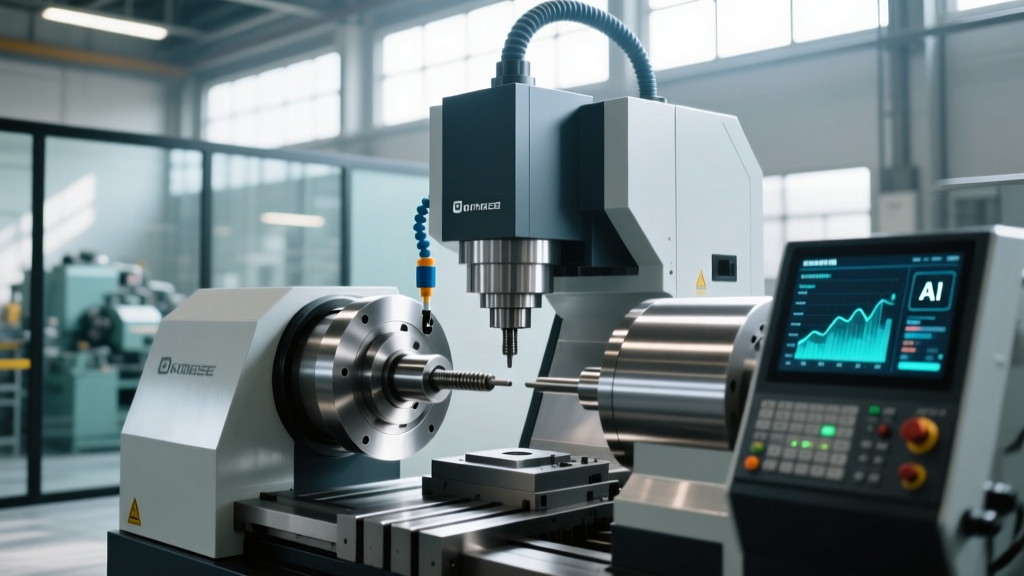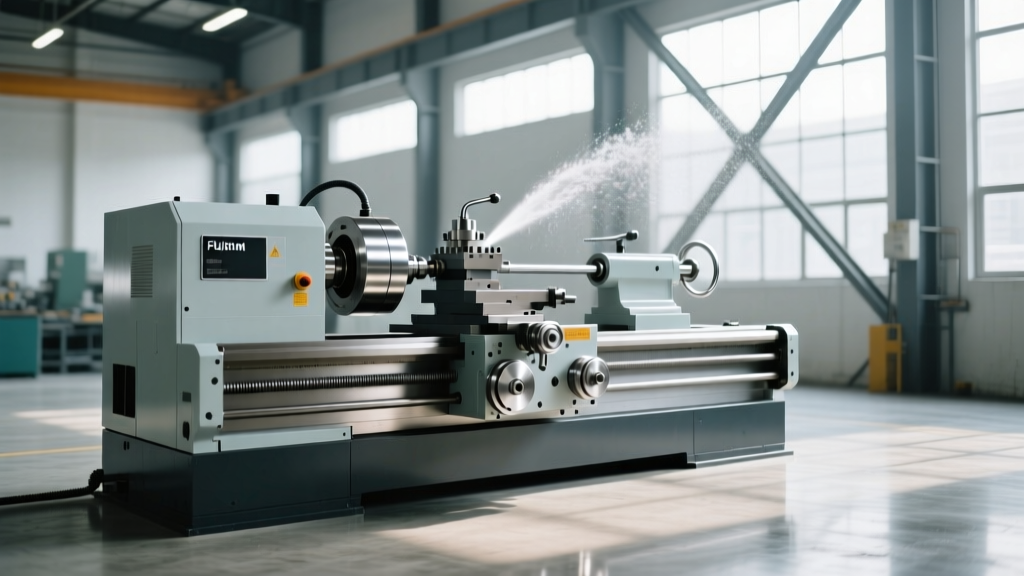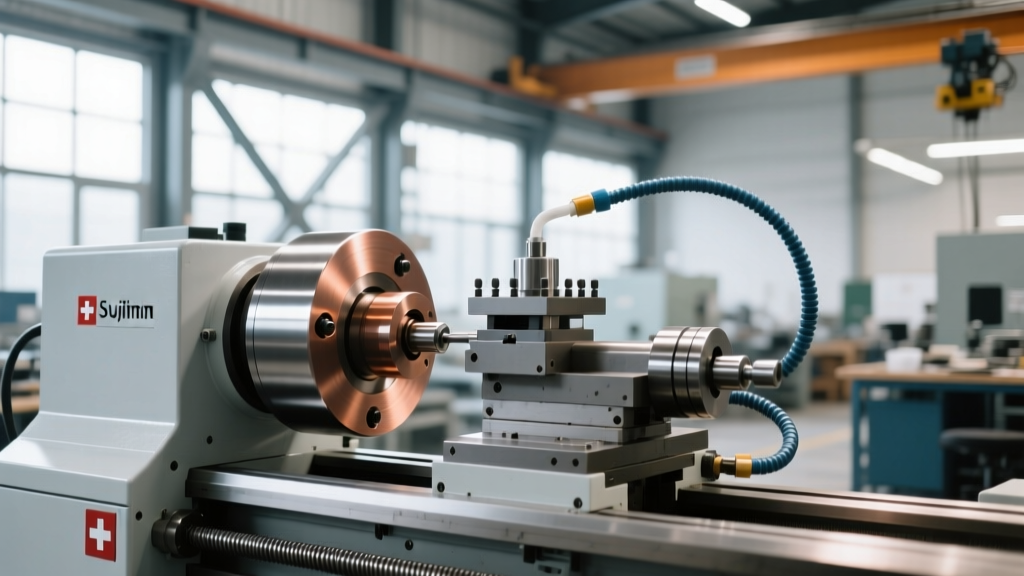
Inside a Swiss Machine CNC: Technical Specs & Kinematics
Explore the technical specifications, guide bushing kinematics, and operational frameworks of a Swiss machine CNC for high-precision turning.
Core Kinematics: The Sliding Headstock Principle
Unlike conventional fixed-headstock lathes where the cutting tool moves along the Z-axis to remove material, a Swiss machine CNC operates on an inverted kinematic model. The material (bar stock) moves through the Z-axis while the cutting tools remain fixed radially. This fundamental shift in mechanics allows the machine to support the workpiece immediately adjacent to the cutting zone, virtually eliminating part deflection even when machining long, slender geometries with high length-to-diameter (L/D) ratios.
In a standard Swiss-type configuration, the main spindle dictates the Z-axis feed. The guide bushing, mounted directly in front of the tooling area, acts as a stationary support sleeve. Because the cutting action occurs within millimeters of the bushing exit, the unsupported overhang of the material is near zero. This mechanical advantage is what enables the machining of complex, high-aspect-ratio components—such as bone screws, watch pinions, and aerospace hydraulic fittings—without the need for secondary tailstock support or steady rests.
The Guide Bushing: Tolerances and Thermal Dynamics
The guide bushing is the defining component of a Swiss machine CNC. It is typically constructed from hardened steel, carbide, or specialized polymers, and its internal diameter must be matched precisely to the bar stock. The clearance between the bar and the bushing is a critical variable that dictates surface finish, dimensional accuracy, and tool life.
⚠️ Critical Tolerance Warning: Bar Stock Preparation
Never use standard cold-drawn bar stock in a guide bushing. Cold-drawn stock typically carries a diameter tolerance of ±0.002 inches, which will cause severe binding or excessive chatter. Swiss machining requires centerless ground bar stock, specifically certified to ISO h6 tolerance (e.g., a 10mm bar must fall between 9.991mm and 10.000mm). The ideal diametral clearance between the bushing and the ground bar is strictly between 0.0002" and 0.0005" (0.005mm to 0.012mm).
Thermal growth is a secondary factor governed by the bushing. As the spindle rotates at high RPMs, friction between the bar and the bushing generates localized heat. Modern Swiss machines mitigate this through high-pressure flood coolant directed precisely at the bushing exit and by utilizing segmented, adjustable carbide bushings that maintain concentricity even under thermal expansion.
Standard Technical Specifications Matrix
When evaluating a Swiss machine CNC for production integration, technical specifications scale based on the target part envelope. The following matrix outlines standard configurations for entry-level, mid-range, and heavy-capacity Swiss platforms, reflecting current market offerings from manufacturers like Tornos and Star Micronics.
| Specification | Micro/Precision (12mm) | Standard Production (20mm) | Heavy Capacity (32mm+) |
|---|---|---|---|
| Max Bar Capacity | 12.7mm (0.5") | 20.0mm (0.78") | 38.0mm (1.5") |
| Main Spindle RPM | 12,000 - 15,000 RPM | 10,000 - 12,000 RPM | 6,000 - 8,000 RPM |
| Standard Axis Count | 5 to 7 Axes | 7 to 9 Axes | 9 to 12+ Axes (B-Axis equipped) |
| Max Machining Length | 180mm (Guide Bushing) | 200mm (Guide Bushing) | 320mm (Guide Bushing) |
| Rapid Traverse Rate | 24 m/min | 32 m/min | 24 to 30 m/min |
Guide Bushing vs. Bushingless (Chucker) Operations
While the guide bushing is essential for long parts, it introduces a significant material waste problem known as the "remnant length." Because the bar pusher and spindle collet require physical space to grip the bar, the final 120mm to 180mm of the bar stock cannot be pushed into the guide bushing. In high-volume production running expensive materials like titanium or medical-grade PEEK, this remnant waste severely impacts per-part economics.
To solve this, modern Swiss machines feature a convertible bushingless (chucker) mode. By removing the guide bushing and utilizing a sliding spindle liner, the machine operates like a conventional short-bed lathe. This allows the bar to be pushed entirely through the spindle, reducing the remnant waste to less than 15mm.
Decision Framework: When to Drop the Bushing
- Use Guide Bushing Mode: When the part L/D ratio exceeds 4:1, or when machining deep, small-diameter drills (e.g., 0.5mm drills) that require absolute rigidity to prevent breakage.
- Use Bushingless (Chucker) Mode: When the part L/D ratio is under 3:1, when running short parts (under 30mm length), or when material cost dictates that a 150mm remnant per 3-meter bar is financially unacceptable.
Live Tooling and B-Axis/C-Axis Integration
A Swiss machine CNC is rarely used for turning alone. The integration of live tooling (driven tools) and orthogonal Y-axes transforms the platform into a complete milling and turning center. Advanced models now incorporate a fully programmable B-axis on the upper tool turret. Unlike fixed-angle live tool holders, a B-axis allows the milling spindle to swivel continuously, enabling the machining of complex angled features, helical interpolations, and 3D surface contours in a single setup.
When utilizing live tooling on a Swiss platform, synchronous spindle control (C-axis) is mandatory for operations like polygon turning or cross-drilling. The main spindle and the live tool must be phase-locked via the CNC controller to ensure the drill intersects the rotating part at the exact required coordinate. High-end controllers from Citizen Machinery and Fanuc achieve this synchronization with sub-millisecond latency, preventing tool shear during high-speed cross-drilling.
"The transition from fixed-angle Y-axis tooling to a continuous B-axis on Swiss-type machines has reduced cycle times on complex medical implants by up to 35%, as it eliminates the need for secondary fixturing and multi-axis macro programming workarounds." — Manufacturing Engineering Analysis, 2025.
Real-World Troubleshooting: Chatter and Deflection Diagnostics
Chatter marks on the finished diameter of a Swiss-turned part are the most common failure mode. Because the material is moving rather than the tool, standard lathe troubleshooting logic does not apply. Follow this diagnostic sequence to isolate the root cause:
- Verify Bar Stock Tolerance: Measure the bar diameter at three points along its length using a micrometer. If the variance exceeds 0.0003", the bar is binding or rattling inside the guide bushing. Switch to h6 ground stock.
- Inspect Bushing Wear: Remove the guide bushing and inspect the carbide segments. Look for "bell-mouthing" (wear at the exit edge). A worn bushing allows the bar to whip at high RPMs. Replace or re-shim the bushing segments.
- Adjust Spindle Liner Clearance: Behind the bushing, the bar passes through a spindle reduction liner. If the liner is too loose, the bar will vibrate harmonically before it even reaches the bushing. Ensure the liner matches the bar diameter within 0.005".
- Optimize Feed and Speed for Slenderness: If machining a high L/D part, reduce the spindle RPM by 15-20% and increase the feed rate slightly. This shifts the harmonic frequency away from the natural resonant frequency of the unsupported bar stub.
Capital Equipment Cost Framework
Procuring a Swiss machine CNC requires a significant capital outlay, with pricing heavily dictated by axis complexity, automation readiness, and brand pedigree. As of current market valuations, entry-level 5-axis Swiss lathes (typically 12mm to 16mm capacity, lacking Y-axis or sub-spindles) range from $110,000 to $160,000. These are suited for simple, high-volume electronic contacts or basic pins.
Mid-tier production machines (20mm to 25mm capacity, featuring a sub-spindle, Y-axis, and 8+ axes of motion) represent the industry workhorses and command prices between $220,000 and $320,000. For complex aerospace and orthopedic applications requiring a B-axis, high-pressure coolant pumps (up to 2,000 PSI), and integrated bar feeders with remnant catchers, fully loaded 32mm+ platforms from premium builders easily exceed $450,000 to $600,000+. When calculating ROI, factor in the mandatory cost of a hydrodynamic bar feeder ($15,000 - $25,000) and an oil mist collection system, both of which are non-negotiable for safe, autonomous Swiss operation.