Cost Analysis: CNC Machining Railroad Transparent Manifolds in Houston
Analyze production costs and high-volume CNC strategies for machining transparent railroad manifolds in Houston, covering tooling, materials, and scrap reduction.
The Economics of Optically Clear Fluid Manifolds in Rail Transport
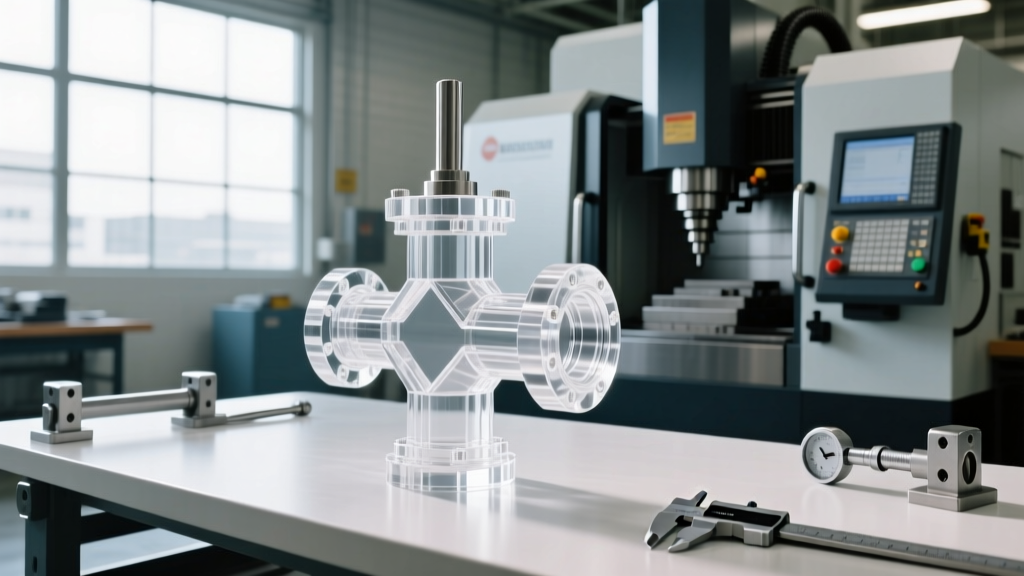
Locomotive maintenance facilities and rail testing laboratories rely heavily on transparent hydraulic and pneumatic manifolds to visualize fluid flow, detect cavitation, and monitor pressure drops in real-time. These components, typically machined from cast acrylic (PMMA) or polycarbonate (PC), are critical for testing heavy-haul braking systems and suspension hydraulics operating between 3,000 and 5,000 PSI. When budgeting for high-volume CNC machining of railroad transparent manifolds in Houston, procurement teams must navigate a complex matrix of material science, specialized tooling, and regional manufacturing economics.
Unlike standard aluminum or steel production runs, machining optically clear polymers at scale introduces severe scrap-rate risks. Internal stress, micro-crazing, and thermal melting can easily push scrap rates above 18% in poorly optimized shops. This cost analysis breaks down the precise financial and operational strategies required to execute 5,000+ unit production runs profitably in the Houston metro area.
Material Selection: Cast Acrylic vs. Polycarbonate
The foundation of your budget hinges on material selection. While both polymers offer optical clarity, their machining characteristics and raw material costs differ drastically.
| Material Grade | Raw Block Cost (per lb) | Optimal Tooling Geometry | Max Hydraulic Rating | High-Volume Scrap Risk |
|---|---|---|---|---|
| Cell-Cast Acrylic (PMMA) | $12.50 - $14.00 | Single-Flute O-Flute Router | 1,500 PSI | Low (4-6%) |
| Machining-Grade Polycarbonate (Lexan) | $18.00 - $22.50 | 2-Flute PCD End Mill | 4,500+ PSI | High (12-20% if fixtured poorly) |
For standard pneumatic brake test benches, cell-cast acrylic is the budget-friendly standard. However, for high-pressure hydraulic fluid monitoring in locomotive suspension systems, polycarbonate is mandatory. Polycarbonate's higher toughness makes it prone to chip welding and thermal deformation, demanding advanced tooling investments.
High-Volume Tooling Strategies to Minimize Scrap
To achieve optical clarity directly off the CNC mill—eliminating the $4.50 to $6.00 per-part cost of secondary flame or vapor polishing—shops must utilize specialized cutting tools. According to Harvey Tool's material-specific technical guides, standard carbide end mills leave micro-chatter marks that scatter light, rendering the manifold useless for flow visualization.
Polycrystalline Diamond (PCD) vs. Coated Carbide
For runs exceeding 2,000 units, PCD tooling is non-negotiable. A 1/2-inch PCD end mill costs approximately $280, compared to $45 for a premium coated carbide alternative. However, PCD tools maintain a razor-sharp edge for 40,000+ linear feet of cutting in acrylic, whereas carbide degrades after 3,000 feet, causing localized melting and part rejection. The upfront tooling amortization adds just $0.85 per part but saves $5.50 per part in secondary polishing and scrap replacement.
Chip Evacuation and O-Flute Geometry
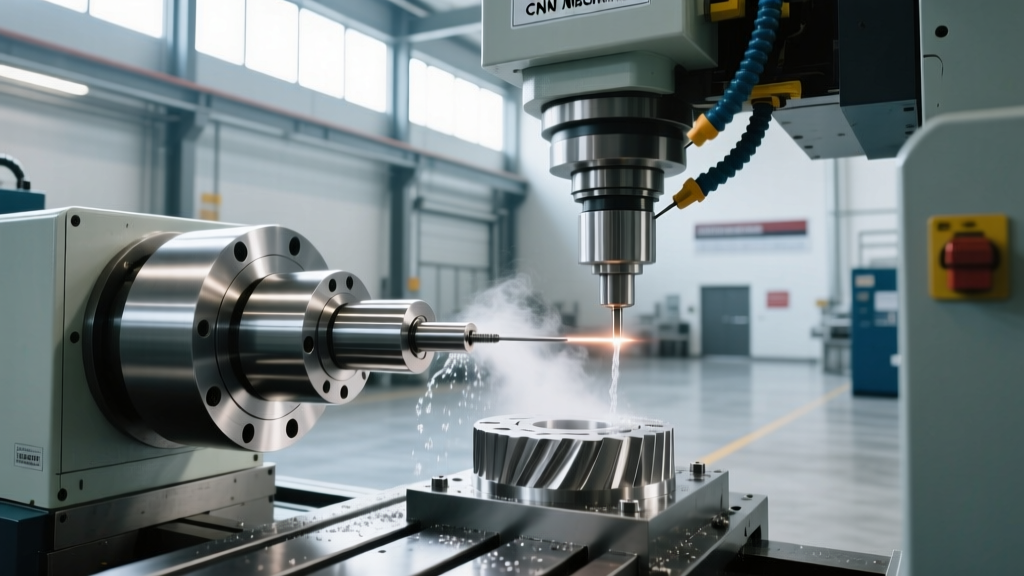
Transparent polymers generate long, stringy chips that easily re-weld to the workpiece if not evacuated instantly. Utilizing Onsrud 63-700 series O-flute routers provides the necessary gullet volume to clear chips at spindle speeds of 18,000–24,000 RPM and feed rates of 150–200 IPM. Failure to use O-flute geometry in deep pocketing operations (common in manifold valve seats) results in a 14% scrap rate due to localized thermal warping.
⚠️ CRITICAL WARNING: Liquid Coolant CrazingNever use standard water-soluble liquid coolants when machining polycarbonate manifolds. The alkaline pH of most CNC cutting fluids chemically attacks polycarbonate, causing micro-crazing (internal fracturing). While invisible to the naked eye, these micro-fractures will cause catastrophic manifold rupture under 3,000+ PSI hydraulic test pressures. High-volume shops must invest in programmable air-blast systems or specialized minimum quantity lubrication (MQL) using pure, non-chlorinated oils.
Fixturing for Zero-Stress Optical Clarity
Mechanical clamping is the silent killer of transparent manifold yields. Over-tightening standard vise jaws induces internal mechanical stress in the polymer block. This stress manifests as birefringence—rainbow-like distortions visible under polarized light—which obscures fluid flow visibility and weakens the structural integrity of the part.
- Vacuum Workholding: For flat manifold bases, porous aluminum vacuum plates pulling 25+ inches of mercury (inHg) distribute clamping force evenly, reducing stress-induced scrap to near zero.
- Cryogenic Soft Jaws: For 5-axis profiling of complex manifold intersections, machine shops must use custom-milled Delrin or UHMW soft jaws, torqued to a strict maximum of 15 ft-lbs to prevent polymer compression.
- Thermal Stabilization: Polycarbonate expands at a rate of 3.8 x 10^-5 in/in/°F. Houston machine shops must climate-control their CNC enclosures to 68°F ± 2°F to maintain the ±0.002-inch tolerances required for O-ring gland sealing surfaces.
Houston Regional Production Economics
Sourcing CNC machining for railroad transparent manifolds in Houston offers distinct logistical and economic advantages, primarily driven by the region's petrochemical supply chain and heavy transport infrastructure.
Labor and Machine Time Rates
Based on current Bureau of Labor Statistics data for machinists, the Houston-The Woodlands-Sugar Land metro area features a highly competitive manufacturing labor market. While standard 3-axis CNC operators average $24.50 per hour, programming and operating 5-axis mills for delicate polymer work requires specialized talent, commanding $34.00 to $42.00 per hour. Consequently, budget planners should model Houston-based machine time at $95 to $125 per hour for high-precision polymer work, slightly below the national coastal averages but higher than rural Texas job shops.
Supply Chain and Logistics
Houston’s proximity to the Port of Houston and major chemical manufacturers (e.g., LyondellBasell, ExxonMobil) ensures a steady, low-cost supply of raw polymer blocks. Procuring 4-inch thick cast acrylic blocks locally reduces inbound freight costs by up to 18% compared to sourcing from Midwest distributors, a critical margin advantage in high-volume runs.
"The difference between a profitable polymer manifold run and a financial loss is almost always thermal management. If your shop is relying on flood coolant and standard carbide, you are essentially paying to machine scrap. Air-blast cooling combined with PCD tooling isn't an optional upgrade; it's the baseline for optical-grade manufacturing."
— Director of Advanced Materials Machining, Gulf Coast Precision Plastics
Unit Cost Breakdown: 5,000-Part Polycarbonate Run
To provide a concrete budgeting framework, below is a modeled cost breakdown for a 5,000-unit production run of a 6-port pneumatic test manifold machined from 2-inch thick polycarbonate block in a Houston-based contract machine shop.
| Cost Category | Per-Unit Cost | Notes & Assumptions |
|---|---|---|
| Raw Material (PC Block) | $28.50 | Based on 3.2 lbs net weight + 15% kerf/drop waste |
| CNC Machine Time | $16.20 | 9 minutes cycle time @ $108/hr blended shop rate |
| Tooling Amortization | $1.10 | PCD end mills and O-flute routers over 5k parts |
| Fixturing & QC | $4.50 | Vacuum plate maintenance, optical polarized QC checks |
| Shop Overhead & Margin | $12.80 | Standard 25% margin for high-precision polymer work |
| Total Landed Cost | $63.10 | Excludes secondary O-ring hardware and shipping |
Actionable Budget Planning Checklist
When issuing RFQs to Houston machine shops for transparent manifold production, procurement engineers must verify the following capabilities to protect their budgets from hidden scrap costs:
- Verify PCD Tooling Inventory: Require the shop to list specific PCD tooling SKUs in their bid. If they quote using standard AlTiN coated carbide, reject the bid or mandate secondary polishing costs be absorbed by the shop.
- Audit Coolant Protocols: Explicitly state in the purchase order that no water-soluble coolants are permitted. Require documentation of their MQL or programmable air-blast setup.
- Demand Polarized Light QC: Standard CMM (Coordinate Measuring Machine) inspections verify dimensional accuracy but cannot detect internal birefringence. Require a polarized light inspection step in the routing to guarantee optical clarity and structural integrity.
- Lock in Material Pricing: Polymer resin prices fluctuate with petrochemical indices. For runs spanning multiple quarters, negotiate a fixed-price material contract with the shop's local Houston distributor to insulate your budget from supply chain volatility.
By shifting the focus from simple hourly machine rates to comprehensive yield-management strategies, rail transport engineers and procurement managers can secure high-quality, optically clear manifolds that withstand the rigorous demands of locomotive testing while maintaining strict budget discipline.