Medical Copper CNC Machining: Safety Standards & FDA Compliance
Navigate FDA compliance and ISO safety standards for copper CNC machining in medical devices. Explore alloy selection, biocompatibility, and tooling.
The Regulatory Framework: ISO 13485 and FDA 21 CFR Part 820
Manufacturing copper components for medical devices requires strict adherence to quality management systems that go far beyond standard industrial machining. Copper is increasingly specified in medical applications due to its inherent antimicrobial properties and high thermal/electrical conductivity, but its integration into patient-contact or surgical devices triggers rigorous regulatory oversight.
Under FDA 21 CFR Part 820 (Quality System Regulation), machine shops must maintain exhaustive Device History Records (DHR). For copper CNC machining, this means every batch of raw material must be tied to a specific lot number, complete with Material Test Reports (MTRs) verifying the exact chemical composition of the copper alloy. Traceability is non-negotiable; if a surgical probe fails in the field, the manufacturer must be able to trace the failure back to the specific bar stock, the CNC machine used, the cutting fluid batch, and the operator who ran the program.
Furthermore, compliance with ISO 13485 mandates that risk management (per ISO 14971) is integrated into the manufacturing process. In copper machining, this translates to controlling specific failure modes like work hardening, built-up edge (BUE), and micro-burr formation, all of which can compromise the biocompatibility and mechanical integrity of the final device.
Material Selection: Medical-Grade Copper Alloys
Not all copper is suitable for medical environments. Industrial-grade copper often contains trace impurities (like lead or bismuth) that fail ISO 10993 cytotoxicity testing. Medical device engineers typically specify one of three high-purity alloys, each presenting unique CNC machining challenges.
| Alloy Designation | Common Name | Machinability Rating | Primary Medical Applications | Raw Material Cost (Approx.) |
|---|---|---|---|---|
| UNS C10100 | Oxygen-Free High Conductivity (OFHC) | 20% (Poor) | MRI shielding, high-vacuum components, implantable electrodes | $14.00 - $18.00 / lb |
| UNS C11000 | Electrolytic Tough Pitch (ETP) | 20% (Poor) | Antimicrobial touch surfaces, heat sinks for laser surgical tools | $10.00 - $13.00 / lb |
| UNS C14500 | Tellurium Copper | 85% (Excellent) | Electrosurgical probes, precision nozzles, complex fluidic manifolds | $19.00 - $24.00 / lb |
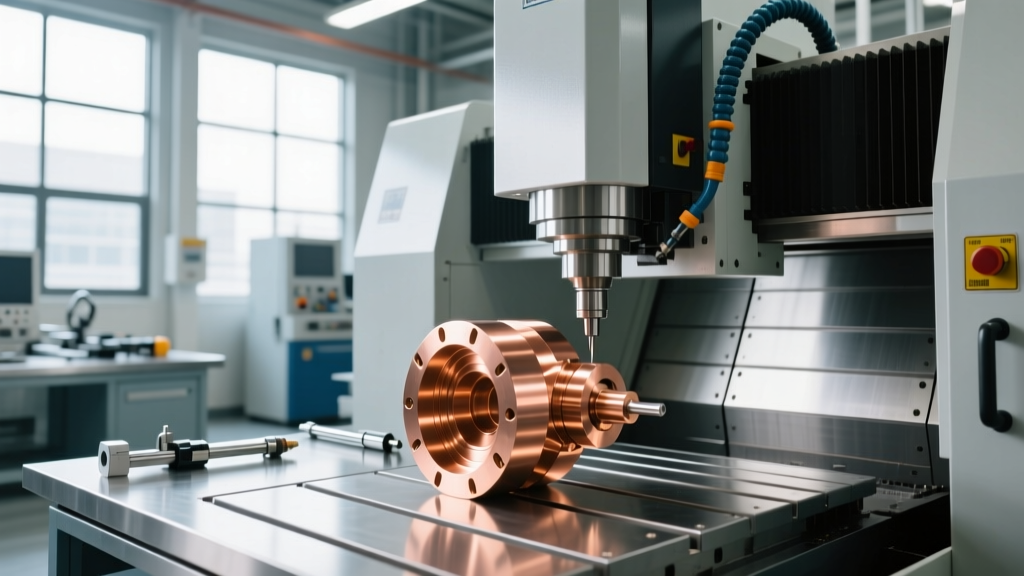
While C101 and C110 offer superior purity and electrical conductivity, their gummy nature makes them notoriously difficult to machine, often resulting in severe tool wear and poor surface finishes. C145 (Tellurium Copper) is the preferred choice for complex CNC milled or turned medical components. The addition of tellurium (0.4% - 0.7%) creates chip-breaking inclusions that allow for high-speed machining without sacrificing the antimicrobial and conductive properties required for medical use.
Overcoming Machining Defects: Galling and Work Hardening
Pure copper alloys (C101/C110) have a high affinity for tool materials, leading to Built-Up Edge (BUE). As copper welds to the cutting edge, it alters the tool geometry, causing catastrophic surface finish degradation and dimensional inaccuracy. According to guidelines published by the Copper Development Association, managing heat and friction is the primary defense against BUE.
Tooling Geometries and Coatings
Standard TiN or TiAlN coatings often fail when machining pure copper due to chemical reactivity and friction. For medical-grade C101 and C110, specify uncoated polished carbide or ZrN (Zirconium Nitride) coated tooling. ZrN provides a highly lubricious surface that prevents copper adhesion.
- End Mills: Use 2-flute or 3-flute solid carbide end mills with a high positive rake angle (15° to 20°) and a polished flute surface to ensure efficient chip evacuation.
- Drills: 135-degree split-point geometry is mandatory to prevent the drill from "walking" and to reduce the thrust force that causes work hardening in pure copper.
- Inserts for Turning: Use sharp, uncoated CVD diamond or polished PCD (Polycrystalline Diamond) inserts with a clearance angle of at least 7°.
Speed and Feed Matrices
Running copper too slowly allows heat to transfer into the tool, accelerating BUE. Running it too fast without adequate coolant causes thermal expansion, ruining tight medical tolerances (often ±0.0002 inches for surgical instruments).
Pro-Tip: Peck Drilling in C101When drilling deep holes in C101 OFHC copper for fluidic medical manifolds, use a high-feed peck drilling cycle (G83). Retract the tool completely after every 0.5x diameter depth to clear the stringy chips. Failure to do so will result in chip packing, tool breakage, and scrapped parts that can cost upwards of $150 per blank.
Biocompatibility and Coolant Contamination Risks
One of the most critical, yet frequently overlooked, compliance hazards in copper CNC machining for medical devices is cutting fluid contamination. Medical components must pass ISO 10993 biocompatibility testing, which evaluates cytotoxicity, sensitization, and irritation.
CRITICAL WARNING: Sulfur-Based CoolantsNever use extreme pressure (EP) coolants containing active sulfur or chlorine when machining medical-grade copper. Sulfur reacts chemically with copper to form copper sulfide, causing irreversible black staining. More importantly, residual sulfur compounds on the part surface will cause false failures during ISO 10993 cytotoxicity lab testing. Always use synthetic, sulfur-free, semi-transparent coolants maintained at a pH of 9.0 to 9.5.
Post-machining cleaning is equally regulated. Ultrasonic cleaning in a multi-stage aqueous wash line (typically utilizing alkaline detergents followed by DI water rinses) is required to remove all microscopic coolant residues before the parts move to cleanroom packaging.
Surface Finish and Micro-Burr Elimination
In medical device manufacturing, a micro-burr is not just a cosmetic defect; it is a biological hazard. Burrs on copper surgical instruments or implantable components can harbor bacteria, resist sterilization protocols (like EtO gas or autoclaving), and break off inside the patient's body.
Standard CNC machining of C110 or C145 will inevitably leave micro-burrs on intersecting holes and sharp internal corners. To meet FDA safety standards, shops must employ secondary deburring processes:
- Abrasive Flow Machining (AFM): Ideal for internal fluidic pathways in copper manifolds. A viscoelastic polymer embedded with silicon carbide grit is extruded through the part, polishing internal bores to an Ra < 0.2 µm finish.
- Electropolishing: Removes the amorphous, smeared surface layer left by CNC cutting tools, exposing the pure, crystalline copper structure. This significantly enhances the material's natural antimicrobial efficacy.
- Cryogenic Deburring: Parts are tumbled in liquid nitrogen, making the copper micro-burrs brittle, followed by media blasting. This is highly effective for external geometries on C145 Tellurium copper parts.
Cost Drivers and Lead Time Realities
Procurement managers and design engineers must understand that medical copper CNC machining commands a premium. Expect medical-grade copper parts to cost 40% to 65% more than identical geometries machined for industrial or consumer electronics applications.
Where the Costs Accumulate:
- Material Certification: Sourcing C101 or C145 with full lot traceability and certified MTRs adds 15-20% to raw material costs.
- In-Process Inspection: 100% CMM (Coordinate Measuring Machine) inspection of critical dimensions, rather than statistical sampling, doubles the QA labor time.
- Cleanroom Packaging: Medical copper parts must be vacuum-sealed in anti-static, lint-free polyethylene bags inside an ISO Class 7 or Class 8 cleanroom to prevent oxidation and particulate contamination prior to final sterilization.
- Tooling Attrition: The accelerated wear on polished carbide tooling when machining pure copper alloys increases the consumable tooling cost per part by approximately $0.40 to $1.20, depending on cycle times.
By designing for manufacturability—such as specifying C145 over C101 where electrical conductivity requirements allow, avoiding deep, small-diameter blind holes, and ensuring all internal corners have accessible radii—engineers can significantly reduce the CNC machining costs while maintaining strict compliance with FDA and ISO medical safety standards.