Learn CNC Machining for Automotive Aftermarket Parts
Master how to learn CNC machining for automotive aftermarket parts via real case studies, 5-axis toolpaths, and billet aluminum material specs.
Beyond G-Code: The Aftermarket Performance Standard
Transitioning from basic prismatic milling to the high-stakes, complex geometry of the automotive aftermarket is the ultimate crucible for those looking to learn CNC machining. The specialty equipment market demands extreme precision, aggressive lightweighting, and rapid design iteration. According to data from the Specialty Equipment Market Association (SEMA), the performance aftermarket sector continues to drive intense demand for billet aluminum, titanium, and Inconel components, pushing contract machine shops to adopt 5-axis simultaneous machining and advanced CAM strategies.
2026 Shop Economics Snapshot: High-performance aftermarket machine shops currently average $115 to $165 per hour for 5-axis mill-turn operations. Premium shops specializing in tight-tolerance motorsport components (e.g., Formula Drift or Pikes Peak builds) command upwards of $185 per hour due to the engineering overhead required for fixturing and CAM simulation.Case Study 1: Billet 6061-T6 Intake Manifolds
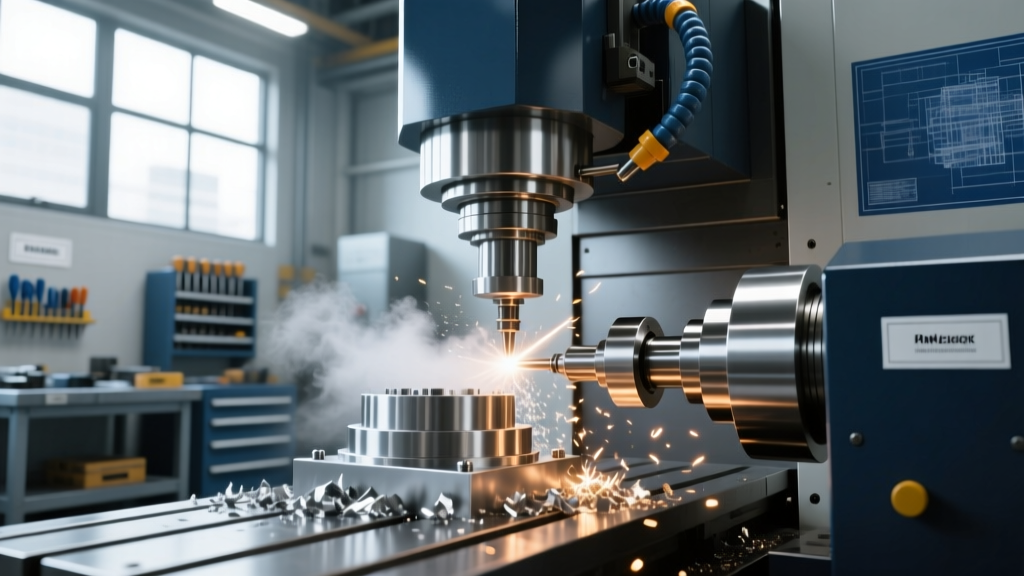
Intake manifolds represent a classic challenge for machinists. The objective is to maximize airflow through smooth internal runners while maintaining structural integrity on thin external walls, often dropping to just 3.5mm thickness. When you learn CNC machining for this specific application, managing harmonic chatter is the primary hurdle.
Standard 3-flute carbide end mills will deflect and chatter on the thin walls of a 6061-T6 billet manifold, leaving a poor surface finish and risking wall fracture. The industry standard solution is utilizing variable helix, variable pitch end mills, such as the Helical Solutions 40305 or Harvey Tool 50308. These tools disrupt the harmonic frequency of the cut, effectively eliminating chatter even at high radial engagements.
Optimized Cutting Parameters for Thin-Wall Billet Aluminum
| Operation | Tooling | Spindle Speed (RPM) | Feed Rate (IPM) | Depth of Cut (Axial/Radial) |
|---|---|---|---|---|
| Roughing (Adaptive) | 1/2' 3-Flute Carbide | 10,500 | 135 | 0.750' / 0.300' |
| Semi-Finish Runners | 3/8' Ball Nose (Long Reach) | 14,000 | 85 | 0.015' Stepover |
| Finish Thin Walls | 1/4' Variable Helix | 16,000 | 45 | 0.400' / 0.005' |
Notice the finishing pass utilizes a high spindle speed with an extremely light radial engagement (0.005 inches). This minimizes lateral cutting forces, preventing the thin walls from vibrating or pushing away from the cutter.
Case Study 2: 7075-T6 Aluminum Suspension Uprights
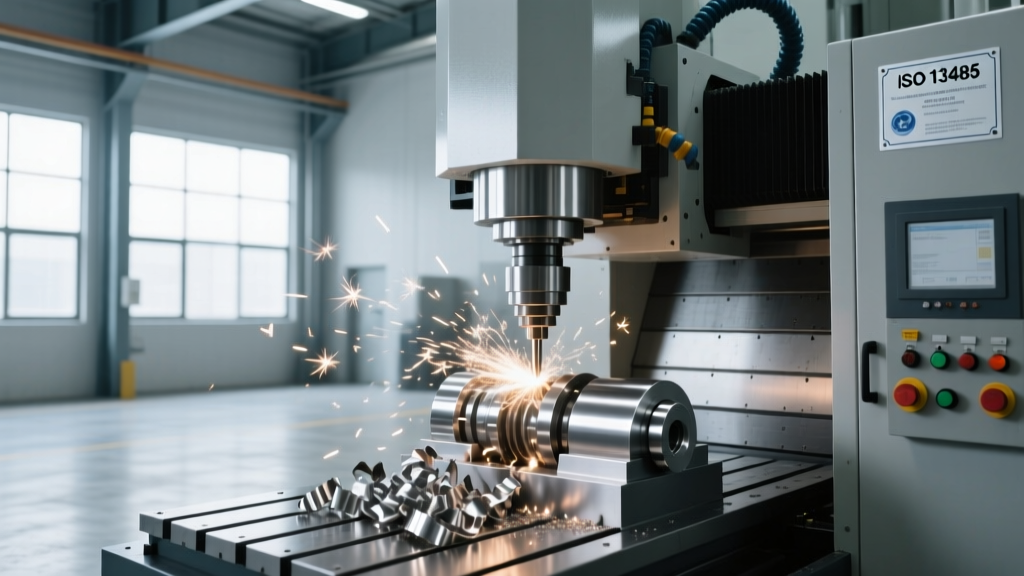
Motorsport and high-performance street vehicles require suspension uprights that withstand massive cornering and braking loads. While 6061-T6 is highly machinable, 7075-T6 offers a tensile strength of 83,000 PSI, making it the mandatory choice for uprights, steering knuckles, and control arms. However, 7075-T6 is notoriously abrasive and prone to built-up edge (BUE) on cutting tools if not managed correctly.
Expert Insight: 'When machining 7075-T6 for structural automotive components, flood coolant is non-negotiable. We run Trim MicroSol 585XT semi-synthetic coolant at 300 PSI through the spindle. This not only prevents BUE on the cutter but flushes the abrasive chips from deep pockets, preventing recutting and premature tool wear.' — Lead Manufacturing Engineer, Apex Motorsport Fabrication
5-Axis Fixture Design and Tolerancing
Learning CNC machining at an advanced level requires mastering workholding. Suspension uprights feature complex compound angles for ball joint tapers and bearing bores. Machining these on a 3-axis VMC requires multiple setups, introducing cumulative error. Shops utilizing 5-axis machines, like the Haas UMC-750, can machine the upright in a single clamping using a custom hydraulic tombstone.
The wheel bearing bore must be held to a strict tolerance of +/- 0.0002 inches to ensure proper bearing preload. To achieve this, the final boring operation is performed using a Sandvik Coromant CoroBore precision boring head, taking a final skim cut of 0.001 inches at a slow feed rate to guarantee size and surface finish without inducing thermal expansion.
Material Selection Matrix for Aftermarket Components
Choosing the correct alloy is critical for component longevity and machinability. Below is a decision matrix used by performance engineering firms in 2026.
| Material Grade | Primary Application | Machinability Rating | Approx. Raw Material Cost (per lb) |
|---|---|---|---|
| 6061-T6 Aluminum | Intake Manifolds, Valve Covers, Brackets | Excellent (200%) | $3.50 - $4.20 |
| 7075-T6 Aluminum | Uprights, Hubs, Steering Knuckles | Good (120%) | $5.80 - $6.90 |
| 4130 Chromoly Steel | Roll Cages, Suspension Links, Axles | Fair (65%) | $2.10 - $2.80 |
| Grade 5 Titanium (Ti-6Al-4V) | Valves, Connecting Rods, Fasteners | Poor (25%) | $28.00 - $35.00 |
Common Failure Modes in Aftermarket Machining
As you learn CNC machining for high-performance applications, you must anticipate how parts fail during the manufacturing process. According to technical analyses published in Modern Machine Shop, identifying these failure modes early in the CAM programming phase saves thousands of dollars in scrapped billet.
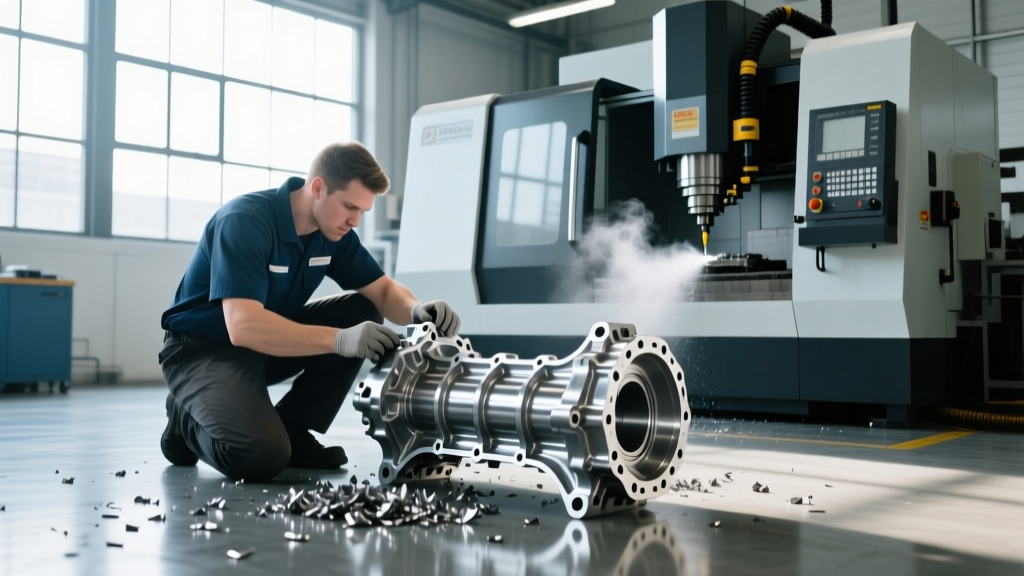
- Thin-Wall Deformation (Springback): When machining deep pockets in transmission cases, the material can flex away from the cutter and spring back, resulting in undersized walls. Solution: Use trochoidal milling (Adaptive Clearing) to maintain constant tool engagement and leave 0.020' of stock for a final spring-pass.
- Thread Stripping in Soft Alloys: Tapping deep holes in 6061-T6 for high-torque applications often results in weak threads. Solution: Abandon standard taps. Use thread milling with a solid carbide multi-form thread mill. This allows the machinist to adjust the minor diameter via CAM offset to achieve a tighter 75% thread engagement without breaking the tool.
- Residual Stress Warping: Removing 80% of the material from a thick block of 7075-T6 releases internal stresses, causing the part to twist like a potato chip once unclamped. Solution: Source stress-relieved billet (T651 temper) and employ a rough/heat-treat/finish machining sequence, or use cryogenic treatment between roughing and finishing passes.
CAM Software and Simulation Realities
Mastering the physical machine is only half the battle; advanced aftermarket machining requires elite CAM proficiency. While Mastercam remains the industry heavyweight for complex 5-axis simultaneous toolpaths, Autodesk Fusion has gained significant ground in 2026 among smaller boutique aftermarket shops due to its integrated CAD/CAM workflow and cloud-based rendering.
Regardless of the software, machine simulation is mandatory. Before cutting a $4,000 block of titanium for a billet crankshaft, the G-code must be run through a kinematic simulator like VERICUT or the native machine simulation in the CAM software. This verifies that the machine's rotary axes (A and C) will not exceed their travel limits and that the tool holder will not collide with the hydraulic clamps during a 5-axis plunge. Learning CNC machining at the professional level means trusting the simulation as much as the spindle.