ISO 9001 vs AS9100 Standards for CNC Machining Production
Compare ISO 9001 and AS9100 quality certifications for CNC machining production. Learn technical specs, audit requirements, and shop compliance.
Quality management in CNC machining production is not a monolithic concept; it is a highly stratified system of risk mitigation, metrological verification, and process control. When OEMs evaluate contract machine shops, the distinction between an ISO 9001:2015-certified facility and an AS9100 Rev D-certified facility dictates everything from acceptable scrap rates to the specific calibration intervals of shop-floor micrometers. While ISO 9001:2015 establishes a baseline for general quality management systems (QMS), the aerospace and defense sectors require the rigorous, statistically driven framework of AS9100 to govern high-stakes CNC machining production.
The Architecture of AS9100 Rev D in CNC Machining Production
AS9100 Rev D is not a standalone standard; it is a superset that incorporates the entirety of ISO 9001:2015 while adding over 100 specific requirements tailored to aerospace, space, and defense manufacturing. In the context of CNC machining production, these additions fundamentally alter how a shop plans, executes, and verifies material removal processes.
The most critical divergence lies in Clause 8.1.1 (Operational Risk Management) and Clause 8.1.2 (Prevention of Counterfeit Parts). In a standard ISO 9001 machine shop, material procurement might rely on approved vendor lists. Under AS9100, the shop must implement physical and digital traceability protocols to ensure that aerospace-grade alloys (like Ti-6Al-4V or Inconel 718) are accompanied by certified mill test reports (MTRs) that trace the heat lot back to the original melt. If a CNC shop machines a critical flight-control actuator from a counterfeit or misidentified billet, the catastrophic failure liability falls on the supply chain. AS9100 mandates a documented, auditable chain of custody from raw stock to finished part.
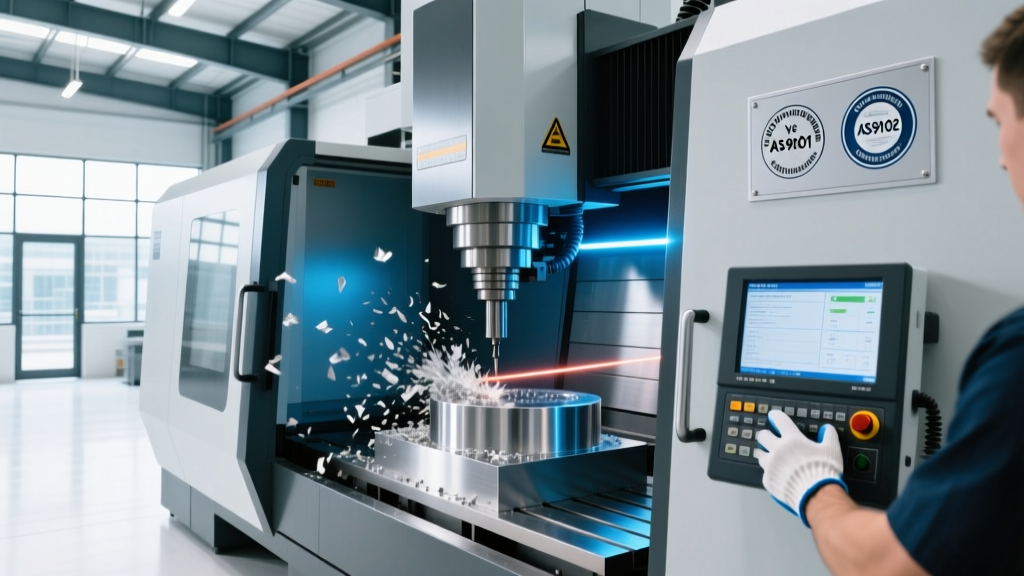
⚠️ Critical Edge Case: Clause 8.5.1.1 (Production Process Verification)Often referred to as First Article Inspection (FAI), this clause requires that the very first part produced from a new CNC program, or after a machine has been relocated or significantly repaired, undergoes a 100% dimensional inspection per AS9102. This is not a simple spot-check. It requires ballooning the engineering drawing and verifying every single GD&T callout, surface finish, and material spec before the production run can commence. Failing to quarantine and FAI the first piece is an automatic major non-conformance during an IAQG audit.
Metrology and Inspection: The Shop Floor Reality
Certifications are only as robust as the metrology equipment used to enforce them. In high-precision CNC machining production, the QMS dictates the exact measurement systems and their acceptable margins of error. Under AS9100, shops must perform rigorous Measurement System Analysis (MSA), specifically Gage Repeatability and Reproducibility (Gage R&R) studies.
- ISO 9001 Environment: A shop might use manual calibration of handheld tools (calipers, micrometers) with a standard 10:1 test accuracy ratio (TAR). CMM (Coordinate Measuring Machine) usage is optional and often reserved for final inspection.
- AS9100 Environment: Gage R&R studies must prove that the measurement system's variation is less than 10% of the part's tolerance band. For a CNC machined aerospace bracket with a positional tolerance of ±0.0005", manual tools are insufficient. The shop must utilize a temperature-controlled CMM (e.g., Hexagon Global S or Zeiss CONTURA) housed in a room maintained at 68°F ± 1°F (20°C ± 0.5°C) to prevent thermal expansion of the aluminum or steel workpiece from skewing the data.
Furthermore, AS9100 demands strict adherence to ASME Y14.5 GD&T standards. CNC programmers and quality inspectors must be formally certified in interpreting datum reference frames, true position callouts, and maximum material condition (MMC) modifiers to ensure the 5-axis toolpaths align perfectly with the inspection software (such as PC-DMIS or Polyworks).
Comparative Matrix: ISO 9001 vs. AS9100 for Machine Shops
| Feature | ISO 9001:2015 | AS9100 Rev D |
|---|---|---|
| Primary Scope | General manufacturing, commercial goods, automotive tier 2/3. | Aerospace, space, defense, and critical medical CNC components. |
| Risk Management | High-level organizational risk (Clause 6.1). | Granular operational and product-level FMEA (Clause 8.1.1). |
| Traceability | Required only where specified by the customer. | Mandatory full lot/heat traceability for all raw materials. |
| Audit Duration (50-employee shop) | 4 to 6 days (Initial). | 8 to 12 days (Initial), heavily focused on shop floor execution. |
| Key Metric Tracking | Customer satisfaction, general defect rates. | OEARs: On-Time Delivery (OTD), Quality (PPM), and escapes. |
The Financial and Operational Reality of Certification
Transitioning a CNC machine shop from an uncertified state to AS9100 compliance is a capital-intensive operational overhaul. It is not merely a paperwork exercise; it requires fundamental changes to shop floor routing, ERP integration, and personnel training.
Hard Costs and Timelines
For a mid-sized contract machining facility (30-50 employees, 15-25 CNC mills/lathes), the financial commitment breaks down as follows:
- QMS Software Implementation: $12,000 – $25,000 annually for platforms like MasterControl, ETQ Reliance, or Plex ERP to manage digital traveler routing, non-conformance reports (NCRs), and corrective actions (CAPA).
- Consulting and Gap Analysis: $8,000 – $15,000 to hire an aerospace quality consultant to map existing workflows to AS9100 clauses.
- Registrar Audit Fees: $22,000 – $38,000 for the initial Stage 1 and Stage 2 certification audits, assuming an auditor day-rate of $1,400 – $1,800 plus travel expenses.
- Annual Surveillance: $9,000 – $14,000 per year to maintain the certificate.
The timeline from project kickoff to certificate issuance typically spans 9 to 14 months. This includes a mandatory 3-month period where the new QMS is fully operational and generating historical data (such as internal audit reports and management review minutes) before the registrar will conduct the Stage 2 audit.
Decision Framework: Sourcing CNC Machining Production
For procurement engineers and supply chain managers, selecting the right certification tier prevents both over-spending and catastrophic supply chain failures. Use this framework to align your sourcing strategy with the correct QMS standard:
If-Then Sourcing Logic
- IF the component is a commercial enclosure, non-structural bracket, or general automation fixture with tolerances looser than ±0.005" THEN an ISO 9001 machine shop is sufficient. You avoid paying the overhead premium of aerospace compliance.
- IF the component is a flight-critical structural member, a high-pressure hydraulic valve body, or a satellite deployment mechanism requiring AS9102 FAI and material traceability THEN you must strictly mandate AS9100 Rev D. Verify their OEAR (On-Time Delivery and Quality) scores on the OASIS database before issuing an RFQ.
- IF the component is an automotive powertrain or steering part THEN look for IATF 16949, which bridges the gap between ISO 9001 and AS9100, focusing heavily on statistical process control (SPC) and high-volume production part approval processes (PPAP).
Navigating the Modern Audit Landscape
As of the mid-2020s, the auditing landscape for CNC machining production has shifted heavily toward digital verification. Registrars now expect machine shops to utilize paperless manufacturing execution systems (MES). Auditors will frequently ask to see a digital audit trail on a shop-floor tablet, tracing a specific serialized part back to the exact CNC program revision, the operator's training matrix, and the CMM inspection file generated by the probing cycle.
Furthermore, recent amendments to ISO management system standards have introduced requirements regarding climate action and environmental risk. Forward-thinking CNC shops are integrating coolant recycling metrics, swarf briquetting data, and energy consumption per spindle-hour directly into their QMS management reviews. Understanding these nuanced, evolving requirements separates elite CNC machining production partners from commodity job shops that merely treat certifications as a marketing badge.