Budgeting High-Volume CNC Machining for Consumer Products
Master cost analysis and budget planning for high-volume CNC machining for consumer products. Learn strategies to reduce per-part costs at scale.
The Economics of Scaling Consumer Hardware
Transitioning a consumer product—such as smart home enclosures, high-end audio components, or drone chassis—from a 500-unit pilot run to a 50,000-unit production cycle requires a complete teardown of your cost architecture. In prototyping, machine time is a secondary concern to design flexibility. In high-volume production, a 4-second reduction in cycle time or a 2% improvement in material yield dictates whether the product achieves target gross margins. As of 2026, with fully-burdened machine shop rates averaging $85 to $165 per hour depending on axis complexity, precision budget planning for advanced CNC machining strategies is non-negotiable for hardware startups and established consumer brands alike.
Cost Distribution Shift: Prototype vs. Mass Production
The most common budgeting error in consumer electronics and hardware is applying prototype cost multipliers to production volumes. Setup amortization behaves inversely to volume, while raw material and spindle time become the dominant cost drivers.
| Cost Factor | 1,000 Units (% of Total) | 50,000 Units (% of Total) | Strategic Action at Scale |
|---|---|---|---|
| Setup & Programming | 38% | 4% | Invest in custom hydraulic tombstones and macro-programming. |
| Machine & Spindle Time | 32% | 54% | Transition from 3-axis VMC to 4-axis HMC with pallet pools. |
| Raw Material | 18% | 29% | Negotiate mill-direct extrusion feeds; optimize nesting. |
| Secondary Finishing | 12% | 13% | Design for "as-machined" cosmetics; eliminate manual deburring. |
Equipment Architecture: Selecting the Right Spindle for the Part
High-volume consumer goods typically fall into two categories: small, complex geometries (e.g., smartwatch cases, wearable hinges) and mid-sized structural components (e.g., e-bike motor housings, camera gimbals). Matching the machine architecture to the part envelope is the first lever for cost reduction.
Vertical Machining Centers (VMC) for Small Footprints
For consumer parts under 150mm in length, high-speed VMCs with integrated pallet changers dominate. The Brother Speedio S140X2 is an industry standard here. With a 14,000 RPM spindle, 0.9-second chip-to-chip tool changes, and simultaneous Z-axis tool changes during table indexing, it shaves 15-22% off cycle times compared to standard 10,000 RPM VMCs. Budgeting for a high-speed VMC cell typically requires $95-$115 per hour, but the sheer volume of parts per shift offsets the premium rate.
Horizontal Machining Centers (HMC) for Multi-Side Milling
When a consumer product requires machining on 4 or 5 sides—such as a bicycle suspension linkage—re-fixturing on a VMC introduces unacceptable cycle penalties and tolerance stack-up. The Makino a61nx (or similar 4-axis HMC) utilizes a tombstone setup, allowing the machine to access multiple parts and multiple faces in a single cycle. While HMC rates run $135-$165 per hour, the elimination of secondary setups and the ability to run lights-out with 60+ pallet pools drastically lowers the per-part cost at volumes above 10,000 units. Leveraging resources from the NIST Manufacturing Extension Partnership can help mid-sized brands identify regional contract manufacturers equipped with these automated HMC cells.
The Secondary Operation Trap
Consumer products demand flawless aesthetics. A $4.00 CNC machined aluminum enclosure can easily accrue $3.50 in secondary costs if not designed for manufacturing. Manual deburring of internal intersecting holes, bead blasting, and Type II anodizing require massive labor and logistics overhead. Budget Rule: Mandate a minimum 1.5mm corner radius on all internal pockets to match standard end mill profiles, and design through-holes instead of blind holes wherever possible to allow for automated thermal deburring or abrasive flow machining.
Tooling and Material Yield Strategies
At 50,000 units, tooling wear and material scrap become primary margin killers. Standard carbide end mills are insufficient for high-volume aluminum milling.
- Polycrystalline Diamond (PCD) Tooling: For 6061-T6 and 7075-T6 aluminum consumer enclosures, PCD-tipped end mills allow surface speeds exceeding 3,500 SFM. A $450 PCD tool will outlast twenty $45 carbide tools, maintaining tight surface finishes (Ra 0.8 μm) without the need for secondary polishing.
- Custom Extrusion Profiles: If your consumer product has a consistent cross-section (e.g., a smart speaker housing or a linear actuator track), do not mill it from solid plate. Budget $8,000–$15,000 for a custom aluminum extrusion die. Feeding near-net-shape extrusions into a bar-fed mill-turn center reduces raw material waste from 45% down to 8%, paying for the die tooling by unit 4,000.
- Through-Tool Coolant: When deep-hole drilling for consumer fastener points, use high-pressure through-spindle coolant (70 bar+) with specialized drills like the Sandvik CoroDrill 860. This prevents chip packing and eliminates the need for peck drilling cycles, reducing hole-making time by up to 60%.
The Volume Crossover: CNC vs. High-Pressure Die Casting (HPDC)
CNC machining offers unparalleled precision and zero tooling lead time, but it has a mathematical ceiling in consumer goods manufacturing. Budget planners must know exactly when to pivot from subtractive manufacturing to High-Pressure Die Casting (HPDC) or Metal Injection Molding (MIM).
Decision Framework: When to Abandon CNC
Use this framework to calculate your specific crossover point based on 2026 average tooling and cycle costs:
- Calculate Fully Burdened CNC Cost: (Material + Machine Time + Secondary Finishing) per unit. Example: $18.50.
- Estimate HPDC Tooling: A 4-cavity P20 steel die for a mid-sized consumer housing costs $45,000 to $75,000 and requires 12-16 weeks to build.
- Estimate HPDC Piece Price: Cast part + CNC secondary machining (for critical tolerance bores/faces) + finishing. Example: $6.20.
- Calculate Crossover: Tooling Cost / (CNC Cost - HPDC Cost). In this scenario: $60,000 / ($18.50 - $6.20) = 4,878 units.
If your forecasted lifecycle volume exceeds 15,000 units and the geometry allows for draft angles and uniform wall thicknesses, CNC is the wrong budget allocation for production. Reserve CNC for the bridge tooling phase (0-5,000 units) while the HPDC tooling is being manufactured.
Labor, Automation, and Lights-Out ROI
The most volatile variable in the 2026 manufacturing budget is skilled labor. High-volume CNC production must be decoupled from human intervention to maintain predictable margins. Budgeting for automation is no longer a luxury; it is a baseline requirement for consumer goods scaling.
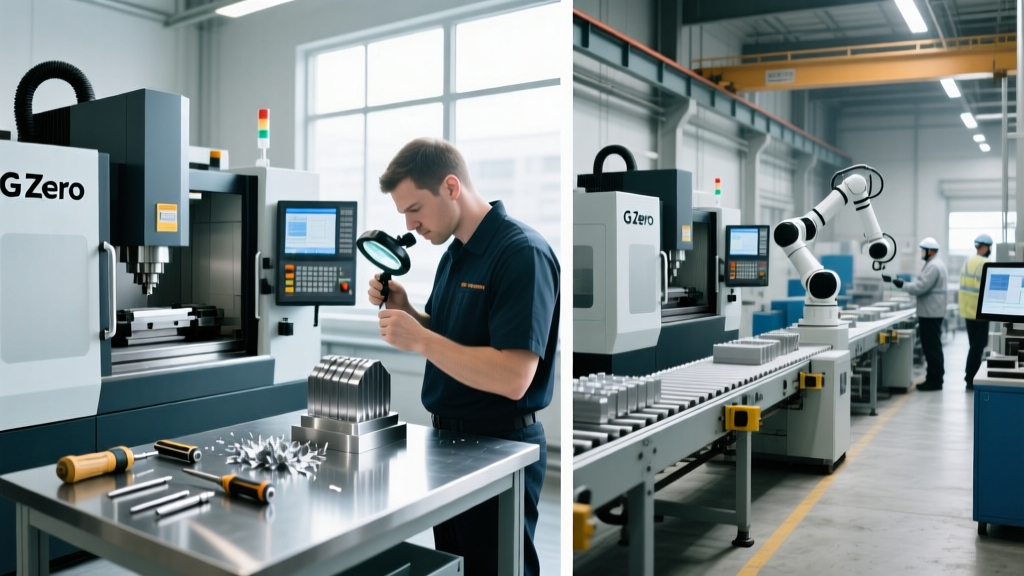
Implementing a linear pallet pool system (such as a Fastems or Makino MMC2) adds $150,000 to $300,000 to the initial capital expenditure of a machine cell. However, this enables "lights-out" manufacturing. By loading raw material and tooling during the day shift, the spindle can run unattended for 12-16 hours overnight. This effectively doubles the machine's annual output without adding a second shift of operators, reducing the per-part labor allocation from $3.10 to under $0.85. When drafting your production budget, always request quotes from contract manufacturers that explicitly detail their automated pallet capacity and unattended runtime capabilities.