Aircraft CNC Machining: Prototyping vs Production Operator Guide
Master the transition from rapid prototyping to high-volume production in aircraft CNC machining with this operator training guide on tooling, setups, and QC.
The Core Divide: Prototyping vs. Production in Aerospace
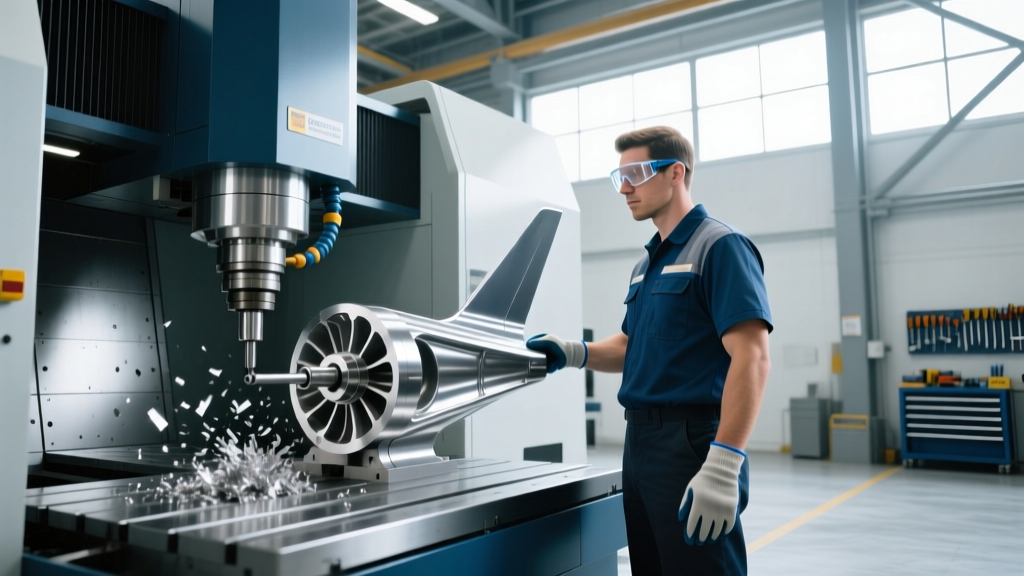
When transitioning a component from rapid prototyping to full-scale production in aircraft CNC machining, the operator's role fundamentally shifts from a design-validator to a process-guardian. In the prototype phase, the primary objective is geometric proof and material verification. Operators prioritize flexibility, utilizing 5-axis simultaneous machining on platforms like the Makino D500 to complete complex aerospace bulkheads in a single setup. Tolerances are held to print, but cycle time is a secondary concern.
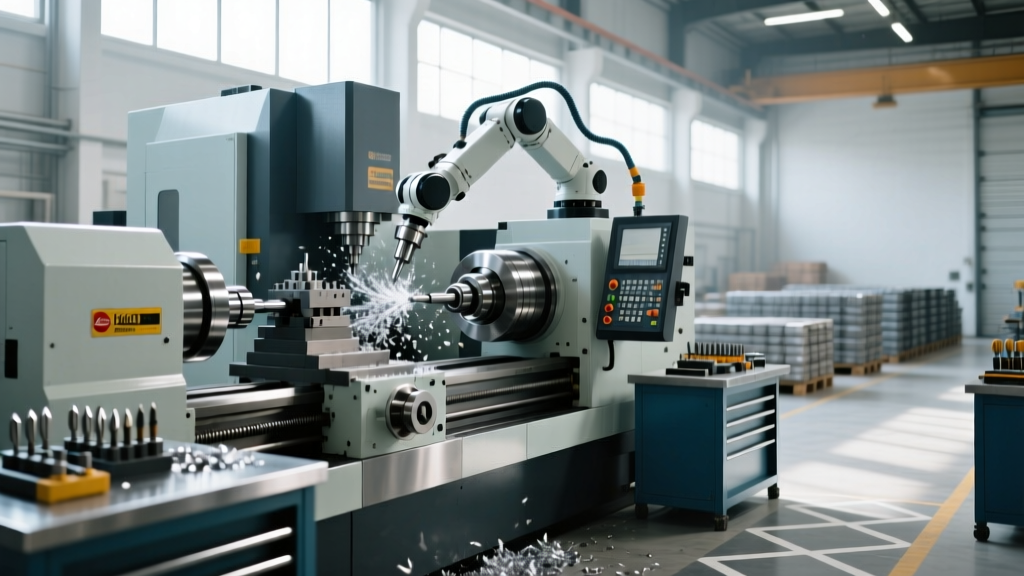
Production machining, however, demands absolute repeatability, minimized cycle times, and rigorous statistical process control (SPC). Running 10,000 aluminum 7075-T6 structural ribs on a horizontal machining center (HMC) like the Makino a61nx requires a completely different operator mindset. The focus moves to thermal stability, tool life predictability, and automated in-process probing. Understanding this dichotomy is the first step in advanced operator training for aerospace manufacturing.
Strategic Comparison Matrix
| Parameter | Rapid Prototyping (1-50 Parts) | Production Machining (500+ Parts) |
|---|---|---|
| Machine Architecture | 5-Axis VMC (Trunnion table) | 4-Axis/5-Axis HMC with Pallet Pool |
| Tooling Strategy | Standard carbide, versatile geometries | PVD/CVD coated, application-specific (e.g., Sandvik CoroMill) |
| Coolant Delivery | Standard flood / manual air blast | High-pressure through-tool (1000+ PSI) |
| Workholding | Modular vises, standard step clamps | Custom hydraulic/pneumatic tombstones |
| Inspection | Manual CMM, hand tools, optical comparators | Inline probing, automated CMM, SPC tracking (Cpk > 1.33) |
Toolpath Optimization and Tooling Realities
The CAM programming and tool selection strategies for aircraft CNC machining diverge sharply based on the production phase. During prototyping, CAM programmers often rely on adaptive clearing and trochoidal milling to navigate complex aerospace geometries without specialized tooling. Operators must be trained to monitor these dynamic toolpaths for chatter, as the varying radial engagement can induce harmonic vibrations in long-reach toolholders.
Prototyping: The Flexibility Mandate
For one-off titanium Ti-6Al-4V landing gear components, operators should utilize solid carbide end mills with variable helix angles to disrupt harmonics. A standard roughing strategy might run at 150 SFM and 0.004 IPT (inches per tooth). The operator's primary job here is to verify chip formation and ensure that the tool is not rubbing, which would work-harden the titanium and ruin the part before the finishing pass.
Production: The Rigidity Mandate
When scaling to production, variable toolpaths are replaced by highly predictable, constant-engagement toolpaths. According to Sandvik Coromant's aerospace machining guidelines, transitioning to indexable tooling with specialized aerospace grades (like GC1115 for titanium finishing) is mandatory for cost-per-part reduction. Operators must be trained to monitor spindle load meters rather than just listening for chatter. In a production environment, a 5% increase in spindle load indicates predictable flank wear, prompting a scheduled tool change before the part dimensions drift out of the ±0.0005-inch tolerance band.
The Operator's P2P (Prototype-to-Production) Shift Protocol
Training operators to manage the scale-up requires a formalized protocol. The P2P Shift Protocol ensures that the lessons learned on the shop floor during prototyping are systematically applied to the production line.
- Thermal Equilibrium Mapping: In prototyping, a machine might only run for four hours. In production, the HMC runs 24/7. Operators must execute a 45-minute thermal warm-up cycle (spindle and axis jogging) and map the machine's thermal growth using a Renishaw OMP60 spindle probe. Production setups must include automated thermal compensation offsets in the controller.
- Chip Evacuation Verification: Aerospace aluminum (7075-T6) produces long, stringy chips that can wrap around toolholders and scratch critical aerodynamic surfaces. Operators must transition from manual chip clearing to verifying high-pressure coolant nozzle alignment and conveyor timing. If chips are not evacuated within 3 seconds of generation, the production cycle will eventually fail due to recutting.
- Workholding Deflection Analysis: A modular vise used in prototyping applies uniform pressure. A custom hydraulic tombstone used in production applies localized clamping force. Operators must use dial indicators to measure part deflection upon clamping and unclamping, adjusting hydraulic pressure to the exact PSI required to hold the part without inducing post-machining springback.
- First-In-Process (FIP) Probing: Operators must program and verify touch-trigger probing routines that check raw stock dimensions before the first cut. This prevents a scrapped production run caused by a batch of forgings that are 0.020 inches undersized.
Metrology and In-Process Quality Control
The Federal Aviation Administration (FAA) mandates strict production approval processes, meaning quality control cannot be an afterthought relegated to a separate inspection room. In aircraft CNC machining, metrology must be integrated directly into the operator's workflow.
Expert Insight: 'Relying solely on post-process CMM inspection for high-volume aerospace production is a critical failure point. By the time a CMM flags a drifting bore diameter, 15 parts may have already been machined out of tolerance. Operators must utilize in-machine probing for critical datums and deploy shop-floor gauging systems like the Renishaw Equator for 100% inspection of high-risk features.'
Operators must be trained to interpret SPC charts. A Cpk (Process Capability Index) of 1.33 is the minimum acceptable standard for aerospace production. If an operator notices a trend line on the X-bar chart moving toward the upper control limit—even if the parts are still technically in tolerance—they must proactively adjust the tool wear offset before the control limit is breached.
Common Operator Pitfalls When Scaling Up
Even highly skilled prototype machinists can struggle when transitioning to production environments. Training programs must specifically target these common failure modes:
- Over-Inspection Paralysis: Prototype operators are used to stopping the machine every few minutes to check dimensions with micrometers. In production, this destroys cycle time and introduces thermal cooling errors. Operators must trust the in-process probing and only perform manual checks at the intervals dictated by the control plan (e.g., every 25th part).
- Ignoring Coolant Concentration: Prototyping often uses standard sump coolant. Production machining of Inconel 718 or titanium requires strict coolant concentration management (typically 8-10% for heavy aerospace alloys). Operators must use refractometers daily; a drop in concentration will lead to catastrophic tool failure and work-hardening of the part.
- Manual Override Abuse: In prototyping, operators frequently use feed and speed overrides to 'feel' the cut. In production, overriding the programmed feeds invalidates the validated CAM simulation and can alter the surface finish (Ra) beyond the aerospace specification. Overrides should be locked or strictly limited to ±5% during production runs.
Mastering the transition from rapid prototyping to production in aircraft CNC machining requires more than just reading a blueprint. It demands a fundamental shift in how operators interact with the machine, the tooling, and the metrology equipment. By implementing structured P2P protocols and leveraging advanced in-process inspection, machine shops can ensure that the part validated in prototyping is the exact part delivered on the production floor.
For further reading on advanced manufacturing standards and digital thread integration in aerospace, refer to the NIST Advanced Manufacturing guidelines, which outline the future of closed-loop machining and automated quality assurance.