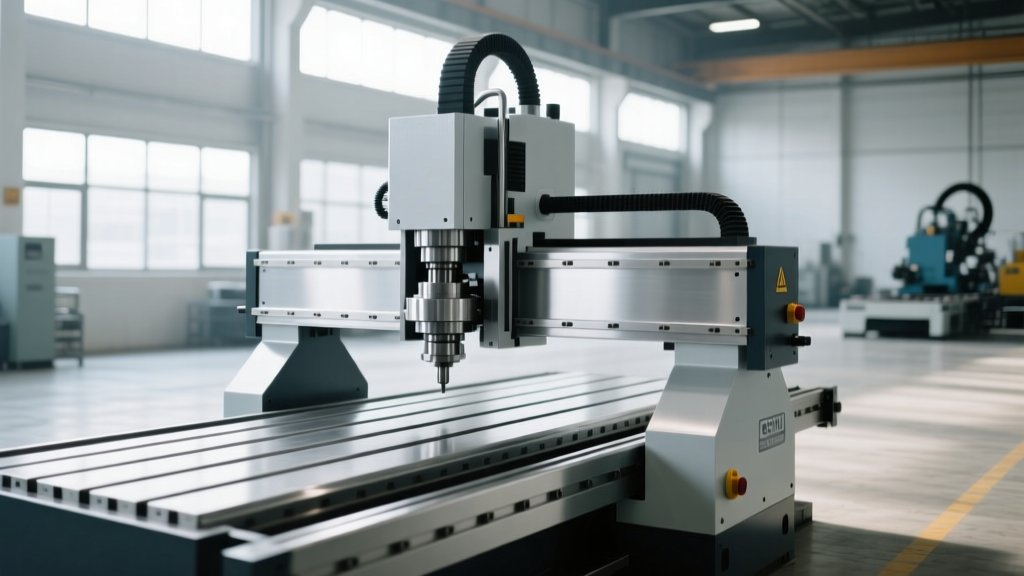
Preventative Maintenance Schedules for CNC Machine Routers
Maximize uptime and spindle life with detailed preventative maintenance schedules for industrial CNC machine routers. Includes daily and annual checklists.
The True Cost of Deferred Maintenance on Industrial CNC Machine Routers
Operating heavy-duty industrial CNC machine routers, such as the Biesse Rover KFT or SCM Accord 42, represents a massive capital investment. When a 5-axis router goes down unexpectedly, the cost is not just the replacement part; it is the $800 to $1,500 per hour in lost production, missed delivery deadlines, and scrapped aerospace or custom millwork materials. In 2026, with supply chain lead times for specialized spindle bearings and proprietary servo drives still fluctuating, reactive maintenance is a financial liability. Implementing a rigid, data-driven preventative maintenance (PM) schedule is the only way to protect your Overall Equipment Effectiveness (OEE).
⚠️ Critical Warning: The Hidden Toll of Taper NeglectOver 40% of premature spindle bearing failures in high-speed CNC machine routers are traced back to contaminated toolholders. A single 0.001 in. wood dust particle trapped between an HSK63F taper and the spindle nose creates radial runout. At 24,000 RPM, this microscopic imbalance acts like a hammer, brinelling the ceramic spindle bearings within weeks. Never use WD-40 or standard shop rags to clean tapers; use lint-free wipes and 99% isopropyl alcohol.
The Daily Operator Checklist (Shift Start & End)
Daily maintenance on CNC machine routers should be integrated into the operator's standard operating procedure (SOP). These tasks take less than 15 minutes but prevent the majority of catastrophic, unplanned downtime.
Shift Start Protocols
- Spindle & ATC Verification: Run a 5-minute spindle warm-up cycle starting at 6,000 RPM and stepping up to 18,000 RPM. Listen for high-frequency whining, which indicates low lubrication or bearing preload issues.
- Vacuum Pump Inspection: Most industrial routers utilize Becker U4.400 or Busch rotary vane pumps. Check the sight glass to ensure the oil level is between the MIN and MAX lines. If your system uses dry carbon vane pumps, verify the vacuum gauge reads a minimum of 22 inHg (0.75 bar) at idle.
- Linear Guide Wipe-Down: Wipe the exposed X and Y-axis linear rails. Wood dust mixed with way oil creates an abrasive paste that destroys wiper seals.
Shift End Protocols
- Toolholder Extraction: Never leave toolholders clamped in the spindle overnight. The constant tension fatigues the Belleville washer stack in the drawbar. Return all tools to the ATC magazine.
- Chiller System Check: Verify the spindle chiller (e.g., S&A or OptiTemp) is maintaining the setpoint, typically 20°C (68°F). A fluctuation of more than ±1°C causes thermal expansion in the spindle housing, ruining Z-axis depth accuracy.
Weekly & Monthly Preventative Service Intervals
While daily tasks focus on cleanliness and basic verification, weekly and monthly intervals require physical measurements, fluid top-offs, and filter replacements. Below is the standard PM matrix for industrial 3-axis and 5-axis CNC machine routers.
| Interval | Component | Action Required | Specification / Material |
|---|---|---|---|
| Weekly | Way Lube System | Check reservoir level; manually trigger lube cycle to verify pressure gauge spikes to 15-20 PSI. | Mobil Vactra #2 (ISO 68) |
| Weekly | Vacuum Pods & Spoilboard | Clear micro-chips from pod seals; skim spoilboard if vacuum hold-down drops below 18 inHg. | 1/8 in. skim cut maximum |
| Monthly | Control Cabinet Filters | Remove and wash or replace intake filters on the electrical enclosure to prevent servo drive overheating. | Rittal or Hoffman replacement pads |
| Monthly | ATC Magazine Cams | Inspect the swing-arm cam followers for flat spots; apply a thin layer of lithium-based grease. | Kluber Isoflex NBU 15 |
| Monthly | Z-Axis Brake Test | With the Z-axis at mid-stroke, E-stop the machine. Measure drift. Any movement > 0.010 in. indicates brake failure. | Dial indicator measurement |
Bi-Annual & Annual Deep Service Schedules
Annual maintenance on CNC machine routers transitions from operator-level tasks to certified technician interventions. This is where you verify the mechanical integrity of the machine's core drive systems.
Spindle Drawbar Force & Runout Testing
The drawbar mechanism relies on a stack of Belleville (disc) washers to generate the clamping force necessary to keep the toolholder seated. Over thousands of tool changes, these washers fatigue and lose their spring rate. An HSK63F spindle requires a minimum drawbar force of 18 to 22 kN (kilonewtons), while an ISO30 taper requires 8 to 12 kN. If a force gauge reads below these thresholds, the entire Belleville stack must be replaced immediately to prevent a tool-pullout crash. Furthermore, annual runout testing using a precision test arbor and a 0.0001 in. dial indicator must confirm that radial runout at the tool tip does not exceed 0.0005 in. For deeper technical specifications on spindle bearing tolerances and preload adjustments, refer to the SKF Machine Tool Spindle engineering guidelines.
Ball Screw Preload & Linear Guide Re-greasing
Industrial CNC machine routers utilize precision ground ball screws (typically C3 or C5 accuracy grades) to translate servo motor rotation into linear motion. Over time, the grease inside the ball nut degrades and becomes contaminated with fine particulate. Annual maintenance requires purging the old grease and injecting fresh, high-speed synthetic grease directly into the zerk fittings until clean grease purges from the wiper seals. According to the THK Ball Screw Maintenance protocols, using the wrong viscosity grease can cause the recirculation tubes to clog, leading to catastrophic ball screw seizure. Additionally, technicians must check the end-fix bearing preload using a torque wrench to ensure zero axial backlash.
"In modern CNC routing environments, the integration of IoT vibration sensors on spindle housings and ball screw bearings allows facilities to transition from calendar-based maintenance to predictive maintenance. However, the physical lubrication and mechanical verification schedules remain non-negotiable baselines for machine longevity." — Society of Manufacturing Engineers (SME), Advanced Machining Division
Troubleshooting Common Maintenance Failures
Even with strict adherence to PM schedules, components wear. Use this decision matrix to diagnose the most common mechanical failures encountered on industrial CNC machine routers.
Symptom: ATC Tool Drop During High-Speed Machining
- Root Cause 1: Low drawbar clamping force due to fatigued Belleville washers. Action: Measure force with a drawbar dynamometer; replace washer stack.
- Root Cause 2: Contaminated spindle taper causing false seating. Action: Clean taper with specialized HSK cleaning tool and isopropyl alcohol.
- Root Cause 3: Worn retention knob (pull stud) on the toolholder. Action: Inspect the retention knob neck for micro-fractures; replace all pull studs every 12 months.
Symptom: X/Y Axis Following Errors & Servo Alarms
- Root Cause 1: Way lube system failure causing dry rails. Action: Check the Bijur/Devco metering valves for clogs; verify pressure switch functionality.
- Root Cause 2: Ball screw end-fix bearing failure. Action: Check for axial play using a magnetic base dial indicator; replace angular contact bearings.
- Root Cause 3: Servo motor coupling slippage. Action: Inspect the Oldham or bellows coupling between the servo and the ball screw; re-torque clamp bolts to OEM specs.
Symptom: Loss of Vacuum Hold-Down on Nested Pods
- Root Cause 1: Worn carbon vanes in the dry rotary vane vacuum pump. Action: Remove the pump inspection cover and measure vane length. Replace if worn past the manufacturer's minimum threshold (usually 20mm).
- Root Cause 2: Clogged sintered bronze filters inside the vacuum pods. Action: Remove pod filters, blow out with compressed air from the inside out, or replace if saturated with MDF resin.
Sourcing Genuine Replacement Consumables
A critical mistake many shop managers make is substituting OEM-specified lubricants and filters with generic, off-the-shelf alternatives to save money. Using an incorrect way oil that lacks tackifiers will result in the oil slinging off the linear guides at high traverse speeds, leaving the rails unprotected. Sourcing certified CNC maintenance supplies from established industrial distributors like MSC Industrial Supply ensures you are receiving fluids and filters that meet the exact ISO and DIN standards required by your router's manufacturer. Protect your capital equipment by treating your maintenance schedule with the same rigor as your production schedule.
Related reading

How To Match Troubleshooting With Work: A CNC Router Operator’s Precision Protocol

Essential Textile Tools Checklist for CNC Router Operators: Precision, Safety, and Workflow Optimization