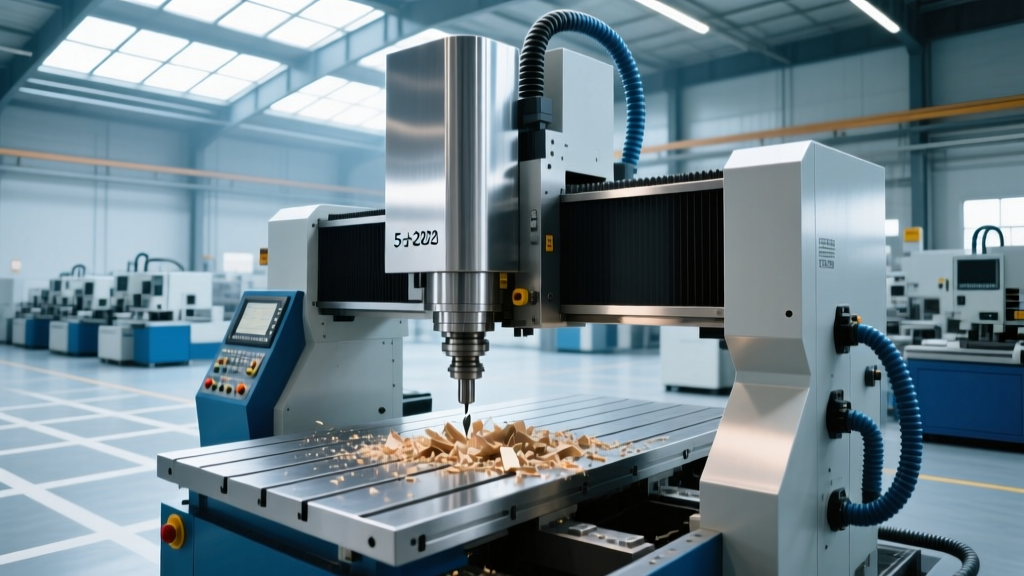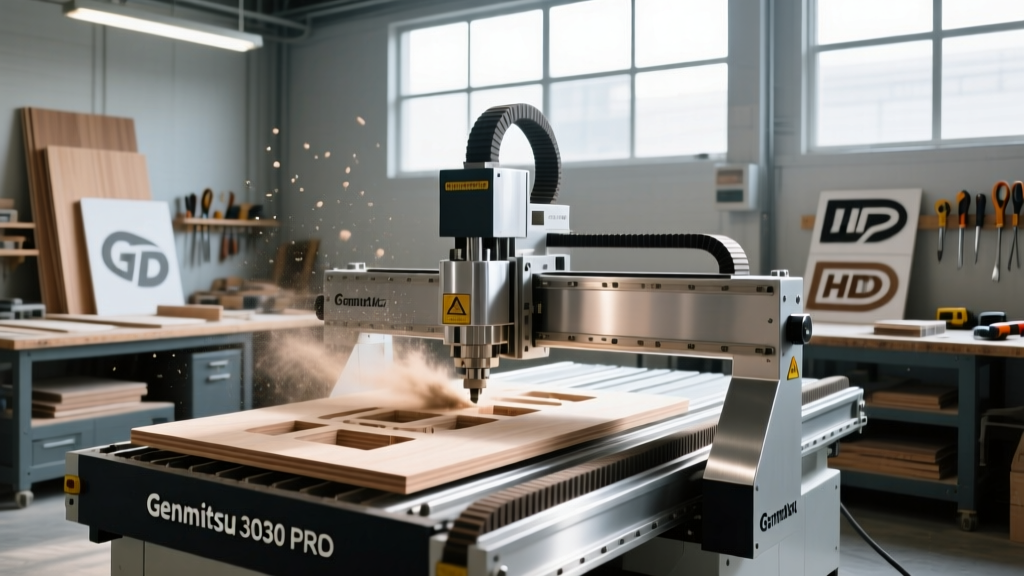
Genmitsu 3030 PROVer Max CNC Router: Sign Shop Case Study
Explore how a boutique shop uses the Genmitsu 3030 PROVer Max CNC router machine for HDU carving and wood pocketing, with real feeds, speeds, and ROI.
The Prosumer Shift in Boutique Signmaking
As of early 2026, the barrier to entry for custom architectural signage and boutique woodcraft has fundamentally shifted. Industrial flatbed routers costing upwards of $15,000 are no longer the sole gateway to high-margin custom work. The Genmitsu 3030 PROVer Max CNC router machine has emerged as a critical bridge for micro-manufacturers, offering a rigid aluminum chassis and NEMA 23 stepper motors at a sub-$500 price point. However, bridging the gap between hobbyist carving and commercial production requires more than just unboxing the machine; it demands rigorous workflow engineering, precise feeds and speeds, and strategic hardware modifications.
This case study examines a composite production model based on real-world Etsy and local sign shop operations utilizing the 3030 PROVer Max. We break down the exact toolpaths, material constraints, and economic realities of running a high-mix, low-volume sign business on a 300x300mm desktop format.
Machine Profile: Genmitsu 3030 PROVer Max
- Work Area: 300 x 300 x 90 mm (11.8 x 11.8 x 3.5 in)
- Frame Architecture: Anodized aluminum extrusion with linear rail guides on X/Y axes
- Spindle Options: Stock 300W DC spindle (12,000 RPM max) or Makita RT0701C trim router upgrade (30,000 RPM)
- Drive System: NEMA 23 stepper motors with GT2 belts and lead screw Z-axis
- Controller: Grbl-based offline touch screen pendant + USB tethering
Case Study: Apex Heritage Signs Production Workflow
To understand the machine's commercial viability, we analyze three core materials processed weekly in a boutique sign environment: 15lb High-Density Urethane (HDU) sign foam, 3/4-inch Black Walnut, and 1/8-inch architectural brass. According to the International Sign Association, HDU has largely replaced cedar and redwood in exterior signage due to its dimensional stability and resistance to moisture rot, making it an ideal medium for small-format CNC routing.
Material 1: High-Density Urethane (HDU) Sign Foam
HDU is unforgiving if cut with dull tooling or incorrect speeds; it melts and tears rather than shears. The stock 300W spindle on the Genmitsu lacks the RPM ceiling required for clean HDU finishing. Upgrading to the Makita RT0701C compact router is mandatory for commercial sign work. With the Makita mounted, the spindle can sustain 18,000 RPM under load.
For a standard 12x12 inch exterior house sign, the shop uses a 1/4-inch solid carbide 2-flute upcut spiral bit. The upcut geometry efficiently evacuates the fine, static-prone HDU dust from the pocket, preventing re-welding at the bottom of the cut. The feed rate is locked at 45 IPM (inches per minute) with a depth of cut (DOC) of 0.125 inches per pass. A final finishing pass with a 1/8-inch ball nose bit at an 8% stepover yields a paint-ready surface directly off the bed.
⚠️ Dust Management Warning: HDU dust is micro-fine and highly static. It will bypass standard shop vac filters and coat the Genmitsu's X-axis linear rails, leading to premature bearing wear. A dedicated dust shoe with an ionizing air nozzle is required to neutralize static and protect the machine's linear motion components.Material 2: Solid Walnut Pocketing and Brass Inlay
Hardwood pocketing requires managing tear-out on the top veneer. The shop utilizes a 1/4-inch downcut bit for the walnut pocket, running at 16,000 RPM and 30 IPM. The downward shear angle compresses the wood fibers against the spoilboard, yielding a razor-sharp top edge. Because the 3030 PROVer Max has a 90mm Z-axis travel, clearing deep pockets in 3/4-inch stock requires careful workholding to avoid the spindle collet nut crashing into the material perimeter.
For the brass inlay, the workflow shifts to V-carving. Using a 60-degree carbide V-bit, the machine engraves the negative space at 8,000 RPM and 12 IPM. Brass work hardens rapidly if the feed rate is too slow or the DOC is too shallow. A strict 0.015-inch DOC ensures the bit cuts rather than rubs.
Production Metrics & Tooling Matrix
| Material | Tooling | Spindle RPM | Feed Rate | DOC | Cycle Time |
|---|---|---|---|---|---|
| 15lb HDU Foam | 1/4" 2-Flute Upcut | 18,000 | 45 IPM | 0.125" | 42 mins |
| 3/4" Black Walnut | 1/4" 2-Flute Downcut | 16,000 | 30 IPM | 0.100" | 85 mins |
| 1/8" Brass (Engrave) | 60° Carbide V-Bit | 8,000 | 12 IPM | 0.015" | 28 mins |
Edge Cases, Failure Modes, and Hardware Tweaks
Running a commercial workload on a prosumer machine exposes mechanical limitations that hobbyists rarely encounter. Addressing these edge cases is the difference between a profitable shop and a frustrated tinkerer.
Z-Axis Deflection in Metals
The Z-axis on the 3030 PROVer Max utilizes a lead screw and a cantilevered aluminum mounting plate. While exceptionally rigid for wood and HDU, lateral forces generated when cutting 6061 aluminum will cause micro-deflections in the Z-plate, resulting in poor surface finishes and broken end mills. The commercial rule: Restrict this machine to wood, acrylic, HDU, and engraving-only operations in soft metals. If aluminum milling is absolutely necessary, limit the DOC to 0.010 inches and use a single-flute carbide end mill to reduce lateral cutting forces.
GRBL Calibration and Belt Tension
The NEMA 23 motors provide immense holding torque, but this torque can mask loose GT2 belts until a layer shift ruins a 4-hour 3D carve. The Grbl firmware wiki outlines the necessity of precise steps/mm calibration. Out of the box, the X and Y axes may exhibit a 0.5mm drift over a 300mm travel due to belt stretch. Shops must use a dial indicator to measure actual travel, then adjust the `$100` (X) and `$101` (Y) parameters in the Grbl settings until the physical movement perfectly matches the digital command. Belts should be tensioned to approximately 15 lbs of force—tight enough to produce a low musical note when plucked, but not so tight that they whine under acceleration.
Workholding for Small Formats
Clamping a 12x12 inch sign board leaves the center unsupported, inviting harmonic vibration. The preferred commercial workholding method for the 3030 PROVer Max is the "tape and glue" technique. Apply 3M 233+ green masking tape to both the MDF spoilboard and the back of the workpiece. Apply a thin bead of medium-viscosity cyanoacrylate (CA) glue to the tape, press the pieces together, and activate with a baking soda accelerator. This provides Z-axis pull-up resistance that rivals mechanical T-track clamps, without obstructing the toolpath perimeter.
"The moment we stopped treating the Genmitsu like a toy and started treating it like a scaled-down ShopBot, our margins tripled. The offline controller is the real MVP—it frees up the shop laptop and eliminates USB disconnects during 90-minute walnut pocketing cycles."
— Production Manager, Composite Boutique Sign Shop
ROI and Scaling Limitations
The economic argument for the Genmitsu 3030 PROVer Max in a micro-manufacturing environment is undeniable, provided the operator respects its physical boundaries.
- Capital Expenditure: Base machine ($399) + Makita RT0701C ($119) + Carbide tooling starter set ($150) + Dust extraction shoe ($85) = $753 Total Setup.
- Material Cost: A 15lb HDU sheet (24x24x1") costs approximately $65, yielding four 12x12 signs ($16.25 per blank).
- Market Price: Custom CNC-carved and painted HDU house signs retail between $140 and $220 on direct-to-consumer platforms.
- Break-Even Point: Factoring in tooling wear, electricity, and finishing materials, the machine pays for its total capital expenditure after selling just 6 to 8 signs.
However, scaling is constrained by the 300x300mm bed size and the manual tool-change requirement. For a solo operator producing 15 signs a week, the machine is a highly profitable asset. Once demand exceeds 25 signs a week, the labor cost of manually swapping bits for clearing, finishing, and V-carving, combined with the time spent taping and gluing workpieces, creates a bottleneck. At that volume, upgrading to a 4x8 foot automatic tool changer (ATC) industrial router becomes a mathematical necessity.
Until that threshold is crossed, the Genmitsu 3030 PROVer Max remains the most capable, rigid, and economically efficient desktop CNC router machine for serious signmakers entering the commercial market in 2026.