Smart CNC Milling Machine Control Panel Innovations for 2026
Explore 2026 innovations in the CNC milling machine control panel, including AI interfaces, IIoT edge computing, multi-touch hardware, and retrofit economics.
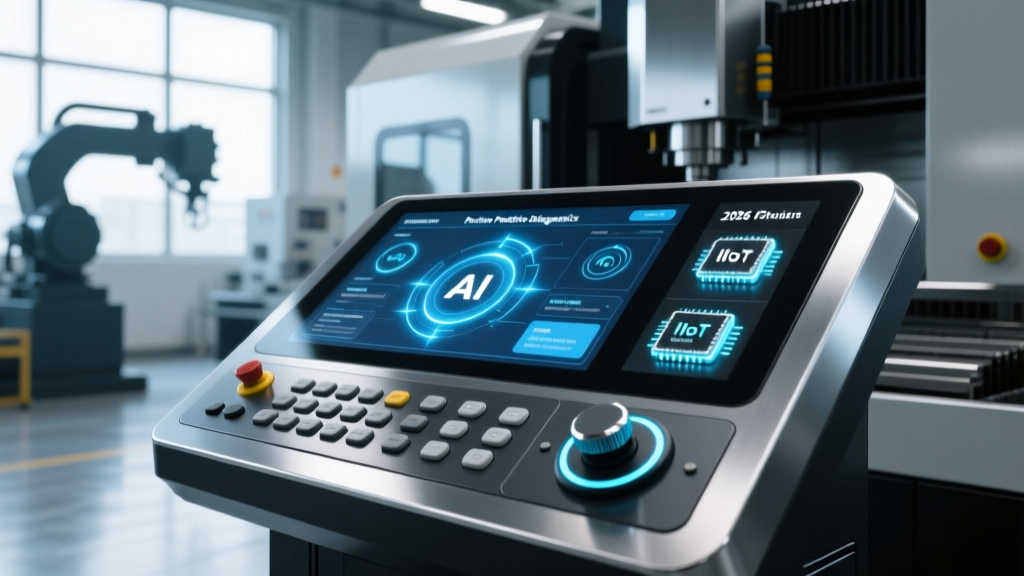
The modern CNC milling machine control panel has evolved from a simple array of tactile membrane switches into a sophisticated edge-computing hub. As manufacturing environments demand tighter integration between shop-floor operations and enterprise-level analytics, the physical interface where operators interact with G-code and machine parameters is undergoing a radical transformation. In 2026, the control panel is no longer just a command input device; it is an AI-assisted diagnostic terminal, a digital twin renderer, and an IIoT edge node.
The Hardware Paradigm: PCAP Glass vs. Legacy Membrane
For decades, membrane keypads dominated the CNC milling machine control panel landscape due to their resistance to coolant ingress and metal swarf. However, the shift toward Projected Capacitive Touch (PCAP) glass interfaces—driven by consumer electronics and adapted for harsh industrial environments—has fundamentally changed operator workflows. Modern PCAP panels utilize an armored glass substrate with a specialized oleophobic and hydrophobic coating to reject tramp oil and synthetic coolants.
| Specification | Legacy Membrane Keypad | 2026 Industrial PCAP Glass |
|---|---|---|
| Actuation Force | 2.0N - 3.5N | 0N (Capacitive field disruption) |
| Mechanical Lifespan | ~1,000,000 cycles | Unlimited (No moving parts) |
| Multi-Touch Capability | None | 10-point simultaneous pinch/zoom |
| Ingress Protection | IP65 (Front face) | IP67 (Sealed optical bonding) |
| Average Replacement Cost | $450 - $800 | $2,200 - $4,500 |
While PCAP offers superior usability for manipulating complex 3D toolpath simulations, it introduces new variables. Optical bonding between the LCD and the touch glass eliminates the air gap, reducing internal reflections under harsh overhead LED shop lighting and preventing coolant from seeping between layers if the outer glass is cracked.
AI-Assisted UI and Digital Twin Integration
The most significant software innovation in the CNC milling machine control panel is the integration of localized AI and digital twin rendering. Systems like the Siemens Sinumerik ONE architecture utilize the panel's onboard GPU to run a real-time kinematic digital twin of the milling environment. This allows operators to visually verify 5-axis simultaneous movements without relying solely on abstract G-code verification.
Expert Insight: The Latency ThresholdWhen rendering 3D collision monitoring directly on the control panel, the system must maintain a sub-15-millisecond latency between the physical spindle encoder feedback and the visual UI update. If latency exceeds 20ms, operators lose trust in the visual simulation during high-speed machining (HSM) of aerospace titanium alloys, reverting to manual single-block execution and destroying cycle time efficiency.
Furthermore, conversational AI interfaces are beginning to appear in advanced CNC controls. Instead of navigating through six layers of nested menus to adjust a spindle load limit, an operator can use localized voice commands or natural language text prompts to query the machine's state, such as "Show me the thermal growth compensation offset for the Z-axis over the last four hours."
The Panel as an IIoT Edge Node
In 2026, the CNC milling machine control panel acts as a localized edge server. Rather than streaming raw, high-frequency vibration and spindle load data directly to the cloud—which consumes massive bandwidth and introduces security vulnerabilities—the panel aggregates and processes this data locally.
Standardized Protocol Stack at the Panel Level
- MTConnect: The MTConnect Institute standard remains the bedrock for machine tool data extraction. Modern panels run an MTConnect adapter natively, translating proprietary CNC registers into standardized XML/JSON streams.
- OPC UA: For deeper integration with PLCs and robotic part-loaders, OPC UA servers embedded in the control panel provide secure, certificate-based data exchange with zero-trust architecture.
- MQTT Sparkplug B: For lightweight, high-speed telemetry (like acoustic emission sensors monitoring tool wear), panels utilize MQTT to publish state changes to local edge brokers.
Economic Analysis: OEM vs. Aftermarket Smart Panel Retrofits
Upgrading an older vertical machining center (VMC) with a smart CNC milling machine control panel requires a careful cost-benefit analysis. Machine builders offer factory-installed smart glass options, but the aftermarket retrofit sector has matured significantly, offering integrators that swap out legacy CRT or early LCD monitors with modern PCAP touchscreens running custom Windows CE or Linux-based HMI overlays.
| Upgrade Path | Hardware Cost | Integration & Downtime | Total Estimated Cost |
|---|---|---|---|
| OEM Factory Option (New Machine) | $8,000 - $12,000 | Zero (Installed at build) | $8,000 - $12,000 |
| OEM Field Retrofit (Legacy) | $14,000 - $22,000 | 3-5 Days ($6,000 lost prod.) | $20,000 - $28,000 |
| Aftermarket HMI Integrator | $6,500 - $9,500 | 1-2 Days ($2,400 lost prod.) | $8,900 - $11,900 |
Aftermarket retrofits are highly cost-effective for machines with solid mechanical ways and high-torque spindles but outdated electronics. However, they often lack the deep, proprietary kernel-level integration required for advanced AI collision avoidance, restricting the panel to macro-level monitoring and basic touch navigation.
Real-World Failure Modes in Smart Glass Panels
Despite IP67 ratings, smart CNC milling machine control panels experience specific failure modes in aggressive machining environments that facility managers must anticipate.
1. Capacitive Desensitization from Synthetic Coolants
Standard PCAP screens rely on the electrical capacitance of the human body. When operators wear nitrile or heavy synthetic leather gloves, the screen may fail to register inputs. More problematically, certain synthetic cutting fluids (specifically those with high glycol and potassium hydroxide concentrations) can create a conductive film over the glass. This 'ghost touching' effect causes the panel to register phantom inputs, potentially leading to accidental cycle starts or feedrate overrides. Solution: Specify panels with active frequency-hopping touch controllers that can differentiate between a gloved finger and a static conductive fluid film.
2. Thermal Throttling of ARM Processors
Modern control panels utilize high-performance ARM or x86 system-on-chips (SoCs) to render 3D toolpaths. In enclosed machining cells where ambient temperatures routinely exceed 38°C (100°F) due to spindle heat and lack of HVAC, the panel's processor will thermally throttle. This results in a dropped frame rate during toolpath simulation and laggy UI response. Solution: Ensure the panel enclosure features active closed-loop liquid cooling or Peltier thermoelectric coolers rated for 55°C ambient operation, rather than relying on passive finned heat sinks.
3. Swarf Ingress in Bezel Seams
While the glass itself is impervious, cast aluminum or stainless steel bezels with mechanical gaskets can trap fine cast iron or aluminum swarf. Over time, vibration from heavy roughing cycles (like trochoidal milling) works microscopic metal particles into the gasket seal, eventually compromising the IP rating and allowing mist to corrode the internal LCD driver boards. Opting for optically bonded, flush-mount glass with zero-bezel gaps eliminates this mechanical failure point entirely.
By understanding the intersection of advanced capacitive hardware, edge-computing protocols, and the harsh physical realities of the shop floor, manufacturers can select and maintain a CNC milling machine control panel that genuinely accelerates productivity rather than introducing fragile complexity.