Smart CNC Machine Spindle Assembly Tech: 2026 Trends
Explore 2026 innovations in CNC machine spindle assembly tech, including smart sensors, magnetic bearings, and predictive maintenance frameworks.
The Shift from Mechanical to Mechatronic Spindles
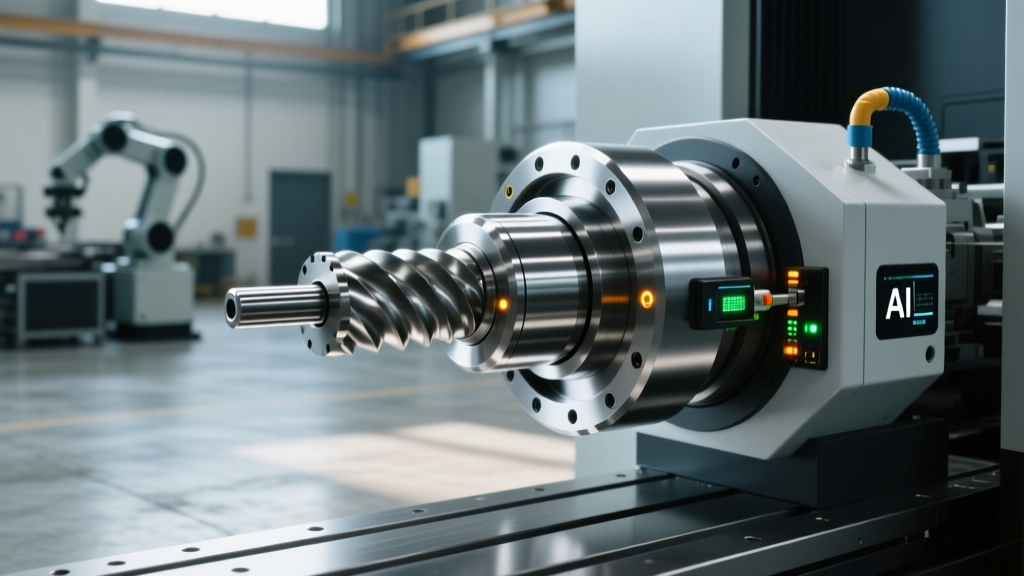
The architecture of the CNC machine spindle assembly has fundamentally shifted from a purely mechanical drivetrain to a mechatronic sensor node. In 2026, the spindle is no longer just a rotating shaft housed in a cast-iron or aluminum block; it is the primary data-gathering edge device on the shop floor. Driven by the demand for micron-level tolerances in aerospace and medical machining, modern spindle assemblies now integrate real-time telemetry, active damping, and advanced tribology directly into the housing.
2026 Market Data Highlight: According to recent manufacturing telemetry reports, adoption of smart spindle assemblies with embedded vibration and thermal sensors has increased by 42% year-over-year in 5-axis machining centers, reducing unplanned spindle downtime by an average of 68%.For manufacturing engineers and maintenance managers, understanding these hardware and software integrations is critical. A standard HSK-A63 belt-driven spindle assembly might cost between $9,000 and $14,000, but a direct-drive smart spindle with embedded piezoelectric telemetry commands $28,000 to $38,000. The ROI is justified not by raw cutting speed, but by the elimination of catastrophic failure modes like thermal seizure and bearing cage fragmentation.
Core Innovations Redefining Spindle Assemblies
Active Magnetic Bearings (AMB) in Heavy Milling
Traditional hybrid ceramic bearings (using silicon nitride Si3N4 balls) remain the standard for high-speed routing, but Active Magnetic Bearings (AMB) are redefining heavy-duty and ultra-high-speed CNC machine spindle assemblies. By levitating the spindle shaft using electromagnetic fields, AMB systems eliminate mechanical friction and the need for oil-air or grease lubrication.
Companies like SKF have miniaturized AMB systems to fit within standard machining center footprints. The primary advantage in 2026 is infinite fatigue life for the bearing system, provided the power supply remains stable. Furthermore, AMB spindles can actively shift the shaft centerline by up to 50 µm in real-time to compensate for thermal growth or tool deflection during heavy titanium roughing cycles. The trade-off is the initial capital expenditure, with AMB retrofit kits and integrated assemblies frequently exceeding $45,000, alongside the requirement for specialized magnetic shielding to prevent interference with sensitive CNC scales.
Embedded Piezoelectric Vibration and Acoustic Sensors
Tool chatter and bearing degradation are traditionally detected via external accelerometers mounted on the spindle housing, which often suffer from signal attenuation through the cast iron. The 2026 standard involves embedding piezoelectric sensors directly into the spindle's stationary outer race or cooling jacket.
Systems utilizing Kistler machining process monitoring technology can sample acoustic emissions (AE) and vibration frequencies up to 20 kHz directly at the source. This allows the CNC controller to detect micro-chatter and adjust spindle speed (RPM) by 1-2% in milliseconds to move the cutting process out of the harmonic resonance zone. Additionally, these sensors monitor the specific frequency signatures of the Belleville spring stack in the drawbar, alerting operators to drawbar fatigue before a catastrophic tool pull-out occurs at 24,000 RPM.
Comparative Analysis: 2026 Spindle Architectures
| Feature | Traditional Belt-Driven | Direct-Drive Smart Spindle | Active Magnetic Bearing (AMB) |
|---|---|---|---|
| Max RPM (HSK-63) | 12,000 - 15,000 | 20,000 - 24,000 | 30,000 - 60,000+ |
| Lubrication | Grease / Oil-Air | Oil-Air / Minimal Quantity | None (Frictionless) |
| Telemetry Integration | External Sensors Only | Embedded Thermal & Vibration | Full Axis Position & Load Mapping |
| Thermal Growth (Z-Axis) | 15 - 40 µm | 5 - 12 µm | < 2 µm (Active Compensation) |
| Estimated Assembly Cost | $9,000 - $14,000 | $28,000 - $38,000 | $45,000 - $75,000+ |
| MTBF (Mean Time Between Failure) | 8,000 - 12,000 Hours | 15,000 - 20,000 Hours | 25,000+ Hours (Electronics Dependent) |
Thermal Management and Phase-Change Materials
Thermal expansion remains the primary enemy of spindle accuracy. In a standard CNC machine spindle assembly, heat generated by the motor and bearing friction transfers into the housing, causing Z-axis growth. While traditional liquid cooling jackets circulate chilled water or oil, 2026 innovations focus on micro-channel cooling and Phase-Change Materials (PCM).
Manufacturers like GF Machining Solutions (Step-Tec) have optimized cooling jacket geometries using computational fluid dynamics (CFD) to ensure uniform heat extraction around the stator. More radically, some high-precision grinding spindle assemblies now incorporate PCM layers within the housing. These materials absorb latent heat during heavy roughing cycles and release it during idle periods, effectively flattening the thermal curve and keeping Z-axis growth strictly under 3 µm without relying entirely on the machine's external chiller unit.
Digital Twin Integration via MTConnect and OPC UA
A smart spindle assembly is useless if its data is trapped in a proprietary PLC. The current ecosystem relies on MTConnect and OPC UA protocols to stream spindle telemetry (temperature, vibration, motor load, and drawbar clamping force) into a Digital Twin environment, such as Siemens Sinumerik ONE or Fanuc FIELD.
'The spindle is no longer a wear part; it is a continuous data stream. By feeding real-time spindle load and vibration data into our digital twin, we can predict bearing race spalling up to 400 machining hours before it impacts surface finish.'
— Lead Manufacturing Engineer, Tier 1 Aerospace Supplier
This integration allows for predictive maintenance frameworks. Instead of rebuilding a spindle assembly every 10,000 hours based on a calendar schedule, maintenance is triggered by actual bearing degradation algorithms analyzing high-frequency acoustic envelopes. This shifts spindle management from preventive to strictly predictive, saving thousands in premature rebuild costs.
Purchasing Framework: Selecting the Right Assembly
Upgrading or specifying a CNC machine spindle assembly requires matching the technology to the specific machining application. Use the following decision framework to guide your 2026 capital expenditures:
- High-Mix / Low-Volume Aluminum & Plastics: Stick to Traditional Direct-Drive Spindles with standard oil-air lubrication. The ROI for embedded sensors is low when cutting forces are minimal and tool changes are frequent. Focus budget on high-speed drawbar mechanisms (e.g., 1.5-second tool change times).
- Aerospace Titanium & Inconel Roughing: Specify Active Magnetic Bearings (AMB) or heavily reinforced direct-drive spindles with high-torque windings. AMB provides the active damping required to prevent chatter during high-radial-depth-of-cut operations, extending carbide end mill life by 20-30%.
- Medical & Micro-Machining (5-Axis): Mandate Smart Spindles with Embedded Piezoelectric Sensors and micro-channel cooling. When machining 0.5mm end mills at 40,000 RPM, detecting a 2% increase in vibration amplitude is the difference between a finished part and a broken tool inside a $50,000 titanium implant blank.
- High-Precision Jig Grinding: Require Phase-Change Material (PCM) Thermal Management. In grinding, Z-axis thermal growth directly translates to part size variation. PCM-integrated assemblies eliminate the need for 45-minute morning warm-up cycles, increasing daily spindle utilization by up to 12%.
Ultimately, the modern CNC machine spindle assembly is an investment in process stability. By leveraging embedded telemetry, advanced cooling, and magnetic levitation, machine shops can transition from reactive spindle rebuilding to proactive process optimization, securing a distinct competitive advantage in high-tolerance manufacturing.
Related reading
Navigating Safety Standards and Compliance for CNC Swiss Screw Machined Parts
How To Start CNC Maintenance: A Practical, Step-by-Step Foundation for Machine Longevity and Precision
