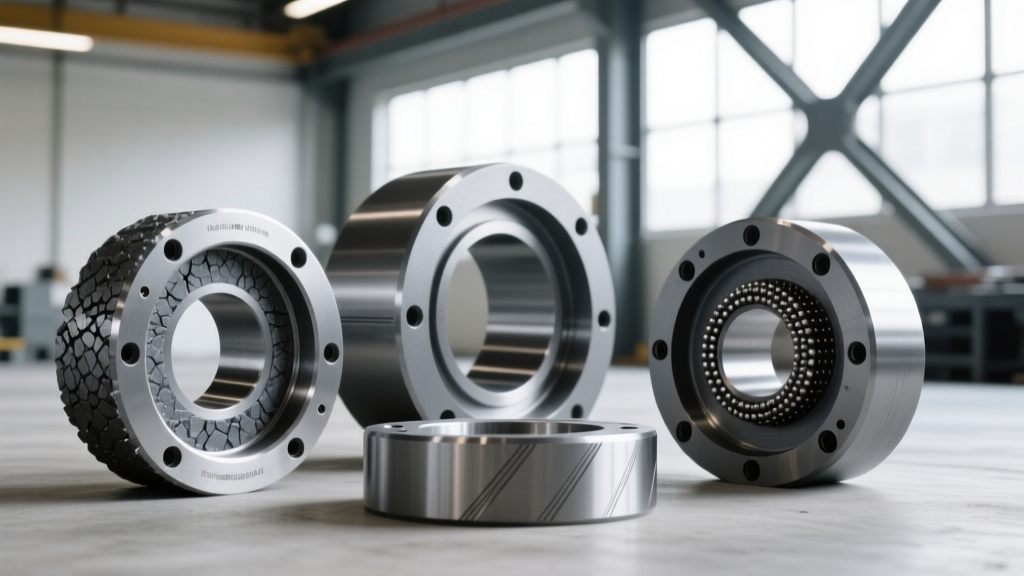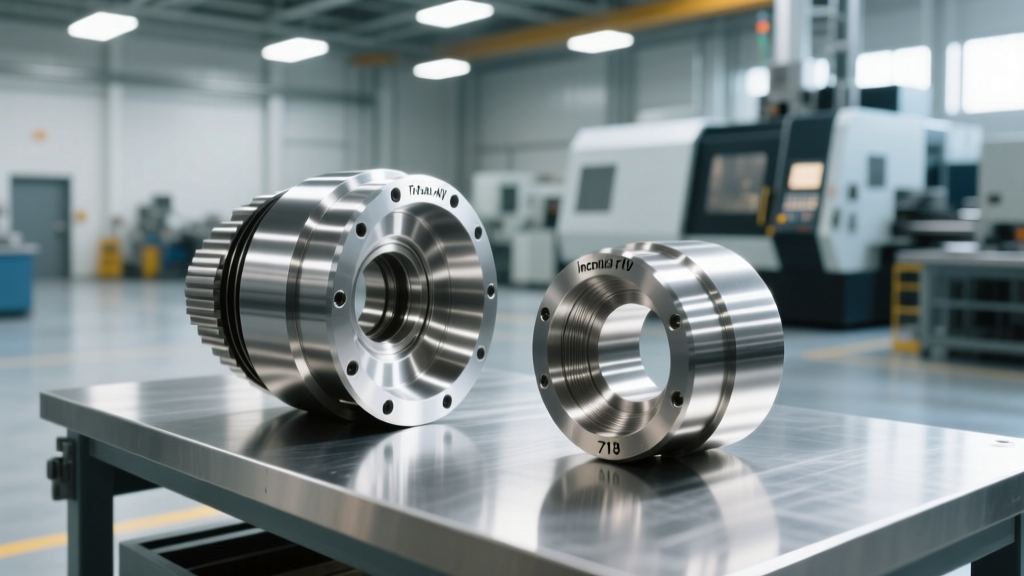
Precision Aerospace CNC Machined Parts: Titanium vs Inconel
Compare Ti-6Al-4V and Inconel 718 for precision aerospace CNC machined parts. Analyze cutting speeds, tooling, 5-axis strategies, and AS9100D costs.
The Engineering Reality of Aerospace Alloys in 2026
Manufacturing precision aerospace CNC machined parts requires navigating extreme material hostility. As next-generation turbofan engines push operating temperatures past 1,700°C and airframe designs demand higher strength-to-weight ratios, machine shops are forced to choose between two dominant superalloys: Grade 5 Titanium (Ti-6Al-4V) and Inconel 718. Selecting the wrong machining strategy for these materials does not merely increase cycle times; it causes catastrophic tool failure, work-hardened scrap, and out-of-tolerance features that violate strict AS9100D quality management standards.
This analysis compares the metallurgical behavior, tooling requirements, and economic realities of machining Ti-6Al-4V versus Inconel 718, providing a definitive framework for manufacturing engineers and procurement specialists sourcing complex aerospace components.
Material Matrix: Ti-6Al-4V vs. Inconel 718
Understanding the baseline metallurgy is critical before programming toolpaths. Titanium is notorious for its low thermal conductivity and chemical reactivity, while Inconel suffers from severe work hardening and high shear strength at elevated temperatures.
| Property / Metric | Ti-6Al-4V (Grade 5) | Inconel 718 |
|---|---|---|
| Density | 4.43 g/cm³ | 8.19 g/cm³ |
| Tensile Strength (Yield) | 880 MPa (128 ksi) | 1,035 MPa (150 ksi) |
| Thermal Conductivity | 6.7 W/m·K (Very Low) | 11.4 W/m·K (Low) |
| Optimal Cutting Speed (Vc) | 50 – 75 m/min | 10 – 25 m/min |
| Primary Failure Mode | Chemical diffusion / Galling | Notch wear / Work hardening |
| Approx. Billet Cost (2026) | $28 – $36 / lb | $48 – $62 / lb |
Inconel 718 work-hardens rapidly during machining. If your CNC feed rate drops too low, or if the tool dwells in the cut, the material surface hardness can spike from 40 HRC to over 55 HRC in seconds. Subsequent passes will shatter standard carbide end mills. Always maintain a constant, aggressive feed rate and never let the tool rub.
Tooling and Coolant Strategies: A Comparative Approach
Standard catalog tooling is insufficient for precision aerospace CNC machined parts. The tooling geometries and coatings must be matched to the specific failure modes of each alloy.
Titanium (Ti-6Al-4V) Tooling Protocol
Titanium’s low thermal conductivity means 80% of the cutting heat transfers directly into the tool, not the chip. Furthermore, titanium is highly reactive and will chemically weld (gall) to standard TiAlN coatings.
- Substrate: Use sub-micron grain carbide with high cobalt content (10-12%) for toughness.
- Coating: Avoid Titanium-based coatings (TiN, TiAlN). Specify AlCrN (Aluminum Chromium Nitride) or uncoated polished carbide to prevent chemical affinity.
- Geometry: Variable helix angles (e.g., 35°/37°) to disrupt harmonic chatter, which is prevalent in deep pocket milling of titanium structural brackets.
- Coolant: Flood coolant is mandatory. Through-tool coolant at 700–1,000 PSI is required for deep cavity milling to evacuate chips and prevent secondary cutting.
Inconel 718 Tooling Protocol
Inconel generates extreme cutting forces and abrasive carbide particles that cause rapid flank wear and depth-of-cut notch (DNC) wear.
- Substrate: Fine-grain carbide optimized for heat resistance over pure shock toughness.
- Coating: PVD AlTiN or specialized high-temperature ceramic whisker-reinforced grades for roughing operations.
- Geometry: Sharp cutting edges with a light hone (0.0002" - 0.0004" edge prep) to shear the material cleanly rather than plowing through it. A reduced radial rake angle helps manage the high cutting pressures.
- Coolant: High-pressure through-tool coolant at a minimum of 1,000–1,500 PSI is non-negotiable. This pressure mechanically breaks the stringy, work-hardened chips that otherwise wrap around the spindle and score the part surface.
For deeper insights into advanced toolpath generation and tool selection for these superalloys, manufacturing engineers frequently reference the Sandvik Coromant aerospace machining guidelines, which detail specific insert grades like Sialon ceramics for high-speed Inconel roughing.
Machine Kinematics: 5-Axis Mill vs. Mill-Turn
When producing precision aerospace CNC machined parts, the choice of machine architecture dictates both the geometric capability and the unit economics.
| Architecture | Best Suited For | Aerospace Application Examples | Hourly Shop Rate (Est.) | Setup Complexity |
|---|---|---|---|---|
| 5-Axis VMC (e.g., Hermle C42U) | Complex structural pockets, thin webs, 3D contoured airfoils. | Wing ribs, bulkheads, impeller blisks. | $140 - $180 / hr | High (requires complex workholding & probing) |
| Mill-Turn (e.g., Mazak Integrex i-400) | Rotational symmetry mixed with off-center features. | Landing gear actuators, hydraulic valve bodies, turbine shafts. | $160 - $220 / hr | Medium (single chucking reduces cumulative tolerance stack) |
| Swiss-Type Lathe | Micro-precision, high-aspect-ratio cylindrical parts. | Fasteners, sensor housings, fuel injector nozzles. | $110 - $150 / hr | Low (bar feed automation) |
For Inconel landing gear actuator shafts, utilizing a 5-axis mill requires multiple fixtures, introducing a ±0.001" tolerance stack-up risk between turning and milling operations. Transitioning to a Mill-Turn center allows the part to be machined in a single chucking. While the hourly rate is higher, the elimination of secondary setups and the reduction in First Article Inspection (FAI) failures yields a 22% lower total cost per part.
Navigating AS9100D and Quality Assurance Costs
The cost of precision aerospace CNC machined parts extends far beyond spindle time. Compliance with SAE AS9100 Rev D mandates rigorous traceability, material certification, and First Article Inspection (FAI) per AS9102 Rev C.
The Hidden Cost of Tolerances
Design engineers must apply tolerances based on functional necessity, not arbitrary defaults. Machining a Ti-6Al-4V bracket pocket to ±0.0005" costs roughly 40% less than holding ±0.0002". The tighter tolerance requires:
- Thermal Stabilization: Running the 5-axis machine for 2 hours to warm up the ball screws and spindle bearings before cutting.
- Tool Wear Mapping: Using a laser tool setter to map flank wear and automatically apply cutter compensation offsets mid-cycle.
- CMM Inspection: 100% Coordinate Measuring Machine inspection rather than sample-based batch checking.
For complex geometries, shops often utilize specialized Harvey Tool technical guides on titanium milling to optimize chip thinning calculations, ensuring that the tool engages the material correctly at tight tolerance bands without deflection.
Procurement Decision Framework: Sourcing in 2026
When evaluating machine shops for your next production run, use this decision matrix to align your part geometry with the supplier's capabilities.
- If the part is >80% Inconel and features deep cylindrical bores with intersecting radial ports: Source exclusively from shops equipped with Y-axis Mill-Turn centers and high-pressure coolant systems (1,500+ PSI). Verify they use automated tool breakage detection to prevent scrap from catastrophic notch wear.
- If the part is a thin-walled Ti-6Al-4V structural rib (walls <0.040"): Require the shop to demonstrate adaptive roughing toolpaths (e.g., Mastercam Dynamic Motion or Siemens Trochoidal). Constant radial engagement is mandatory to prevent tool deflection and subsequent wall chatter marks.
- If the production volume exceeds 5,000 units annually: Push for near-net-shape forgings or additive manufactured (DED) pre-forms. Buying a $30,000 block of Inconel 718 to machine away 85% of the material into chips is economically unviable in the current supply chain environment. Pre-forms reduce CNC cycle time by up to 60%.
Final Engineering Directives
Manufacturing precision aerospace CNC machined parts in Ti-6Al-4V and Inconel 718 is an exercise in thermal and mechanical management. Success requires abandoning generic machining parameters in favor of alloy-specific tooling, extreme coolant pressures, and kinematic machine selections that minimize part handling. By aligning the metallurgical realities of the workpiece with the appropriate 5-axis or mill-turn architecture, aerospace manufacturers can secure predictable yields, maintain AS9100D compliance, and control the escalating costs of superalloy machining.