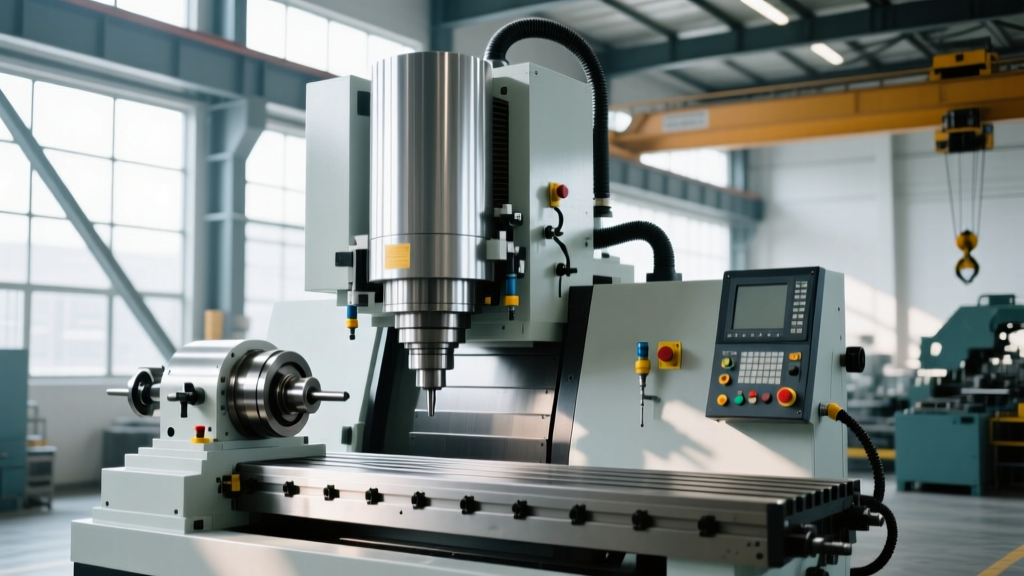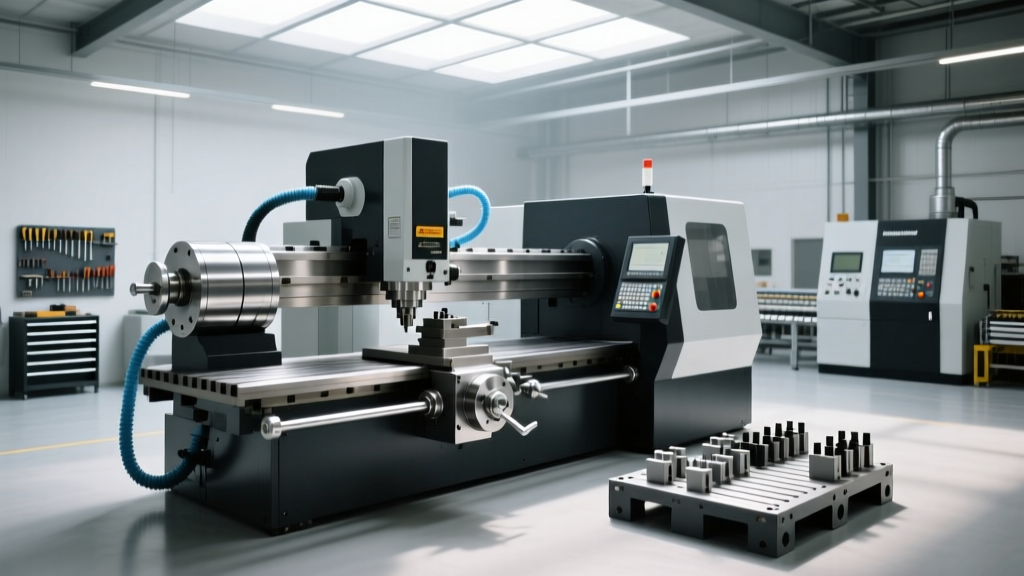
2026 Buyer Guide: Choosing a CNC Horizontal Milling Machine
Discover how to select the ideal CNC horizontal milling machine for your shop in 2026. Compare specs, pallet pool options, and top OEM pricing tiers.
The Horizontal Advantage: When to Ditch the VMC
Transitioning from a vertical machining center (VMC) to a CNC horizontal milling machine is rarely about achieving tighter tolerances; it is a mathematical decision driven by spindle utilization and labor economics. In a typical 2026 job shop environment, a standard VMC achieves only 30% to 40% actual cutting time due to manual loading, chip clearing, and tool changes. By contrast, a CNC horizontal milling machine equipped with a basic 2-pallet pool routinely sustains 85% to 92% spindle utilization.
The physics of horizontal machining also solve the most persistent issue in deep-cavity milling: chip evacuation. Gravity pulls chips away from the cutting zone and directly into the conveyor. This eliminates recutting, extends tool life by up to 30% in stringy materials like 6061-T6 aluminum, and prevents surface finish degradation in Inconel 718 aerospace components.
💡 The Utilization Multiplier: If your shop runs multiple VMCs with one operator per machine, replacing three VMCs with a single 5-pallet CNC horizontal milling machine and one operator often yields higher daily part output while reducing floor space requirements by 40%.Core Specifications to Scrutinize (Beyond Travel Limits)
Buyers frequently fixate on X/Y/Z travel limits, but the true differentiators in horizontal milling are spindle torque curves, rapid traverse rates, and tool changer mechanics. When evaluating Makino's horizontal machining center lineup or competing OEMs, demand the torque curve graph, not just the peak horsepower number.
| Specification Tier | 400mm Pallet Class | 500mm Pallet Class (Industry Standard) | 630mm+ Pallet Class (Heavy Duty) |
|---|---|---|---|
| Typical Spindle Taper | HSK-A63 / CAT40 | HSK-A63 / CAT50 | CAT50 / HSK-A100 |
| Spindle Speed Range | 12,000 - 20,000 RPM | 10,000 - 14,000 RPM | 6,000 - 10,000 RPM |
| Rapid Traverse Rates | 60 - 80 m/min | 50 - 60 m/min | 30 - 40 m/min |
| Base Price Range (2026) | $220,000 - $310,000 | $320,000 - $480,000 | $550,000 - $850,000+ |
| Primary Application | High-speed aluminum, medical | General aerospace, automotive, valves | Heavy equipment, energy, large prismatic |
For general-purpose machining in 2026, the 500mm pallet class remains the sweet spot. It offers enough work envelope (typically 700mm x 700mm x 700mm) to mount a standard 4-sided tombstone, while maintaining rapid rates fast enough to keep non-cutting times minimal.
Pallet Pools and Automation Readiness
A CNC horizontal milling machine without a pallet pool is a wasted investment. The automation interface is where your ROI is realized.
2-Pallet vs. Multi-Pallet (FMS) Configurations
- 2-Pallet Changer (Standard): Allows the operator to load/unload Part B while the machine cuts Part A. Ideal for batch sizes of 50-500 parts. Adds roughly $35,000 to the base machine cost.
- 5 to 10-Pallet Pool (FMS): Enables lights-out machining. Systems like the Mazak Palletech or Makino MMC2 integrate a rail-guided vehicle (RGV) to swap pallets automatically. Budget an additional $120,000 to $250,000 for the hardware, plus $15,000 per additional pallet.
Top OEM Tiers and 2026 Pricing Realities
Based on current Association for Manufacturing Technology (AMT) market data and recent OEM releases, here is how the major players stack up in the 500mm horizontal category.
1. Makino (a61nx / a51nx)
Makino dominates the high-speed aluminum and tight-tolerance aerospace sector. The a61nx features a highly rigid casting and an HSK-A63 spindle capable of 14,000 RPM. Their proprietary spindle cooling technology minimizes thermal growth, holding Z-axis repeatability under 3 microns over a 24-hour cycle. Target Price: $380,000 - $450,000 (equipped).
2. Mazak (HCN 5000)
The workhorse of the industry. The HCN 5000 paired with the MAZATROL SmoothAi control offers exceptional chip evacuation via its steeply sloped base and center-through table design. It is highly forgiving for general job shop environments and integrates seamlessly with robotic tending. Target Price: $320,000 - $410,000. Review Mazak HMC configurations for specific Palletech integrations.
3. Okuma (MA-500III)
Okuma’s Thermo-Friendly Concept is not a marketing gimmick; it actively compensates for ambient shop temperature fluctuations without requiring a climate-controlled room. The OSP control and absolute encoders eliminate the need for daily homing routines, saving 15 minutes of setup time per shift. Target Price: $360,000 - $430,000.
4. DN Solutions / Hyundai WIA (Value Tier)
For shops with strict capital expenditure limits, DN Solutions (formerly Doosan) and Hyundai WIA offer robust 500mm horizontals starting in the $240,000 range. While they may lack the 14,000 RPM spindles or advanced thermal compensation of Tier 1 brands, their heavy box-way or hybrid linear-guide designs handle aggressive steel milling exceptionally well.
Hidden Costs: Tooling, Fixturing, and Coolant Delivery
The most common budgeting failure when purchasing a CNC horizontal milling machine is underestimating the peripheral equipment required to make it run efficiently.
- Tombstone Fixturing: A standard 4-sided 500mm tombstone from Mitee-Bite or Kurt costs between $3,500 and $6,000. Outfitting it with hydraulic clamps, valves, and a rotary union for the B-axis can push the initial workholding budget to $15,000 per machine.
- High-Pressure Coolant (HPC): Standard 20 bar (300 psi) coolant is obsolete for modern HMCs. You must specify 70 bar (1,000 psi) through-spindle coolant (TSC) as a baseline. If you machine titanium or deep-cavity aluminum, upgrade to the 150 bar (2,200 psi) option. This adds $18,000 to $25,000 to the machine cost but reduces cycle times by up to 40% via effective chip breaking.
- Chip Conveyors: Never opt for a standard hinge-belt conveyor if you are cutting aluminum or stringy stainless steel. Specify a scraper-type or dual-hinge conveyor with a coolant filtration system rated to 50 microns to prevent pump cavitation.
Final Procurement Checklist
Before signing the purchase order, verify these critical specifications with your OEM sales engineer:
- Tool Changer Capacity: Ensure the matrix or chain-type ATC holds enough tools for a fully loaded tombstone (minimum 60 tools for a 4-sided setup, ideally 120+ for FMS).
- B-Axis Torque and Braking: If you are performing heavy off-center milling on a tombstone, verify the B-axis clamping torque. Hydraulic clamping is mandatory to prevent axis shift during aggressive cuts.
- Spindle Chiller Capacity: Confirm the chiller is sized for continuous 100% duty cycle at peak RPM, not just intermittent cutting.
- Software Post-Processors: Ensure the OEM provides verified 4-axis post-processors for your specific CAM software (Mastercam, Fusion 360, HyperMill) prior to machine delivery.