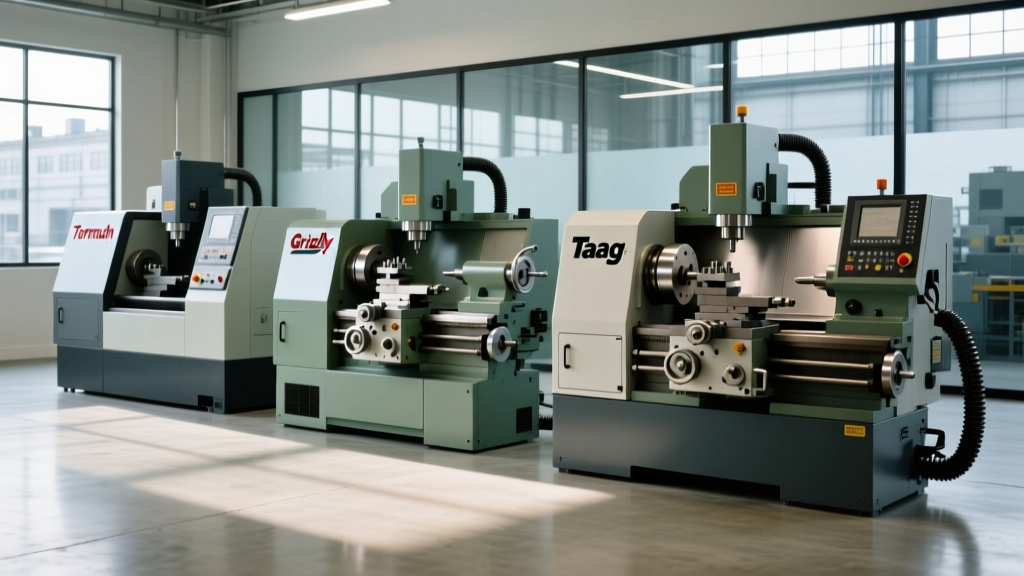
CNC Swing Machine Technical Specs: Entry-Level Lathes 2026
Compare entry-level CNC swing machine technical specifications. We analyze Tormach, Grizzly, and Taig lathes to help makers choose the right SOC.
The 'Swing Illusion': Decoding CNC Lathe Specifications
When hobbyists and independent makers search for cnc swing machine technical specifications, they are typically trying to answer one critical question: Will my workpiece fit and rotate without crashing into the machine's bed or carriage? In the CNC lathe market, 'swing' defines the maximum diameter of a cylindrical part that can be machined. However, entry-level manufacturers frequently exploit a specification loophole that catches novice buyers off guard.
⚠️ The SOB vs. SOC TrapMarketing materials heavily promote Swing Over Bed (SOB)—the maximum diameter that can clear the flat ways of the lathe bed. But the cutting tool is mounted on the cross-slide, which sits higher than the bed. The actual usable diameter is the Swing Over Carriage (SOC), which is often 40% to 50% smaller than the advertised SOB. Attempting to machine a 6-inch diameter flange on a machine with a 9-inch SOB but a 4-inch SOC will result in an immediate, catastrophic collision between the workpiece and the cross-slide.
According to foundational machining guidelines outlined by Modern Machine Shop, evaluating a benchtop CNC lathe requires looking past the headline SOB number and focusing strictly on the SOC, the spindle bore diameter, and the Z-axis clearance. Below, we dissect the true technical specifications of the top entry-level CNC lathes dominating the maker space in 2026.
2026 Entry-Level CNC Lathe Comparison Matrix
| Model | 2026 Base Price | Swing Over Bed (SOB) | Swing Over Carriage (SOC) | Spindle Bore | Max RPM |
|---|---|---|---|---|---|
| Tormach 8L | $3,995 | 9.84' (250mm) | 4.72' (120mm) | 1.18' (30mm) | 3,000 |
| Grizzly G0768 | $2,495 | 9.00' (228mm) | 5.00' (127mm) | 0.79' (20mm) | 2,000 |
| Taig Tools DSLS 3000 | $1,895 | 3.50' (89mm) | 2.00' (50mm) | 0.41' (10.4mm) | 3,200 |
Deep-Dive: Analyzing the Maker Market Leaders
Tormach 8L: The Bar-Stock Specialist
The Tormach 8L is engineered for makers who need to feed long, continuous bar stock through the headstock. Its standout specification is the 1.18-inch (30mm) spindle bore. In the entry-level segment, a bore larger than 0.8 inches is exceptionally rare. This allows hobbyists machining aerospace-grade aluminum or brass plumbing fittings to pass 1-inch OD stock directly through the chuck, enabling automated production of small batches without manual sawing to length.
However, its SOC is limited to 4.72 inches. If your primary workflow involves turning large-diameter, short-profile parts (like robot chassis hubs or custom pulleys), the 8L's carriage will interfere with anything exceeding a 4.7-inch diameter. Furthermore, the 8L utilizes a belt-driven spindle rather than a direct-drive servo, which slightly reduces low-end torque for heavy interrupted cuts on steel.
Grizzly G0768: The High-SOC Budget Workhorse
Grizzly's G0768 flips the Tormach's philosophy. It sacrifices spindle bore capacity (a restrictive 0.79-inch hole) to achieve a superior 5.00-inch Swing Over Carriage. This makes it the superior choice for makers turning short, chunky components from billet stock. The 9-inch SOB and 5-inch SOC provide a generous working envelope for custom automotive bushings or large-diameter Delrin spacers.
The trade-off is the Z-axis travel and cross-slide mass. The G0768 uses a lighter cross-slide casting to maximize the swing arc, which can introduce harmonic chatter when taking deep radial cuts in stainless steel or titanium. To mitigate this, operators must utilize carbide inserts with aggressive positive rake geometries to reduce cutting forces.
Taig Tools DSLS 3000: The Micro-Machining Alternative
For makers focused on horology, micro-fluidics, or small-scale RC components, standard benchtop swings are unnecessarily massive and lack the required precision. The Taig DSLS 3000 features a microscopic 2.00-inch SOC and a 0.41-inch spindle bore. While it cannot handle macro-engineering projects, its low-mass carriage and high-speed spindle (up to 3,200 RPM) allow for exceptional surface finishes on sub-millimeter brass and aluminum pins. The rigid, compact bed prevents the thermal expansion issues common in larger, cheaper cast-iron hobby lathes.
Terminology Clarification: Swing-Head CNC Routers
It is vital to address a secondary interpretation of the search term 'cnc swing machine.' In the CNC router and mill domain, a 'swing' specification occasionally refers to a swing-head or tilting spindle (the A or B axis in 5-axis machining). For hobbyists exploring desktop 5-axis machines (like the Pocket NC V2-50), the 'swing' defines the rotational clearance of the spindle housing as it tilts up to 120 degrees. If your application requires undercutting or complex 3D contouring rather than cylindrical turning, you must pivot your research from lathe swing diameters to 5-axis kinematic envelope clearances.
Decision Framework: Matching Specs to Maker Projects
Use this procurement logic flow to select the correct machine for your 2026 workshop:
- Scenario A: High-Volume Small Shafts. If you are producing 100+ stainless steel shafts per week from 12-foot bar stock, Spindle Bore is your governing metric. Purchase the Tormach 8L and pair it with an aftermarket pneumatic bar feeder.
- Scenario B: Large-Diameter Billet Turning. If you are machining 4.5-inch diameter aluminum flanges for drone or robotics applications, SOC is your governing metric. Purchase the Grizzly G0768 and invest in a heavy-duty 4-jaw independent chuck to manage the off-center mass.
- Scenario C: Micro-Precision Pins. If your tolerances require holding +/- 0.0002 inches on parts smaller than a pencil eraser, Rigidity-to-Mass Ratio is your governing metric. Purchase the Taig DSLS 3000 and utilize HSS (High-Speed Steel) micro-ground tooling rather than standard carbide inserts.
Final Procurement Checklist for Hobbyist CNCs
Before finalizing an entry-level CNC lathe purchase, verify these three physical constraints in your shop space:
- Chip Tray Volume vs. Swing: Machines with a larger SOB require a wider chip tray. Ensure your workbench has at least 12 inches of lateral clearance on both sides of the headstock for chip evacuation and maintenance access.
- Power Phase Requirements: While the Taig and Grizzly run on standard 110V/120V single-phase household circuits, verify the Tormach 8L's specific controller and spindle motor requirements, as some high-torque configurations may require a dedicated 20A circuit to prevent breaker trips during heavy roughing passes.
- Tooling Clearance: Remember that the published SOC does not account for the tool holder. A standard CNMG carbide holder will eat up another 0.5 to 0.75 inches of your swing envelope. Always subtract 1 inch from the published SOC to determine your true maximum safe cutting diameter.