Entry-Level CNC Machine Made in USA: 2026 Comparison
Compare the best entry-level CNC machine made in USA for 2026. We analyze Tormach, Bantam, and Pocket NC against imported alternatives for hobbyists.
The 'Made in USA' Premium: Is It Worth It for Hobbyists?
For years, the hobbyist CNC market was dominated by imported, belt-driven routers built on aluminum extrusions. While affordable, these machines often suffer from belt stretch, spindle runout, and catastrophic lead times for replacement parts. As we navigate 2026, the landscape for the cnc machine made in usa has matured significantly. Domestic manufacturers are no longer just serving industrial job shops; they are engineering highly rigid, benchtop-friendly mills specifically for advanced makers, garage inventors, and small-scale prototypers.
According to data from the Reshoring Initiative, the localized production of capital equipment has surged over the last three years. For the end-user, this means localized technical support, domestic supply chains for spare parts, and engineering teams operating in the same time zones as their customers. But domestic assembly comes with a higher baseline cost. This analysis breaks down the top US-assembled entry-level CNC mills, comparing their real-world capabilities against popular imported alternatives to help you allocate your maker-space budget effectively.
Top US-Assembled Entry-Level CNC Mills: Comparison Matrix
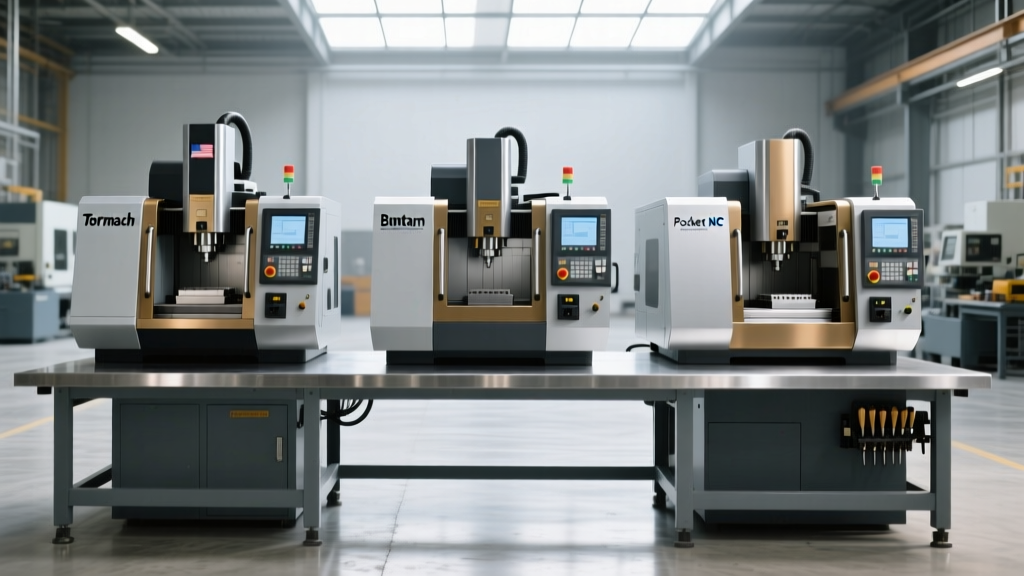
The following matrix contrasts the three dominant US-based benchtop CNC manufacturers. Note that pricing reflects 2026 base MSRP figures before mandatory tooling, enclosures, or software upgrades.
| Model | Primary Assembly | Work Envelope (X, Y, Z) | Spindle Power & Max RPM | Drive System | Approx. Base Price (2026) |
|---|---|---|---|---|---|
| Tormach PCNC 440 | Waunakee, WI | 10' x 6.25' x 10' | 0.75 HP / 10,000 RPM | Belt Drive / Ball Screws | $6,899 |
| Bantam Tools Desktop CNC | Hawthorne, NY | 7' x 9' x 3.5' | 250W / 20,000 RPM | Belt Drive / Lead Screws | $3,999 |
| Pocket NC V2-50 | Bozeman, MT | 4.5' x 5.0' x 3.5' | 125W / 30,000 RPM | Direct Drive / Ball Screws | $4,999 |
Tormach PCNC 440: The Heavy-Duty Garage Standard
If your objective is to machine steel, stainless, or titanium in a home garage, the Tormach PCNC 440 remains the undisputed benchmark for entry-level domestic CNC machines. Tormach utilizes a cast-iron frame and linear guide ways, providing the mass necessary to dampen the high-frequency vibrations generated when cutting hard metals.
- The TTS Tooling Ecosystem: Tormach’s proprietary Tormach Tooling System (TTS) is a major advantage for hobbyists. Unlike expensive BT30 or CAT40 toolholders, TTS holders cost a fraction of the price, allowing makers to build a comprehensive tool library on a budget. However, TTS lacks a pull-stud retention mechanism, meaning it can slip during aggressive facing operations in steel.
- Controller Software: The machine runs on PathPilot, Tormach’s custom LinuxCNC-based interface. It includes conversational programming, rigid tapping, and a highly intuitive UI that drastically reduces the learning curve for machinists transitioning from manual mills.
- Real-World Limitation: The PCNC 440 uses a belt-driven spindle to maintain its price point. While adequate for 90% of hobbyist work, it limits the machine's ability to take heavy, interrupted cuts in hardened alloys compared to direct-drive or geared-head industrial mills.
Bantam Tools Desktop CNC: The Precision Prototyper
Assembled in New York, the Bantam Tools Desktop CNC Milling Machine is engineered for a completely different use case: high-speed machining of PCBs, Delrin, and soft aerospace aluminums (like 6061-T6).
Maker Tip: Bantam's proprietary milling software is exceptionally user-friendly for 2.5D operations and PCB isolation routing. However, if you plan to run complex 3D contours generated in Fusion 360 or Mastercam, ensure you purchase the 'Professional' software tier, which unlocks full G-code import capabilities.With a 20,000 RPM spindle, the Bantam excels at using small-diameter endmills (down to 0.005 inches) without snapping them—a common failure mode on slower, high-torque routers. The machine achieves a repeatability of 0.0008 inches, making it ideal for press-fit enclosures and precision electronics housings. Its primary drawback is the Z-axis travel (3.5 inches) and the standard 1/8-inch collet, which restricts you to smaller tooling unless you invest in the optional ER11 spindle upgrade.
Pocket NC V2-50: 5-Axis American Engineering
Manufactured entirely in Montana, the Pocket NC V2-50 brings true 5-axis simultaneous machining to the hobbyist bench. Priced around $5,000, it is a marvel of compact engineering, utilizing a tilting rotary table (A and B axes) mounted directly to the machine bed.
For makers designing aerospace brackets, impellers, or complex medical prototypes, 5-axis capability eliminates the need for multiple setups and manual part flipping. The V2-50 supports standard ER11 tooling and integrates seamlessly with 5-axis CAM workflows. The trade-off is the extremely small work envelope (roughly 4.5 x 5 inches) and the steep learning curve associated with 5-axis toolpath generation and collision avoidance.
The Imported Alternatives: Where Global Machines Win
To provide a complete alternatives analysis, we must address the imported heavyweights: the Carbide 3D Shapeoko 5 and the Inventables X-Carve. Both are designed by US teams but manufactured overseas to hit the $1,500 to $2,500 price brackets.
'Imported gantry routers win on work envelope and price, but they lose fundamentally on rigidity. You cannot compensate for aluminum extrusion flex with software.' — Independent CNC Metrology Review, 2025
Machines like the Shapeoko 5 offer massive cutting areas (up to 16 x 16 inches on the XXL model) and are exceptional for woodworking, sign-making, and cutting carbon fiber sheets. However, they rely on NEMA 23 stepper motors and belts. When a hobbyist attempts to machine 6061 aluminum on a belt-driven router, the belt stretch introduces chatter, resulting in poor surface finishes and rapid endmill wear. If your maker space focuses exclusively on wood, plastics, and light engraving, the imported alternatives offer a superior ROI. If you intend to machine metal, they are a false economy.
Decision Framework: Matching the Machine to Your Maker Space
Selecting the right CNC machine made in USA requires matching the machine's physical architecture to your specific material pipeline. Use this framework to finalize your purchasing decision:
- Choose the Tormach PCNC 440 if: You are machining steel, brass, or stainless steel; you need to drill and tap holes precisely; and you have the floor space (and 220V power, if opting for the larger models, though the 440 runs on 110V) for a 300+ lb cast-iron machine.
- Choose the Bantam Tools Desktop CNC if: Your primary output consists of custom PCBs, aluminum front panels for electronics, and Delrin gears. You value a clean, desktop-friendly footprint and software that simplifies 2.5D workflows.
- Choose the Pocket NC V2-50 if: You are an advanced hobbyist or engineering student who needs to prototype complex, multi-sided geometries in aluminum or wax, and you are already proficient in 5-axis CAM programming.
- Pivot to an Imported Alternative (Shapeoko/X-Carve) if: Your projects are strictly limited to wood, acrylic, MDF, and soft foams, and you require a cutting area larger than 12 x 12 inches.
Final Thoughts on Domestic Entry-Level CNCs
The entry-level CNC machine made in USA market has successfully bridged the gap between industrial reliability and hobbyist accessibility. While the initial capital expenditure for a Tormach, Bantam, or Pocket NC is significantly higher than a flat-pack imported router, the investment yields dividends in rigidity, repeatability, and domestic technical support. By accurately assessing your material requirements and tolerance needs, you can select a domestically supported machine that will serve your maker space reliably for decades.