OSHA & ANSI Safety Standards in CNC Machining Training
Discover the critical OSHA and ANSI safety standards required in CNC machining training. Learn compliance costs, guarding specs, and curriculum must-haves.
The Regulatory Framework Governing CNC Training
CNC machining training that ignores formal safety standards is a liability. In modern manufacturing environments, a spindle operating at 12,000 RPM generates enough kinetic energy to turn an unsecured aluminum billet into a lethal projectile. Consequently, compliant CNC machining training programs must be built upon the foundational frameworks established by the Occupational Safety and Health Administration (OSHA) and the American National Standards Institute (ANSI).
Facilities that rely on informal 'shadowing' for new hires face severe regulatory exposure. OSHA's maximum penalty for willful safety violations currently exceeds $161,000 per infraction, and repeat violations can trigger federal injunctions that shut down production entirely. A robust training curriculum bridges the gap between theoretical G-code programming and the physical realities of machine guarding, lockout/tagout (LOTO), and material handling.
Warning: The 'On-the-Job' Training TrapOSHA does not recognize undocumented peer-to-peer shadowing as valid safety training. If an operator is injured while performing a setup task they were not formally tested on, the facility will be cited under the General Duty Clause (Section 5(a)(1) of the OSH Act) for failing to provide a workplace free from recognized hazards.
OSHA 1910.212: General Machine Guarding
Any compliant CNC machining training must begin with OSHA 1910.212(a)(1), which mandates that one or more methods of machine guarding shall be provided to protect the operator and other employees in the machine area from hazards such as those created by point of operation, ingoing nip points, rotating parts, and flying chips. Trainees must learn not just how to close a polycarbonate door, but how to inspect the door's physical integrity and verify that the safety interlocks have not been bypassed or 'cheated' with tape or zip ties.
ANSI B11 Series: Equipment-Specific Standards
While OSHA provides the legal enforcement mechanism, the ANSI B11 series provides the technical engineering specifications for machine safety. Training programs must differentiate between equipment types:
- ANSI B11.8: Covers safety requirements for lathes, turning centers, and boring mills. Trainees must learn the specific dangers of entanglement from rotating chucks and the mandatory use of chuck guards.
- ANSI B11.23: Governs machining centers (vertical and horizontal CNC mills). This standard dictates the required stopping distances for spindle brakes and the specifications for light curtain placements.
Mandatory Safety Modules in Compliant Training Curricula
A superficial overview of safety glasses is insufficient. Advanced CNC machining training integrates safety directly into the operational workflow. Below is the required module breakdown for a comprehensive, compliance-ready training program.
| Training Module | Standard Reference | Practical Application & Specifics | Min. Hours |
|---|---|---|---|
| Energy Isolation (LOTO) | OSHA 1910.147 | Applying physical locks to main disconnects during tool changes, verifying zero-energy state via control panel diagnostics. | 4.0 |
| Workholding & Kinetic Hazards | ANSI B11.8 / B11.23 | Calculating centrifugal clamping force loss at high RPM; verifying hydraulic chuck pressure gauges before cycle start. | 6.0 |
| Hearing Conservation | OSHA 1910.95 | Mapping shop noise zones; selecting ANSI S3.19-rated earplugs (NRR 25+) for air-blowing operations exceeding 85 dBA TWA. | 2.0 |
| Coolant & Fluid Management | OSHA 1910.1200 (HazCom) | Reading SDS for synthetic coolants; using refractometers to maintain 6-8% concentration to prevent dermatitis and bacterial growth. | 3.0 |
| Emergency Stop Architecture | ISO 13850 / NFPA 79 | Understanding Category 0 vs. Category 1 stops; testing E-stop circuits for hardwired redundancy without relying on PLC software. | 2.5 |
Machine Guarding and Interlock Verification
The most critical failure mode in CNC operation is the defeat of safety interlocks. Trainees must be taught the engineering principles behind NIMS-certified operator credentials, which heavily emphasize machine guarding. Modern CNC machines utilize RFID-coded safety switches (such as Euchner or Schmersal units) to prevent door bypasses. Training must cover the diagnostic procedures for when a machine faults out due to a safety circuit interruption, rather than teaching operators how to reset the fault blindly.
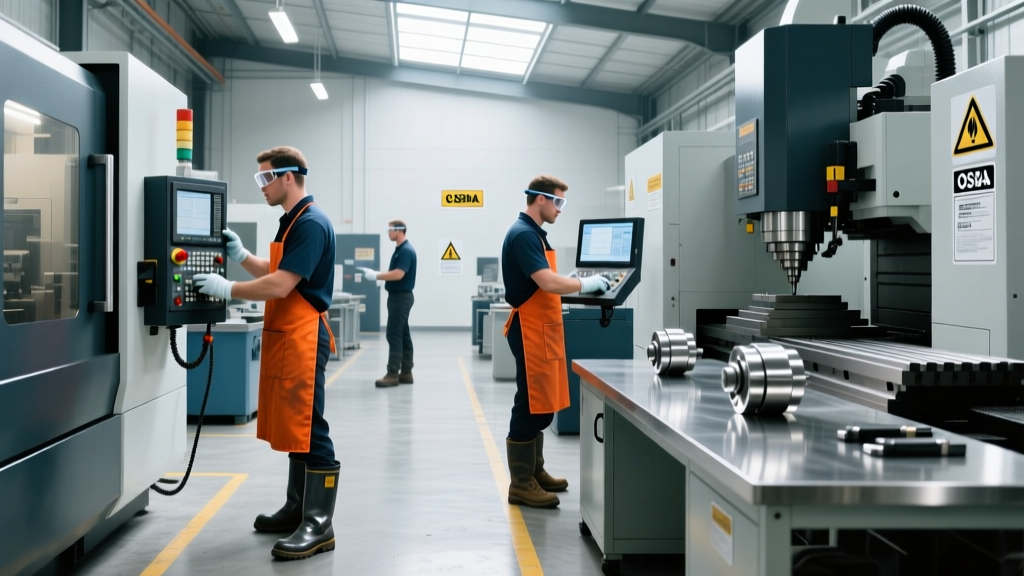
Pro-Tip: PPE Selection for Deburring vs. MachiningTrainees must learn context-specific PPE. While ANSI Z87.1-2020 safety glasses with side shields are mandatory at all times, cut-resistant gloves (ANSI A4 or higher) should only be worn during part loading, unloading, and manual deburring. Gloves must be strictly prohibited when working near rotating tooling, spindles, or bar feeders to prevent catastrophic degloving entanglement injuries.
Evaluating a Training Provider's Safety Curriculum
Manufacturing managers and prospective students must audit training programs for true compliance depth. Use this decision matrix to evaluate a provider's curriculum:
- Documentation of Competency: Does the program issue a physical certificate of completion for LOTO and machine-specific guarding, or just a general 'safety overview'?
- Equipment Parity: Are trainees practicing on machines equipped with current ANSI-compliant guarding, or are they learning on outdated, unguarded manual-knee mills retrofitted with CNC kits?
- Crash Recovery Protocols: Does the curriculum include specific, step-by-step procedures for safely clearing a machine crash, including spindle runout inspection and tool holder taper cleaning?
- Third-Party Validation: Is the training aligned with NIMS CNC Operator credentials, which require passing a standardized, proctored safety exam?
'Safety in CNC machining is not about memorizing a handbook; it is about developing a conditioned response to abnormal machine acoustics, vibrations, and control panel anomalies before they escalate into mechanical failures or injuries.'
— Industrial Safety Engineering Framework, 2025 Edition
The Financial Reality of Safety Non-Compliance
Skimping on comprehensive CNC machining training to save on onboarding time yields negative ROI. Beyond the immediate OSHA fines, the hidden costs of inadequate safety training include:
- Workers' Compensation Premiums: A single recordable amputation or crush injury can trigger an Experience Modification Rate (EMR) spike, increasing annual workers' comp premiums by 20% to 40% for three consecutive years.
- Machine Downtime: Following a severe safety incident, OSHA mandates an immediate work stoppage and investigation. A 5-axis machining center sitting idle at a burden rate of $150/hour costs the shop $1,200 per 8-hour shift in lost capacity.
- Tooling and Spindle Damage: Operators untrained in proper workholding and crash-recovery often cause secondary damage by restarting a machine after a collision without verifying spindle taper runout, leading to premature bearing failure ($8,000+ replacement cost).
Frequently Asked Questions (FAQ)
Is an OSHA 10-Hour card sufficient for CNC operators?
No. The OSHA 10-Hour General Industry card provides a baseline awareness of workplace hazards but lacks the machine-specific technical depth required for CNC operation. It should be treated as a prerequisite, supplemented by machine-specific ANSI B11 training and documented LOTO authorization.
How often must CNC safety training be refreshed?
OSHA requires retraining whenever there is a change in job assignments, a change in machinery that presents new hazards, or when an operator demonstrates inadequacies in their safety knowledge. Best practice dictates a formal, documented refresher course every 12 months, with weekly 5-minute 'toolbox talks' focusing on specific shop-floor hazards.
Can operators perform their own LOTO procedures?
Yes, but only if they have been formally trained and authorized as 'Affected Employees' transitioning to 'Authorized Employees' under the facility's specific Energy Control Program. Minor tool changes and setup adjustments that occur during normal production operations may fall under the 'Minor Servicing Exception' (OSHA 1910.147(a)(2)(ii)), provided alternative protective measures like interlocked door guards are fully functional.