CNC Milling Machine Operator Guide to Selecting Shop Equipment
Learn what a CNC milling machine operator prioritizes when selecting equipment, from control ergonomics and torque curves to chip management.
The Operator's Veto: Why Floor-Level Insight Dictates CapEx ROI
Capital expenditure (CapEx) decisions for CNC mills often fall to shop owners or financial officers who prioritize price-per-ton, footprint, or peak spindle RPM. However, the CNC milling machine operator is the end-user whose daily interaction with the equipment dictates actual return on investment. A $95,000 machine with poor chip evacuation, a sluggish tool changer, or an unintuitive control interface bleeds money through lost cycle time, scrapped parts, and operator fatigue.
When lead machinists and senior operators are given a seat at the purchasing table, the evaluation criteria shift from brochure specifications to real-world usability. According to workforce and technology reports from the Society of Manufacturing Engineers (SME), shops that integrate operator feedback into equipment selection see up to a 22% faster ramp-up time on new machines and significantly lower first-year maintenance costs.
⚠️ The Operator Veto: Ignoring floor-level feedback often leads to the 'orphan machine' syndrome—where a highly capable but ergonomically flawed mill sits idle because operators actively avoid setting it up, favoring older, more user-friendly equipment instead.Control Interfaces: Fanuc, Haas, and Siemens from the Keyboard
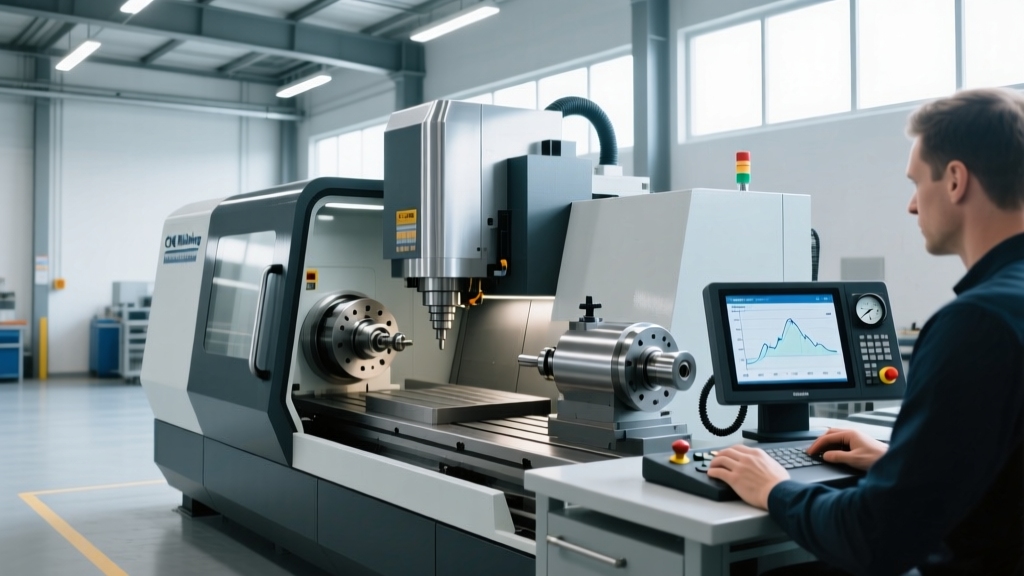
The control pendant is the operator's primary workspace. While a 5-axis programmer might spend hours in CAM software, the CNC milling machine operator on the floor relies on the control for setup, probing, offset adjustments, and manual data input (MDI). Here is how the big three controls stack up from an operator's daily usability perspective.
| Control System | Operator Ergonomics | Macro & Conversational | Setup Speed |
|---|---|---|---|
| Haas NGC | Excellent. Intuitive menu structure, dedicated VPS (Visual Programming System) buttons. | Best-in-class conversational. Macros are accessible but less standardized. | Fastest for standard 3-axis work. |
| Fanuc 0i-F Plus | Good, but relies heavily on memorized G/M codes. Keypad can feel cluttered. | Custom Macro B is powerful but requires deep syntax knowledge. Manual Guide i helps. | Moderate. Universal language, but slower to edit at the pendant. |
| Siemens 840D sl | Steep learning curve. Touch interface is modern but complex for simple mills. | ShopMill is excellent for conversational, but overkill for basic 3-axis. | Slow for 3-axis setups; excels in complex 5-axis simultaneous setups. |
For a high-mix, low-volume job shop, the Haas Next Generation Control (NGC) remains the favorite among operators due to its forgiving syntax and built-in tool life management. For production environments running lights-out, the Fanuc 0i-F Plus is preferred for its bulletproof reliability and standardized macro programming, which allows operators to write custom probing routines that the Haas control might restrict.
Spindle Torque Curves and Real-World Chatter
Brochures highlight peak horsepower (e.g., '30 HP Spindle'), but a CNC milling machine operator knows that peak HP is useless if it only arrives at 10,000 RPM. When roughing 4140 pre-hardened steel or titanium, the cut happens between 800 and 2,500 RPM.
Evaluating the Torque Curve
- Direct-Drive High-Speed (12,000+ RPM): Excellent for aluminum and aerospace composites. However, these spindles often lack low-end torque. Pushing a 2-inch face mill into steel at 1,200 RPM will cause the spindle to stall or trigger an overload alarm.
- Two-Speed Gearbox or Belt-Drive (8,100 RPM): The workhorse configuration. A two-speed gearbox provides massive torque (often 150+ ft-lbs) in low gear for heavy roughing, then shifts to high gear for finishing passes. Operators prefer this for general-purpose steel and stainless machining.
Operator Insight: 'I always ask the builder for the continuous torque rating at 1,500 RPM, not the peak HP at 8,000 RPM. If the machine can't hold a 400 IPM feed rate in the low gear without alarm, it's not a roughing mill.' — Lead Machinist, Tier 1 Aerospace Supplier.
Chip Management and Coolant Delivery: The Unsung Heroes
According to data tracked by the Association for Manufacturing Technology (AMT), non-cutting time (chip clearing, washing down, maintenance) accounts for up to 15% of total spindle downtime in poorly designed cells. Operators despise machines that trap chips.
💡 The Auger Test: When touring a builder's showroom, look at the chip conveyor auger placement. If the auger only runs front-to-back at the very rear of the casting, stringy chips from 303 stainless or 1018 steel will wrap around the table and way covers. Demand a wide-base hinge-belt conveyor with a flush-mount casting design that forces chips directly into the tray.Coolant Pressure Requirements
Standard 300 PSI flood coolant is no longer sufficient for modern carbide tooling. Operators are increasingly demanding High-Pressure Coolant (HPC) systems rated for 1,000 PSI. HPC breaks chips at the shear zone, preventing long, dangerous 'bird's nests' in ductile materials like Inconel and 316 stainless, while drastically extending tool life by preventing built-up edge (BUE).
2026 Equipment Shortlist: What Lead Operators Are Recommending
Based on current floor feedback, serviceability, and control ergonomics, here are three vertical machining centers (VMCs) that consistently earn the operator's vote in 2026.
1. Haas VF-2SS (Super Speed)
Target Price: $78,000 - $85,000 (Base + HPC + Probe)
Best For: High-mix job shops, aluminum aerospace parts, rapid prototyping.
- Pros: The NGC control is universally understood by North American operators. The 12,000 RPM inline direct-drive spindle is ideal for aluminum. The 30+1 side-mount tool changer is fast (2.0s tool-to-tool) and easy to clear jams on without dropping the way covers.
- Cons: Low-end torque is weak. Roughing heavy steel requires careful programming and lighter depth-of-cut passes to avoid spindle stalling.
2. DN Solutions (Formerly Doosan) DNM 5700
Target Price: $105,000 - $115,000
Best For: Heavy steel roughing, large die/mold work, high-volume production.
- Pros: Massive 57-inch X-axis travel and a heavily ribbed casting that absorbs vibration. The 8,100 RPM belt-driven spindle delivers exceptional low-end torque. Operators love the large, easy-to-clean chip tray and standard dual-hinge belt conveyor.
- Cons: The Fanuc control requires a steeper learning curve for shops used to conversational programming. The footprint requires significant floor space.
3. DMG MORI CMX 600V
Target Price: $125,000 - $135,000
Best For: Precision medical components, tight-tolerance production, automated cells.
- Pros: Unmatched thermal stability. The CELOS interface (when paired with Siemens) provides incredible visualization for complex setups. Way cover design prevents fine aluminum dust from infiltrating the linear guides.
- Cons: Service and replacement parts are premium-priced. Operators note that the enclosed CELOS pendant can be difficult to repair in-house if the touch digitizer fails.
The Operator's Final Pre-Purchase Checklist
Before signing the purchase order, the lead CNC milling machine operator should physically verify the following on the showroom floor or via a detailed factory walk-through:
- Way Cover Access: Can the X and Y-axis telescoping way covers be replaced without completely tearing down the table and saddle? (Time-saving maintenance is critical).
- Tool Changer Clearance: With a 12-inch tool in the spindle, is there enough Z-axis clearance to still reach the part, or does the ATC arm dictate a massive Z-height penalty?
- Pendant Swivel: Does the control pendant swivel a full 90 degrees? Operators need to see the screen while standing at the tool changer or the rear of the table during setup.
- Memory & Look-Ahead: Ensure the control has at least 2GB of memory and 200-block look-ahead standard. 3D contouring from CAM software will stutter and leave dwell marks on the part if the processor is underpowered.
For deeper insights into advanced manufacturing equipment integration and workforce training standards, operators and shop managers should consult the NIST Advanced Manufacturing Portal, which provides ongoing research on machining tolerances and equipment lifecycle management.
Ultimately, a CNC mill is only as profitable as the operator running it. By prioritizing control ergonomics, realistic torque curves, and daily maintenance access over flashy brochure specs, shops can secure equipment that operators actually want to run, driving up utilization rates and securing long-term profitability.