CNC Machine Maintenance Training: Troubleshooting & Repair Guide
Master CNC machine maintenance training with this troubleshooting guide. Learn diagnostic frameworks, alarm resolution, and repair protocols for CNC equipment.
Unplanned downtime in a mid-sized machine shop costs between $250 and $500 per hour in lost spindle time, scrapped parts, and delayed shipments. When a 5-axis VMC or a multi-tasking lathe faults out mid-cycle, the difference between a five-minute reset and a five-day service call hinges entirely on the troubleshooting capabilities of the floor staff. Effective CNC machine maintenance training must move beyond basic filter changes and way-lube top-offs, equipping operators and junior technicians with systematic fault-isolation frameworks.
Critical Safety Prerequisite: Before any technician begins electrical or mechanical troubleshooting, they must be certified in Lockout/Tagout (LOTO) procedures. According to OSHA's Lockout/Tagout standards, failure to properly isolate energy sources during CNC repair is a leading cause of severe industrial injuries. Never bypass safety interlocks to diagnose a fault.The Half-Split Diagnostic Framework
Amateur troubleshooters guess; trained technicians isolate. The foundational methodology taught in advanced CNC machine maintenance training is the 'Half-Split' method. This approach divides the machine's operational chain into logical halves to rapidly narrow down the fault location.
- Command vs. Execution: Is the CNC controller outputting the correct signal, or is the mechanical drive failing to execute it? Check the diagnostic page (e.g., Fanuc PMC diagnostics) to verify the command signal is present.
- Electrical vs. Mechanical: If the servo amplifier is receiving power and the command signal is present, but the axis stalls, the fault lies in the mechanical drive (ballscrew binding, way cover jam, or collapsed thrust bearing).
- Feedback vs. Drive: If the axis moves erratically or triggers a following-error alarm, isolate the feedback loop (scale or encoder) from the drive motor. A contaminated glass scale will cause erratic feedback, while a damaged motor winding will cause drive faults.
By repeatedly halving the system, a technician can isolate a fault from thousands of potential components down to a single subsystem in three or four logical steps.
Core Curriculum Matrix for Maintenance Training
Developing an in-house training program or evaluating an external vendor requires a structured curriculum. The Society of Manufacturing Engineers (SME) emphasizes cross-functional competency for modern manufacturing technologists. Below is the recommended module breakdown for a comprehensive 120-hour CNC troubleshooting certification program.
| Training Module | Focus Area | Hours | Target Competency |
|---|---|---|---|
| Electrical & Servo Systems | Amplifiers, motors, cabling, and VFDs | 40 | Multimeter usage, reading ladder logic, identifying IPM faults |
| Geometric & Mechanical Alignment | Way systems, ballscrews, spindle runout | 30 | Ballbar testing, laser interferometry, scraping basics |
| Hydraulic & Pneumatic Logic | Clamps, counterbalance valves, tool changers | 20 | Pressure regulation, solenoid testing, accumulator servicing |
| Controller Alarm Diagnostics | Fanuc, Haas, Siemens, Heidenhain alarm trees | 30 | PMC signal tracing, parameter backup, macro variable debugging |
Decoding Controller Alarms: Real-World Scenarios
Controller alarms are the starting point of troubleshooting, not the conclusion. Effective CNC machine maintenance training teaches technicians how to read the sub-codes and diagnostic bits behind the primary alarm screen.
Fanuc Servo Alarms (e.g., 414 Servo Alarm)
A Fanuc 414 alarm indicates a servo detect error, typically on a specific axis. The alarm screen alone does not tell you what failed. The technician must navigate to the servo amplifier module (SVM) and read the two-digit LED display on the drive.
- LED '8': High voltage in the main circuit. Check the incoming 3-phase power and the regenerative discharge circuit.
- LED '9': IPM (Intelligent Power Module) fault or cooling fan failure in the amplifier. Requires amplifier replacement or bench repair.
- LED 'A': Current abnormality. Often caused by a shorted motor winding, a damaged power cable, or a mechanically seized ballscrew causing the motor to over-amp.
Haas Following Error Alarms (e.g., 114 X-Axis Servo Lag)
Alarm 114 means the actual position of the axis is lagging behind the commanded position beyond the acceptable parameter limit (Parameter 514). While this can be an electrical tuning issue, 80% of the time in a production environment, it is a mechanical or lubrication fault.
Pro-Tip: Before adjusting servo gain parameters to mask a 114 alarm, check the way lube manifold. A clogged metering unit on the X-axis will cause dry ways, increasing friction and resulting in servo lag. Replacing a $40 metering unit solves what looks like a complex servo tuning problem.Mechanical vs. Electrical Fault Isolation Tools
Advanced troubleshooting requires precision metrology tools to quantify mechanical degradation before it triggers catastrophic controller alarms. Investing in the following diagnostic equipment yields immediate ROI by enabling predictive maintenance.
- Wireless Ballbar Systems (e.g., Renishaw QC20-W): Priced around $14,000, a wireless ballbar measures circular interpolation errors. By running a 5-minute ballbar test, a technician can identify servo mismatch, backlash, stick-slip, and squareness errors. This data pinpoints whether a contouring error is caused by a worn ballscrew (mechanical) or improper servo tuning (electrical).
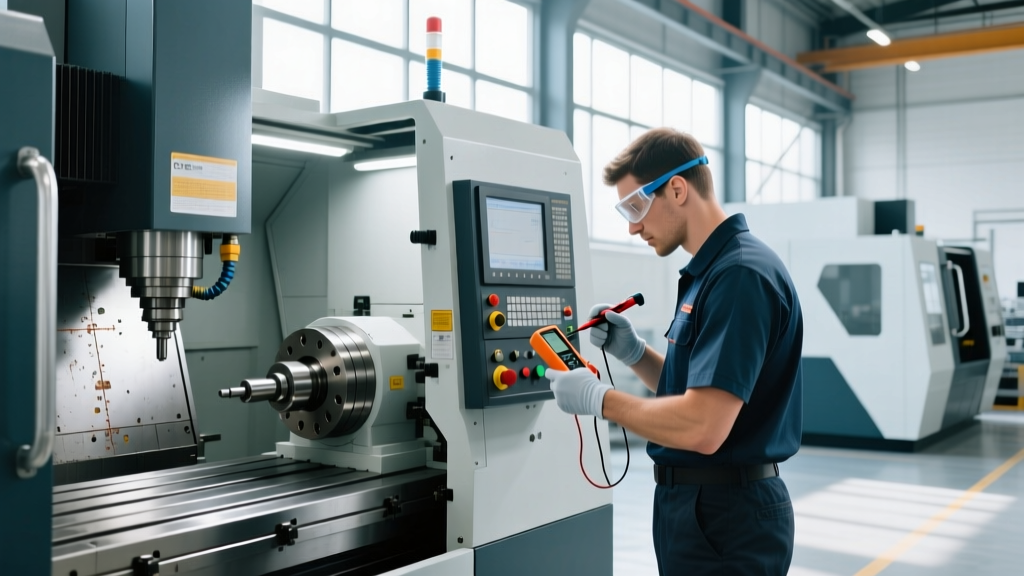
- Insulation Resistance Testers (Meggers): Used to test the dielectric integrity of spindle motor and servo motor windings. Coolant intrusion into motor connectors is a common killer of CNC drives. A Megger test will reveal compromised insulation before it shorts out a $6,000 servo amplifier.
- Thermal Imaging Cameras: Electrical cabinet faults, such as loose contactors or failing transformer windings, generate heat long before they fail completely. Quarterly thermal sweeps of the CNC control cabinet prevent sudden electrical fires and unexplained voltage drops.
Building an In-House Troubleshooting Knowledge Base
The most critical failure in most machine shops is knowledge siloing. When the senior maintenance technician retires, decades of undocumented machine quirks leave the shop floor. A core component of modern CNC machine maintenance training is teaching technicians how to document repairs.
'A machine's repair history is its medical record. If you do not document the symptoms, the tests performed, and the final resolution, the next technician will repeat the exact same diagnostic steps when the fault inevitably recurs.' — Standard practice in Total Productive Maintenance (TPM)
Implement a digital ticketing system where every alarm reset, parameter change, and part replacement is logged against the machine's asset tag. Include photos of the faulty component, the exact parameter numbers altered, and the OEM part numbers used for replacements. This transforms individual experience into institutional assets.
Evaluating Training ROI and Certification Paths
Shops must decide between OEM-specific training and generalized third-party certifications. OEM training (such as Haas Factory Outlet or Mazak University maintenance courses) typically costs between $1,500 and $2,500 per week, per technician, excluding travel. This training is highly valuable for deep electrical diagnostics and proprietary parameter manipulation specific to that brand.
Conversely, generalized credentials, such as those offered by the National Institute for Metalworking Skills (NIMS), focus on broader machining principles, metrology, and foundational mechanical aptitude. For a shop running a mixed fleet of Fanuc, Siemens, and Heidenhain controls, investing in foundational electrical and mechanical troubleshooting frameworks provides a higher baseline ROI than locking a technician into a single OEM's ecosystem.
Ultimately, the goal of CNC machine maintenance training is to shift the shop culture from reactive firefighting to proactive reliability engineering. By mastering the half-split diagnostic method, understanding the sub-codes behind controller alarms, and utilizing precision metrology tools, maintenance teams can reclaim thousands of hours of lost spindle time annually.