CNC Machine Operator Salary: 2026 Pay Scale by Machine Axis & Skill
Analyze the 2026 CNC machine operator salary by technical tier. Discover how 5-axis proficiency, CAM skills, and macro programming scale your hourly wage.
The Mechanics of Wage Scaling in CNC Machining
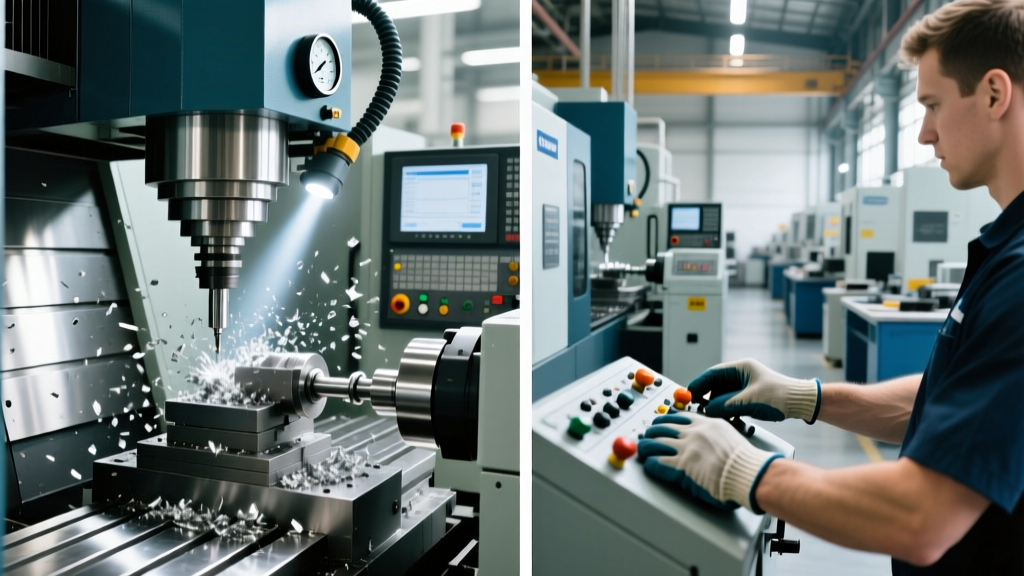
The mechanics of the CNC machine operator salary function less like a standard hourly wage and more like a machine's feed rate: it scales proportionally with the technical inputs, setup complexity, and liability of the operation. In 2026, the compensation gap between a basic 3-axis machine tender and a 5-axis simultaneous programmer-operator frequently exceeds $28 per hour. Understanding the exact technical specifications and skill thresholds that trigger these pay multipliers is critical for navigating the modern manufacturing workforce.
2026 Baseline Data Point: According to the U.S. Bureau of Labor Statistics (BLS), the median pay for machinists and CNC operators hovers around $50,840 annually ($24.44/hr). However, this aggregate data obscures the massive variance driven by machine kinematics and control architecture. The BLS Occupational Employment and Wage Statistics (OEWS) confirms that the top 10% of earners—those managing multi-axis aerospace and medical components—clear $78,000+ annually.The Axis Multiplier: How Machine Kinematics Dictate Pay
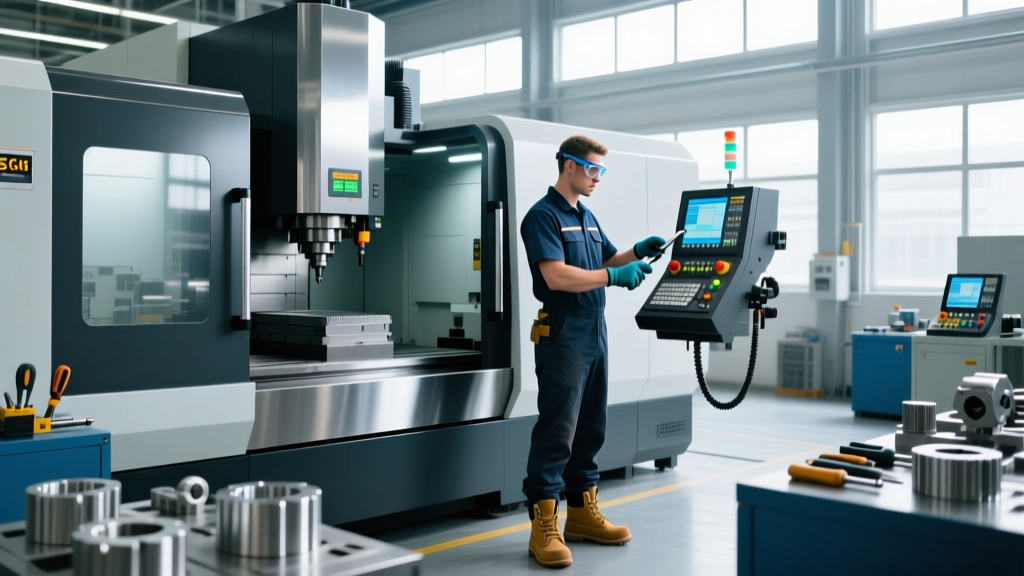
Shop floor compensation is heavily tiered by the number of simultaneous interpolated axes an operator is trusted to command. Each additional axis introduces exponential variables in collision avoidance, tool vector management, and work coordinate system (WCS) alignment.
| Machine Tier | Standard Equipment Example | Core Technical Requirements | 2026 Hourly Wage Band |
|---|---|---|---|
| 3-Axis VMC | Haas VF-2SS, Doosan DNM 500 | Basic WCS (G54-G59), tool length offsets, standard G/M-code editing, ER collet toolholding. | $20.00 - $26.00 |
| 4-Axis Indexed | Mazak VCN-530C + Rotary | Tombstone setups, A-axis centerline calibration, rotary clearance verification, hydraulic fixture management. | $26.00 - $33.00 |
| 5-Axis Simultaneous | DMG MORI DMU 50 3rd Gen, Hermle C 250 | RTCP (G43.4), tilted working planes (G68.2), kinematic chain calibration, collision simulation. | $35.00 - $48.00+ |
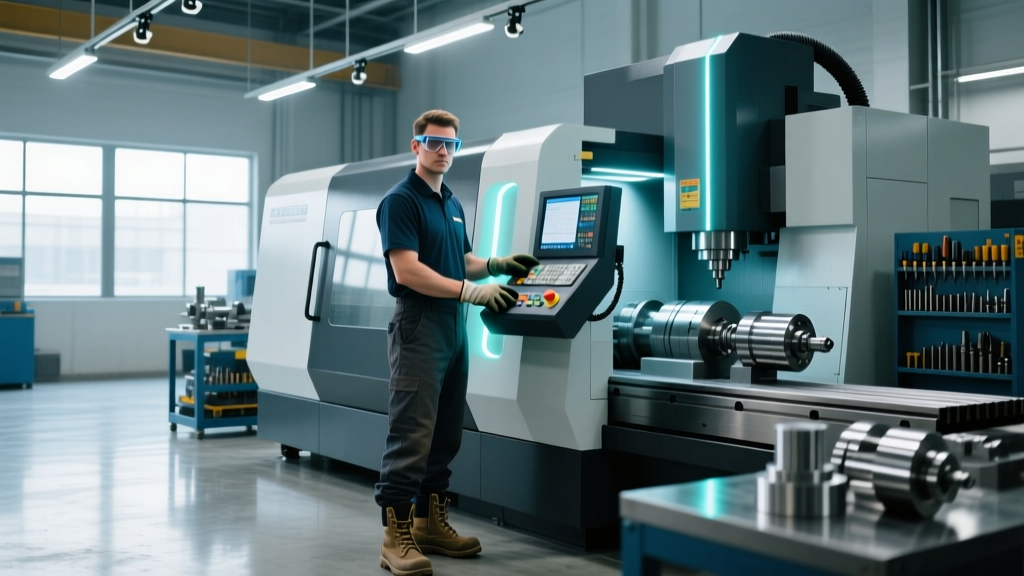
The leap from 3-axis to 5-axis is not merely about pressing a cycle start button on a more expensive asset. A 5-axis operator must understand Tool Center Point Control (TCPC). When utilizing G43.4 on a Fanuc 31i-B5 control, the machine dynamically adjusts linear axes to maintain the tool tip's programmed path while the rotary axes (B and C) pivot. If an operator miscalculates the pivot point distance or fails to verify the kinematic chain after a spindle crash, the resulting collision can cause $150,000 in damages. The premium salary compensates for this extreme liability and required spatial reasoning.
Control Architecture & CAM Integration Premiums
Fluency in a single control system limits an operator to specific job shops. Mastery of multiple control architectures, particularly those dominant in high-mix/low-volume aerospace and medical machining, commands a 12% to 18% wage premium.
Control System Hierarchy
- Fanuc (0i-F Plus / 31i-B5): The industry standard for job shops. High availability of operators keeps baseline wages stable. Proficiency is expected, not rewarded with a premium.
- Haas NGC: Highly conversational and forgiving. Excellent for high-production environments but rarely commands a premium outside of dedicated Haas factories.
- Siemens Sinumerik 840D sl / ONE: Dominant in European aerospace and complex medical milling. Requires understanding of ShopMill/ShopTurn and advanced parametric programming. Operators fluent in Sinumerik are scarce in North America, driving wages up by $4 to $7 per hour.
- Heidenhain TNC 640: The gold standard for 5-axis mold and die machining. Mastery of Heidenhain's "Klartext" conversational language and its superior contouring algorithms is a highly lucrative niche.
Furthermore, operators who bridge the gap between the CAM station and the machine floor—specifically those who can post-process Mastercam or Siemens NX code, verify toolpaths using VERICUT, and manually edit the resulting APT data at the control—effectively operate as Manufacturing Engineers. This hybrid skill set routinely pushes total compensation past $95,000 annually.
Metrology and In-Process Inspection Adders
In modern precision manufacturing, machining and inspection are no longer siloed. The integration of spindle probing and on-machine verification has created a new compensation tier for operators who can write and troubleshoot metrology routines.
The Probing Premium: An operator who can manually write Renishaw OMP60 or Blum MicroCompact probing cycles to automatically update WCS datums and compensate for thermal growth commands an additional $3.00 to $5.00 per hour over an operator who relies solely on manual edge finders and offline CMM inspection.
Beyond spindle probing, proficiency in offline Coordinate Measuring Machines (CMM) using software like Zeiss CALYPSO or PC-DMIS allows an operator to close the quality loop. If a 5-axis impeller requires First Article Inspection (FAI), an operator who can machine the part, program the CMM fixture, execute the inspection, and adjust the machine's tool wear offsets based on the CMM data is virtually immune to layoffs and dictates their own salary.
Troubleshooting the "Stagnant Wage" Failure Mode
Many operators plateau at the $24/hour mark. This "button-pusher trap" occurs when an operator relies entirely on pre-written programs and setup sheets. Breaking this ceiling requires acquiring specific, high-leverage technical skills:
- Custom Macro B Programming: Learning to write parametric routines (using variables like #100, IF/THEN statements, and G65 calls) to automate tool life management, family-of-parts setups, and adaptive probing. This single skill separates a $24/hr tender from a $35/hr setup machinist.
- Advanced Toolholding Management: Transitioning from standard ER collets to hydraulic expansion chucks, shrink-fit holders, and Sandvik Coromant Capto C6 quick-change interfaces. Understanding the runout tolerances (e.g., < 3 microns at 3xD) and balancing requirements (G2.5 at 25,000 RPM) for high-speed machining.
- Chip Evacuation & Coolant Dynamics: Mastering high-pressure coolant systems (1000+ PSI via interfaces like Sandvik CoroTurn HP) to break stringy chips in aerospace superalloys like Inconel 718 or Titanium Ti-6Al-4V. Poor chip control destroys tooling and cycle times; experts who solve these issues are compensated accordingly.
Certification ROI: Do NIMS Credentials Move the Needle?
The National Institute for Metalworking Skills (NIMS) offers standardized credentials that serve as verifiable proof of competency. However, not all certifications yield the same return on investment (ROI) regarding salary negotiation.
High-ROI NIMS Certifications (2026 Market)
- CNC Milling: 5-Axis (Setup & Programming): Immediate leverage for a $5-$8/hr bump in defense and aerospace sectors.
- Measurement, Materials & Inspection: Critical for operators transitioning into Lead Machinist or Quality Assurance roles.
Low-ROI Certifications
- Basic CNC Turning/Milling (Operator): Viewed as an entry-level baseline. It will help you get an interview, but will not trigger a wage premium over demonstrated floor experience.
Strategic Career Positioning
The CNC machine operator salary in 2026 is entirely decoupled from tenure and strictly bound to technical capability and liability management. To maximize earning potential, operators must systematically audit their current skill matrix against the requirements of 5-axis kinematics, advanced control architectures, and automated metrology. By shifting focus from simple part loading to comprehensive process engineering and parametric programming, machinists can engineer their own compensation structures with the same precision they apply to cutting metal.