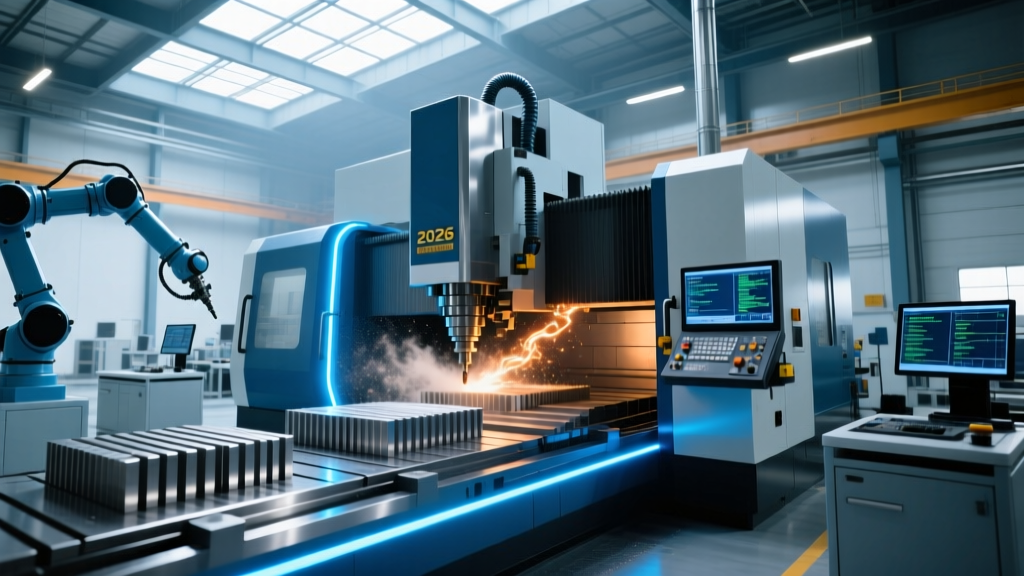
What Are CNC Machines Used For in Advanced 2026 Manufacturing?
Discover what CNC machines are used for in 2026, from hybrid additive-subtractive milling to micro-machining, including pricing and buying frameworks.
The fundamental question of "what are CNC machines used for" has evolved far beyond basic 3-axis subtractive routing. In 2026, computer numerical control architecture serves as the backbone for hybrid additive-subtractive manufacturing, closed-loop AI metrology, and sub-micron medical micro-machining. For modern machine shop owners and manufacturing engineers, understanding these advanced applications is no longer academic—it is the primary driver for capital expenditure (CapEx) justification and machine procurement.
2026 Market Shift: Over 42% of new CNC capital investments in aerospace and medical sectors are now directed toward multi-tasking (5+ axis) or hybrid additive-subtractive platforms, moving away from standalone 3-axis vertical machining centers (VMCs).The Evolution: Beyond Traditional Subtractive Manufacturing
Historically, CNC machines were used strictly to remove material from a solid billet. Today, advanced CNC platforms are used to add, remove, and inspect material in a single chucking. This paradigm shift is dominated by hybrid machines that integrate Directed Energy Deposition (DED) or Selective Laser Melting (SLM) with traditional multi-axis milling.
Hybrid Additive-Subtractive Applications
Manufacturers are using hybrid CNC machines to print complex internal cooling channels or repair high-value turbine blades, and then immediately mill the exterior to exact tolerances. According to the National Institute of Standards and Technology (NIST), advanced manufacturing now heavily relies on these cyber-physical systems to reduce lead times for complex geometries by up to 60%.
- Target Technology: DMG MORI LASERTEC 30 SLM or Mazak INTEGREX i-200S AM.
- Primary Uses: Aerospace turbine blade repair, custom conformal cooling molds, and localized hardfacing of wear surfaces.
- 2026 Pricing Context: Base pricing for hybrid 5-axis platforms ranges from $450,000 to $850,000, excluding necessary inert gas generation and powder handling safety enclosures.
High-Value Applications Driving Modern CNC Purchases
When evaluating what CNC machines are used for in high-margin sectors, the focus shifts to extreme precision and exotic material handling. The buying decision is dictated by the machine's ability to maintain thermal stability and rotary accuracy over long, unattended cycles.
1. Aerospace & EV Battery Enclosures (5-Axis Simultaneous)
The electric vehicle (EV) boom has created massive demand for large-format 5-axis CNC machines used to mill deep-pocket battery enclosures from 6061-T6 and 7075 aluminum. Simultaneous 5-axis machining allows for optimal tool orientation, reducing cycle times by 30% compared to indexed 3+2 machining.
For aerospace, machines are used to mill Inconel 718 and Ti-6Al-4V structural bulkheads. This requires high-torque, direct-drive spindles and advanced rotary tool center point (RTCP) calibration to prevent tool deflection. A standard entry-level 5-axis machine like the Haas UMC-500SS starts around $185,000, but aerospace-grade alternatives like the Grob G550 or Hermle C400 push the investment to $650,000+ due to superior thermal compensation and dynamic rigidity.
2. Micro-Machining for Medical Implants (Swiss-Type CNC)
In the medical sector, CNC machines are used to produce bone screws, orthopedic implants, and surgical robotics components at microscopic tolerances. Swiss-type CNC lathes utilize a guide bushing to support the material inches from the cutting tool, eliminating deflection when machining long, slender parts from difficult materials like Nitinol, titanium, and PEEK (polyether ether ketone).
Multi-tasking Swiss machines, such as the Tsugami B0126-III or Citizen Cincom L32XII, feature B-axis control and back-working spindles. These machines are used to complete complex medical parts in a single operation. Expect to invest between $220,000 and $310,000 for a fully loaded Swiss-type platform with high-pressure coolant systems (2,000+ PSI) required for micro-drilling and deep-hole gun drilling.
Decision Matrix: Matching the Use-Case to Machine Architecture
Understanding what specific CNC machines are used for allows buyers to align their procurement strategy with actual production needs. Use the matrix below to evaluate the architectural requirements for your target applications.
| Application / Use-Case | Ideal Machine Architecture | Critical Feature Requirement | Estimated 2026 CapEx |
|---|---|---|---|
| EV Battery Trays (Deep Pocketing) | Gantry 5-Axis / Horizontal 5-Axis | High-speed spindle (20k+ RPM), HSK-A63 taper | $350,000 - $550,000 |
| Medical Bone Screws (Nitinol/PEEK) | Swiss-Type CNC Lathe (B-Axis) | Guide bushing, 2000 PSI through-tool coolant | $220,000 - $310,000 |
| Conformal Cooling Molds / Repair | Hybrid Additive-Subtractive | DED laser head, inert gas chamber, Capto C6 | $500,000 - $850,000 |
| Aerospace Structural Bulkheads | 5-Axis Simultaneous VMC / HMC | RTCP calibration, direct-drive torque motors | $600,000 - $950,000 |
The Role of AI and Closed-Loop Metrology in Modern CNC Uses
Modern CNC machines are increasingly used as autonomous inspection cells. The integration of in-process probing and closed-loop thermal compensation means the machine is no longer just a cutting tool; it is a metrology device. Multi-tasking platforms, such as those detailed by Mazak's multi-tasking division, utilize AI-driven software to automatically adjust tool offsets in real-time based on temperature fluctuations and tool wear data.
For buyers, this means the machine's control system is just as critical as its cast-iron rigidity. Look for CNC architectures that support native integration with probing systems like Renishaw REVO or Hexagon machine tool scanners. This capability allows shops to machine a part, probe critical datums, and automatically execute a secondary finishing pass to hold tolerances within ±2 microns—all without operator intervention.
Buying Framework: Justifying the CapEx for Next-Gen CNC
When presenting a purchase order for a $600,000 multi-tasking or hybrid CNC machine to stakeholders, the justification must move beyond "increased spindle utilization." Use this framework to build your financial case:
- Calculate Work-in-Progress (WIP) Reduction: Multi-tasking machines eliminate the queue time between the lathe and the mill. Calculate the exact dollar value of the WIP inventory you can eliminate by completing parts in a single chucking.
- Factor in Fixturing Elimination: 5-axis and Swiss-type machines drastically reduce the need for custom soft jaws, tombstones, and hydraulic fixtures. Deduct $15,000 to $30,000 annually in saved fixturing costs.
- Assess the Scrap Cost of Exotic Materials: If you are machining $150/lb titanium or $300/lb aerospace-grade superalloys, a single scrapped part due to manual re-fixturing errors can cost upwards of $8,000. Closed-loop 5-axis CNC eliminates re-fixturing entirely.
- Evaluate Automation Readiness: Ensure the machine you specify includes standard I/O interfaces for robotic part loading (e.g., FANUC Fast Cycle Interface) and high-pressure coolant hookups, preventing $25,000+ retrofit costs when you eventually integrate lights-out manufacturing.
Ultimately, what CNC machines are used for in 2026 is defined by their ability to consolidate multiple manufacturing steps, inspect their own work, and process advanced materials with minimal human intervention. Buyers who align their procurement strategy with these advanced capabilities will secure a distinct competitive advantage in high-margin manufacturing sectors.
Related reading
CNC Tooling Pitfalls: 7 Costly Mistakes Buyers and Operators Make — And How to Avoid Them
Best Cranes for Studies: Precision, Safety, and Educational Value in Academic and Research Settings